
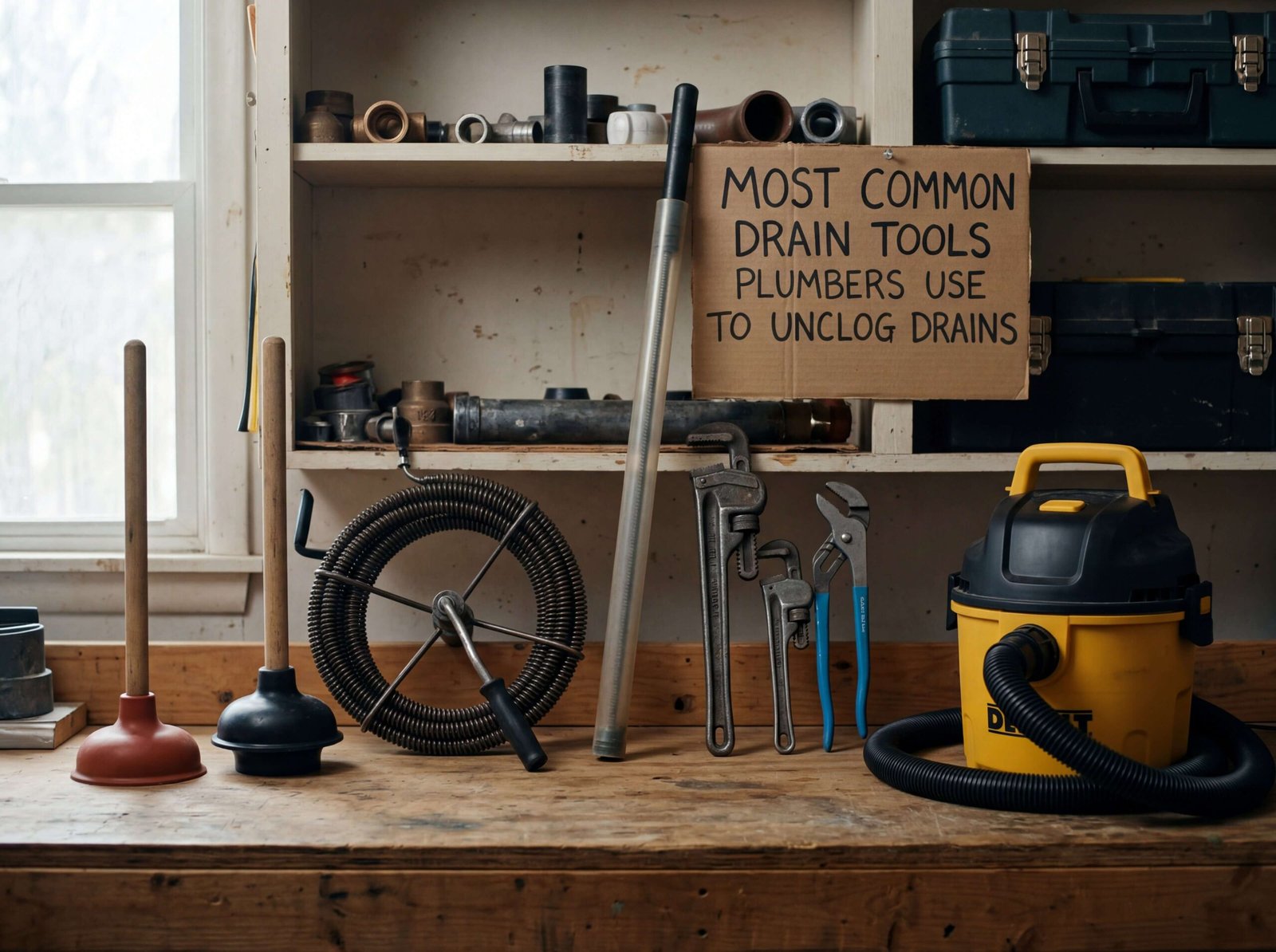
Most homeowners think plumbers fix clogs faster because they have better tools. That’s only partially true.
The real difference is that plumbers understand exactly which tool to use and why—before they even start. Homeowners, on the other hand, often rely on trial-and-error. A plunger doesn’t work, so they try a snake. That fails, so they push harder or switch tools again. This cycle wastes time and often makes the clog worse.
In real homes, drain problems are rarely random. Kitchen sinks build up grease, bathroom drains collect hair, and deeper lines accumulate sludge or even tree roots. Each of these requires a specific type of tool and technique. Using the wrong one doesn’t just fail—it can push the blockage deeper, damage the pipe, or create recurring issues.
This is where understanding plumber tools becomes valuable.
You don’t need to own every professional tool, but you do need to understand:
- What tools are designed to do
- How they differ from basic DIY tools
- When a problem is beyond DIY capability
Once you understand this, you stop guessing. You start making decisions based on how the clog behaves, not just what tools you have available.
This guide will break down the most common tools plumbers use to unclog drains and compare them with everyday DIY tools. More importantly, it will help you understand when each tool makes sense—and when it doesn’t.
What This Page Covers
ToggleWhy Understanding Plumber Tools Matters
Most drain problems don’t become expensive because they’re difficult—they become expensive because they’re handled the wrong way early on.
When you don’t understand how different tools work, every clog turns into guesswork. You try one method, then another, often without knowing whether you’re actually solving the problem or making it worse. This is how small, manageable issues turn into deep blockages or pipe damage.
Understanding plumber tools changes that completely.
It Eliminates Trial-and-Error
When you know what each tool is designed to do, you stop randomly switching between options.
Instead of:
- Trying a plunger repeatedly with no result
- Forcing a snake deeper without understanding resistance
- Jumping to stronger tools too quickly
You begin to:
- Identify the type of clog first
- Choose the correct tool for that situation
- Apply the right method with control
This alone can solve most household drain issues more efficiently.
It Helps You Use DIY Tools More Effectively
Most homeowners already own basic tools, but they don’t get full value from them.
A plunger, for example, is extremely effective—but only for the right type of clog and when used correctly. The same applies to manual snakes and hair removal tools. Without understanding their purpose, these tools feel unreliable.
With the right knowledge:
- A simple tool becomes more precise
- You use less force and get better results
- You avoid unnecessary upgrades to stronger tools
This is why plumbers can achieve more with the same basic tools—they understand their limits and strengths.
It Prevents Pipe Damage
Incorrect tool usage is one of the most common causes of plumbing damage in homes.
When tools are used without understanding:
- Cables are forced into pipe bends
- Joints are stressed or loosened
- Pipe interiors get scratched or weakened
These issues may not show immediately, but they lead to:
- Recurring clogs
- Leaks over time
- Reduced pipe lifespan
Understanding tools helps you work with the pipe system, not against it.
It Helps You Recognize When DIY Is Enough—and When It’s Not
One of the biggest advantages of understanding plumber tools is knowing your limits.
You’ll start recognizing situations like:
- “This is a surface-level hair clog—I can handle it”
- “This feels deeper than my tools can reach”
- “This keeps coming back—there’s likely a bigger issue”
This prevents wasted time and avoids turning a simple problem into a costly repair.
The Real Value
Understanding plumber tools is not about becoming a professional. It’s about making better decisions as a homeowner.
When you:
- Choose tools based on the actual problem
- Use them with the right technique
- Stop when the situation requires more than DIY
You reduce risk, save money, and keep your plumbing system in better condition over time.
What Makes Professional Tools Different
At first glance, many professional drain tools look similar to DIY tools. There’s a snake, a cable, some form of pressure, and a way to reach into the pipe. But the real difference is not just in appearance—it’s in capability, control, and purpose.
Professional tools are designed to solve problems completely, not temporarily.
Power vs Precision
Most homeowners assume professional tools are simply “more powerful.” That’s true, but power alone is not what makes them effective.
Professional tools combine:
- Controlled power to break through tough clogs
- Precision handling to avoid damaging pipes
For example, a motorized auger doesn’t just spin faster—it allows controlled rotation with steady feed. This lets plumbers break through blockages without forcing the cable or stressing the pipe.
In contrast, DIY tools often rely more on manual force. This makes them safer for light use, but less effective for dense or deep clogs.
Greater Reach and Depth
One of the biggest limitations of DIY tools is how far they can reach.
- Basic snakes typically handle short distances
- Hand augers extend a bit further
- Professional machines can reach deep into the system
This matters because many serious clogs are not near the drain opening. They are located:
- Beyond the trap
- Inside long horizontal pipe runs
- In main sewer lines
Professional tools are built specifically to reach these areas without losing effectiveness.
Designed for Specific Clog Types
DIY tools are general-purpose. Professional tools are specialized.
Instead of one tool trying to do everything, plumbers use:
- Different cutting heads for different materials
- Water pressure systems for grease and sludge
- Root cutters for invasive blockages
- Cameras to identify the exact issue
This level of specialization means the tool is matched precisely to the problem, rather than forcing a general tool to handle everything.
Built for Complete Cleaning, Not Just Opening Flow
A key difference is the goal.
- DIY tools often aim to restore basic flow
- Professional tools aim to fully clean the pipe
For example:
- A manual snake might create a hole through a clog
- A hydro jet system removes buildup along the entire pipe wall
This is why DIY fixes sometimes feel temporary. The blockage is partially cleared, but the underlying buildup remains.
Control and Feedback During Use
Professional tools provide better feedback during operation.
Plumbers can feel:
- The type of resistance (soft, solid, tangled)
- Changes in pipe direction
- When the clog starts breaking apart
This allows them to adjust technique in real time instead of forcing the tool blindly.
With basic tools, this feedback is limited, which is why homeowners often rely on guesswork.
Safety and Risk Management
Professional tools may be more powerful, but they are also used with greater control and awareness.
Plumbers are trained to:
- Avoid overloading the pipe
- Adjust speed and pressure
- Stop when resistance indicates a risk
DIY use of advanced tools without this understanding increases the chance of:
- Pipe damage
- Stuck cables
- Worsening the blockage
The Real Difference
The difference is not just “DIY vs professional tools.” It’s:
- General-purpose vs problem-specific
- Limited reach vs full system access
- Temporary fix vs complete solution
- Trial-and-error vs informed execution
When you understand this, you stop comparing tools based only on strength. You start recognizing that the right tool, used correctly, matters far more than just having a stronger one.
Most Common DIY Drain Tools (What Homeowners Use)
Most homeowners already have access to basic drain tools. The problem is not availability—it’s how these tools are understood and used.
DIY tools are designed for simple, early-stage clogs. When used correctly, they can solve a large percentage of everyday drain issues. But they also have clear limits, and pushing them beyond those limits is where problems begin.
Basic Tools Found in Most Homes
These are the tools you’ll find in almost every household. They are simple, affordable, and effective when used in the right situation.
- Plunger
Works by creating pressure to move soft clogs.
Best suited for sinks, toilets, and tubs with recent blockages. - Manual Drain Snake
A flexible cable used to reach slightly deeper into the pipe.
Can break or hook clogs just beyond the drain opening. - Hair Removal Tool (Zip Tool)
Designed to pull out hair and debris near the surface.
Extremely effective for bathroom sinks and shower drains.
How These Tools Work in Real Situations
In real homes, these tools are most effective when the clog is close, soft, and recently formed.
For example:
- A kitchen sink that suddenly stops draining after washing dishes
→ A plunger can often restore flow quickly - A bathroom sink slowing down over time
→ A manual snake can reach and break early buildup - A shower drain collecting hair over weeks
→ A zip tool can remove the clog entirely in one pass
These tools are not meant to handle deep or complex issues. Their strength lies in quick intervention before the problem grows.
Where DIY Tools Start to Fall Short
The limitations of DIY tools become clear when the clog is deeper, denser, or more complex.
Common situations where they struggle:
- Deep clogs beyond the trap or several feet into the pipe
- Hardened grease buildup that sticks to pipe walls
- Recurring blockages that return after temporary clearing
- Mixed clogs (hair + grease + debris combined)
In these cases, you might notice:
- Temporary improvement followed by quick relapse
- Tools passing through without clearing the blockage
- Increased resistance without real progress
The Practical Reality
DIY tools are not weak—they are specific.
They work best when:
- Used early
- Matched to the correct clog type
- Applied with controlled technique
They fail when:
- Used too late
- Forced beyond their capability
- Used without understanding the actual problem
A Simple Way to Use DIY Tools Effectively
Instead of treating them as universal solutions, think of them as first-response tools:
- Use them to handle early-stage issues
- Stop if they don’t produce results after a reasonable attempt
- Avoid forcing them into deeper or unknown problems
DIY drain tools are powerful when used at the right time. But they are not designed to solve everything—and recognizing that is what prevents small problems from becoming major ones.
Most Common Tools Plumbers Use
Professional plumbers don’t rely on one tool—they rely on a system of tools, each designed for a specific type of blockage, depth, and pipe condition.
The key difference is not just power, but precision and purpose. Instead of forcing one tool to handle every situation, plumbers choose the exact tool that matches the problem. This is why they can solve issues faster and more completely.
Motorized Drain Auger (Drain Machine)
This is one of the most commonly used professional tools. It looks similar to a manual snake but operates with a motor, allowing controlled rotation and deeper reach.
It is used when clogs:
- Are deep inside the pipe
- Cannot be reached with basic tools
- Are compacted or dense
In real situations, this tool doesn’t just poke through the clog. It breaks and clears it along the pipe path, restoring proper flow more effectively than manual methods.
At the same time, it requires control. Too much force or incorrect handling can damage pipes, which is why professionals operate it gradually rather than aggressively.
Hydro Jetting Equipment
This tool uses high-pressure water to clean the inside of pipes.
Unlike snakes or augers that create a path through the clog, hydro jetting:
- Removes grease, sludge, and buildup from pipe walls
- Flushes debris completely out of the system
- Restores the pipe closer to its original condition
It is commonly used for:
- Kitchen drains with heavy grease buildup
- Long-term sludge accumulation
- Recurring clogs that keep coming back
This is not a tool for opening a blockage—it’s a tool for fully cleaning the pipe system.
Professional Drain Snake Systems
These are more advanced versions of DIY snakes, with longer cables and interchangeable heads.
What makes them different is flexibility in use:
- Different heads for cutting, grabbing, or breaking clogs
- Greater reach into deeper sections of plumbing
- More control over movement and rotation
This allows plumbers to adapt the tool to the situation instead of relying on a single approach.
In many cases, this is the first professional tool used before moving to more aggressive methods.
Sewer Inspection Camera
Before using powerful tools, professionals often inspect the pipe.
A camera is inserted into the drain to:
- Identify the exact location of the clog
- Determine what the blockage is made of
- Check for pipe damage or structural issues
This step removes guesswork completely.
Instead of trying multiple tools blindly, plumbers see the problem first and choose the correct solution immediately.
Root Cutting Tools
In outdoor or main sewer lines, tree roots are a common cause of blockages.
These tools are designed specifically to:
- Cut through roots inside pipes
- Clear space for water flow
- Prepare the line for deeper cleaning if needed
This is a situation where standard tools fail completely. Without the right equipment, the clog cannot be properly removed.
How These Tools Work Together
Professional tools are not used randomly. They are part of a step-by-step system.
A typical approach might look like:
- Inspect the pipe to understand the issue
- Use an auger to break the blockage
- Follow with hydro jetting to clean remaining buildup
This layered approach is what creates long-lasting results instead of temporary fixes.
The Real Advantage
The advantage of professional tools is not just strength—it’s completeness.
- They reach deeper
- They solve the root cause
- They reduce the chance of recurrence
When you compare this with DIY tools, the difference becomes clear.
DIY tools are designed to handle early and simple problems.
Professional tools are designed to handle deeper, more complex, and recurring issues with precision.
DIY Tools vs Professional Tools (Real Comparison)
At a basic level, both DIY and professional tools are trying to solve the same problem—restore flow in a blocked drain. But how they achieve that, and how effective they are, is very different.
The difference is not just about strength. It’s about reach, control, accuracy, and completeness of the solution.
Strength and Power
DIY tools rely mostly on manual force or limited mechanical support. They are designed to be safe and simple, which makes them effective for light clogs but limited when resistance increases.
Professional tools, on the other hand, provide controlled power. They can break through dense blockages without requiring excessive force from the user. This allows plumbers to handle tougher clogs more efficiently while maintaining control.
Depth and Reach
One of the biggest limitations of DIY tools is how far they can go.
- DIY tools are effective near the drain opening or slightly beyond
- Professional tools are designed to reach deep into pipe systems and main lines
This difference matters because many serious clogs are not located near the surface. Without enough reach, a tool may never even contact the actual blockage.
Accuracy and Diagnosis
DIY work is often based on assumption. You use a tool and see what happens.
Professional work is based on diagnosis before action.
- DIY approach: try a tool and observe results
- Professional approach: identify the exact problem, then choose the tool
This is why professionals avoid unnecessary steps and reduce the risk of making the problem worse.
Type of Results (Temporary vs Complete)
DIY tools often create a temporary opening in the clog.
For example:
- A snake may create a small path through a blockage
- Water starts flowing again
- But buildup remains on pipe walls
Professional tools aim for a complete solution:
- Breaking the clog fully
- Cleaning pipe walls
- Removing underlying buildup
This reduces the chance of the clog returning quickly.
Risk of Pipe Damage
DIY tools are generally safer because they are less powerful. However, misuse—especially applying too much force—can still cause damage.
Professional tools carry more risk due to their power, but they are used with:
- Better control
- More experience
- Awareness of pipe limits
In practice, controlled professional use is often safer than uncontrolled DIY force.
Cost vs Value
There is also a difference in how cost should be viewed.
- DIY tools are low-cost and suitable for repeated minor issues
- Professional tools are expensive but solve deeper problems efficiently
From a value perspective:
- DIY is ideal for prevention and early-stage problems
- Professional work is more efficient for complex or recurring issues
A Simple Comparison
Instead of thinking in terms of better or worse, think in terms of purpose:
- DIY tools → quick access, early-stage solutions, basic maintenance
- Professional tools → deep access, accurate diagnosis, long-term solutions
The Practical Takeaway
Both types of tools have a place.
Use DIY tools when:
- The clog is recent and localized
- The problem is simple and clearly understood
Switch to professional tools or help when:
- The clog is deep or recurring
- DIY methods stop producing results
- There are signs of a larger issue
The goal is not to replace one with the other. The goal is to use each at the right time.
That’s how you solve drain problems effectively without wasting time, money, or risking damage.
When DIY Tools Are Enough
Not every drain problem requires professional equipment. In fact, most household clogs start small and can be handled effectively with basic tools—if you act early and use the right approach.
The key is recognizing when the situation is still within the range of DIY tools, before it develops into something deeper.
Early-Stage Clogs (Before Full Blockage)
DIY tools are most effective when the clog is still forming.
You’ll usually notice:
- Water draining slower than usual
- Minor pooling that clears after a few seconds
- No complete blockage yet
At this stage, the buildup is still loose and easier to remove.
In these situations:
- A plunger can restore flow quickly
- A zip tool can remove early hair buildup
- A manual snake can break light obstructions
Acting here prevents the clog from becoming compacted or deeper.
Hair and Surface-Level Debris
Bathroom drains are one of the easiest areas for DIY tools to work effectively.
Hair tends to collect near the top of the drain or just below it. This makes it accessible with simple tools designed to pull debris out rather than push it deeper.
You’ll typically see:
- Gradual slowdown over time
- Visible hair near the drain opening
- Improvement after simple cleaning
This is where tools like hair removers and manual snakes perform best. They remove the clog completely instead of just shifting it.
Soft or Recent Kitchen Blockages
Kitchen clogs caused by food waste or light grease buildup can often be handled with basic tools.
These are usually:
- Sudden slowdowns after washing dishes
- Partial clogs rather than full blockages
- Caused by soft or recently accumulated material
In these cases, a plunger combined with hot water flushing can often clear the issue before it hardens into a more serious problem.
Single Fixture Problems
If the issue is limited to one drain, it’s more likely to be localized and manageable.
For example:
- Only the bathroom sink is slow
- Only the shower is backing up
- Other drains in the house are working normally
This usually means the clog is close to that fixture and within reach of DIY tools.
Situations Where Tools Show Immediate Progress
A good sign that DIY tools are enough is when you see improvement during use.
This includes:
- Water starting to drain faster
- Debris being pulled out
- Reduced resistance with each attempt
Progress means the tool is working on the actual clog, not just interacting with the pipe.
When Simple Maintenance Solves the Issue
Sometimes, the problem is not a clog yet—it’s buildup.
Regular use of basic tools can:
- Remove early deposits
- Maintain proper flow
- Prevent full blockages
In these cases, you’re not fixing a problem—you’re preventing one from forming.
The Key Advantage of DIY Tools
DIY tools are most effective when:
- Used early
- Matched to the correct clog type
- Applied with controlled technique
They allow you to solve problems quickly without waiting or spending more than necessary.
The Boundary to Keep in Mind
DIY tools are enough as long as the problem is simple, accessible, and improving with your efforts.
Once any of those conditions change—no improvement, deeper blockage, or repeated failure—it’s a sign the situation is moving beyond DIY range.
Understanding this boundary is what helps you use DIY tools effectively without over-relying on them.
When Professional Tools Are Needed
DIY tools work well for early and simple problems. But there is a clear point where they stop being effective—and continuing to use them beyond that point often makes things worse.
Professional tools are needed when the problem is deeper, more complex, or not fully understood. Recognizing these situations early saves time, prevents pipe damage, and avoids repeated frustration.
Recurring Clogs That Don’t Stay Fixed
If a drain clears and then clogs again within a short time, the issue is not fully resolved.
This usually means:
- The clog was only partially removed
- Buildup remains along the pipe walls
- The actual blockage is deeper than your tools can reach
You may see temporary improvement after using a plunger or snake, but the problem keeps returning. This is a strong sign that basic tools are only creating a small opening rather than removing the root cause.
At this point, professional tools are needed to clear the entire pipe, not just part of it.
Deep Blockages Beyond Tool Reach
Most serious clogs are not near the drain opening. They are located:
- Past the trap
- Several feet into the pipe
- In shared or main lines
DIY tools have limited reach. When they can’t physically reach the clog, they cannot solve it.
Common signs:
- No improvement after proper tool use
- Tools pass through without resistance
- Water backs up without any visible progress
Professional equipment is designed specifically to reach and clear these deeper sections safely.
Multiple Drains Showing Problems
When more than one drain starts acting up, the issue is usually not localized.
You might notice:
- Sink and shower draining slowly at the same time
- Water backing up in one fixture when another is used
- Gurgling sounds across different drains
This often points to a main line blockage.
DIY tools are not designed for this level of the system. Attempting to fix it with basic tools can push the problem further or delay proper treatment.
Hardened Grease or Heavy Buildup
Kitchen drains are especially prone to grease buildup that hardens over time.
At an advanced stage:
- Hot water has no effect
- Snakes may pass through without removing buildup
- The pipe interior becomes narrowed rather than blocked
This type of issue requires tools that can clean pipe walls completely, not just create a passage.
Without proper cleaning, the clog will return quickly even after temporary clearing.
Unusual Resistance or Warning Signs
Sometimes the pipe itself gives signals that something is not right.
Stop DIY attempts if you notice:
- Strong or sudden resistance when using a tool
- Grinding or scraping sensations
- The tool getting stuck or difficult to remove
These can indicate:
- Pipe bends or joints being stressed
- Structural issues inside the pipe
- A solid obstruction that requires specialized handling
Continuing in these conditions increases the risk of damage.
Suspected Structural or Sewer Line Issues
Some problems are not clogs at all.
They may involve:
- Pipe misalignment
- Cracks or collapse
- Tree root intrusion
These situations cannot be solved with standard tools. They require:
- Inspection to confirm the issue
- Specialized equipment for correction
Trying to force a solution here often leads to higher repair costs.
The Practical Decision Point
A simple rule to follow:
If you have:
- Used the correct DIY tools
- Applied proper technique
- Tried more than one reasonable approach
- Seen little or no improvement
Then the problem has likely moved beyond DIY range.
The Real Advantage of Switching Early
Calling in professional tools at the right time:
- Solves the issue faster
- Prevents pipe damage
- Reduces repeat problems
- Saves money in the long run
Professional tools are not about doing more—they are about doing what DIY tools cannot.
Knowing when to make that shift is what separates a controlled fix from an escalating problem.
How Plumbers Choose the Right Tool
Plumbers don’t start with a tool—they start with understanding the problem.
This is the biggest difference between professional work and typical DIY attempts. Instead of trying multiple tools and hoping one works, plumbers follow a clear decision process. That process reduces guesswork, avoids unnecessary force, and leads to faster, more reliable results.
Diagnosis Comes First
Before selecting any tool, plumbers look at how the drain behaves.
They pay attention to:
- How fast or slow the water drains
- Whether the issue is isolated or affecting multiple fixtures
- Sounds like gurgling or bubbling
- How the problem developed (sudden vs gradual)
These signals help them estimate:
- The type of clog (hair, grease, debris, or something solid)
- The likely location of the blockage
- The severity of the issue
Instead of reacting, they are reading the system first.
Matching the Tool to the Problem
Once the problem is understood, the tool is selected based on what the clog requires—not what is available.
For example:
- A soft, recent clog
→ A simple pressure-based tool may be enough - A tangled or fibrous blockage
→ A tool that can grab and pull is more effective - A deep or compacted clog
→ A powered auger is used to break through - Heavy buildup along pipe walls
→ A flushing or cleaning tool is required
Each tool is chosen for its specific function, not its strength alone.
Starting with the Least Aggressive Option
Even when professionals have access to powerful tools, they don’t start with them.
They follow a controlled progression:
- Use the least aggressive method that could work
- Check how the drain responds
- Increase tool strength only if necessary
This approach protects:
- Pipe integrity
- Joints and fittings
- Overall system stability
It also prevents turning a manageable issue into a damaged pipe.
Reading Feedback During Use
While using a tool, plumbers constantly adjust based on feedback from the pipe.
They can feel:
- Whether the clog is soft or solid
- If the tool is hitting a bend or an obstruction
- When the blockage starts to break or shift
This allows them to:
- Slow down or change direction
- Switch techniques mid-process
- Stop before causing damage
DIY users often miss this step and continue applying force without understanding what’s happening inside.
Knowing When to Switch Tools
Another key part of the process is knowing when a tool is no longer effective.
Instead of repeating the same method, plumbers:
- Stop when progress stalls
- Reassess the situation
- Choose a different tool that fits better
This avoids wasted effort and reduces the risk of making the clog worse.
Combining Tools for Complete Results
In many cases, one tool is not enough.
A professional approach may involve:
- Breaking the clog with one tool
- Removing debris with another
- Cleaning the pipe fully afterward
This layered method ensures the problem is not just opened temporarily, but resolved completely.
The Core Principle
The process always comes back to one idea:
Use the right tool, at the right time, for the exact problem—without forcing it.
What You Can Take From This
Even without professional tools, you can apply the same thinking:
- Observe before acting
- Match the tool to the clog type
- Start gently and increase only if needed
- Stop and reassess when something doesn’t work
This approach turns drain cleaning from trial-and-error into a controlled, logical process—the same way professionals handle it every day.
Common Mistakes Homeowners Make
Most drain problems don’t become serious because they’re difficult—they become serious because of how they’re handled.
Homeowners often have the right tools available, but the wrong approach. Small mistakes in method, timing, or judgment can turn a simple clog into a deeper blockage or even pipe damage.
Using a Weak Tool for a Deep Problem
One of the most common mistakes is trying to solve a deeper clog with basic tools.
For example, repeatedly using a plunger or a short snake when the blockage is far inside the pipe. These tools may create slight improvement, but they don’t reach the actual problem.
What usually happens:
- The clog remains mostly intact
- Water flow improves briefly, then slows again
- The issue keeps returning
This creates a cycle of temporary fixes instead of solving the root cause.
Jumping to Aggressive Methods Too Quickly
The opposite mistake is starting with too much force or stronger tools without understanding the situation.
Homeowners sometimes:
- Use powered tools without experience
- Apply excessive pressure with a snake
- Try to “push through” resistance
This increases the risk of:
- Pipe scratches and internal damage
- Loosened joints or fittings
- Compacted clogs that are harder to remove
A controlled approach is always safer and more effective.
Ignoring the Type of Clog
Not all clogs behave the same, but many homeowners treat them as if they do.
For example:
- Using pressure tools on hair clogs (which should be pulled out)
- Using a snake on grease buildup (which may just pass through)
When the tool doesn’t match the clog type, it either fails or makes the problem worse.
Understanding the material causing the blockage is just as important as choosing the tool.
Repeating the Same Method Without Results
Trying the same approach multiple times without improvement is a clear sign that the method is not working.
Common patterns include:
- Repeated plunging with no change
- Running a snake again and again through the same section
- Flushing water without addressing the blockage
This wastes time and can push the clog deeper or spread it further along the pipe.
Forcing Tools Against Resistance
Resistance is feedback—not something to overcome with force.
When a tool stops moving easily, it may be:
- Hitting a pipe bend
- Encountering a solid obstruction
- Reaching a joint or connection point
Forcing the tool at this stage can:
- Damage the pipe
- Cause the tool to get stuck
- Worsen the blockage
A better approach is to stop, reassess, and adjust the method.
Ignoring Early Warning Signs
Many serious clogs start as small, manageable issues.
Early signs include:
- Slightly slower drainage
- Occasional gurgling
- Minor backups that resolve on their own
Ignoring these signs allows buildup to grow until stronger tools are required.
Using basic tools early often prevents the need for more aggressive methods later.
Trying to Solve Every Problem Alone
One of the most costly mistakes is not knowing when to stop.
Some problems involve:
- Deep main line blockages
- Structural pipe issues
- Heavy buildup that basic tools cannot remove
Continuing DIY attempts in these cases:
- Delays proper treatment
- Increases the risk of damage
- Leads to higher repair costs
Recognizing the limit of your tools is part of solving the problem effectively.
The Bigger Picture
Most of these mistakes come down to one issue: approach over tools.
When you:
- Choose tools based on the actual problem
- Use controlled and gradual effort
- Stop when progress isn’t happening
You avoid nearly all of these issues.
Drain tools are simple—but using them correctly requires awareness and judgment. Avoiding these mistakes is what keeps a small clog from turning into a major plumbing problem.
Cost Perspective (DIY vs Professional Work)
When dealing with drain problems, cost is often the main factor behind decisions. Most homeowners try DIY first to save money—but the real question is not just “how much does it cost,” it’s what gives you the best outcome for that cost.
A cheap fix that doesn’t solve the problem can end up costing more than a proper solution done once.
The Real Cost of DIY Tools
DIY tools are affordable and easy to access. A basic setup usually includes a plunger, a manual snake, and a hair removal tool. These tools require a small one-time investment and can be reused many times.
This makes them ideal for:
- Early-stage clogs
- Minor maintenance
- Quick response situations
However, the cost is not just in buying tools. It also includes:
- Time spent trying different methods
- Effort without guaranteed results
- Risk of making the problem worse
If the issue is simple, DIY tools provide excellent value. But if the problem is deeper, repeated attempts can add hidden costs without solving anything.
The Cost of Professional Work
Hiring a professional usually involves a higher upfront cost. But that cost includes more than just the tool.
You are paying for:
- Accurate diagnosis of the problem
- Proper tool selection
- Efficient and safe execution
- Reduced risk of damage
In many cases, the issue is resolved in a single visit. This eliminates repeated attempts and reduces the chance of the problem returning quickly.
Short-Term Savings vs Long-Term Value
DIY and professional work differ in how they deliver value.
- DIY approach
- Lower upfront cost
- Best for simple and early issues
- May require multiple attempts
- Professional approach
- Higher upfront cost
- Faster and more complete resolution
- Lower chance of recurrence
The mistake many homeowners make is focusing only on the initial cost, instead of the total cost of solving the problem completely.
When DIY Is More Cost-Effective
DIY tools provide better value when:
- The clog is minor and localized
- The problem is clearly understood
- You see improvement during use
In these cases, a small investment in tools can prevent the need for any service call.
When Professional Work Saves Money
Hiring a professional becomes more cost-effective when:
- The clog keeps returning
- Multiple drains are affected
- DIY tools fail to produce results
- There is a risk of pipe damage
In these situations, continuing DIY attempts can increase the overall cost due to:
- Additional tool purchases
- Time lost
- Potential repairs
A Practical Way to Decide
Instead of choosing based only on cost, think in terms of efficiency and risk:
- Start with DIY for simple problems
- Stop if there is no clear progress
- Switch to professional help before damage occurs
This approach balances cost while protecting your plumbing system.
The Bigger Perspective
The goal is not to avoid spending money—it’s to spend it in the right place.
A small investment in basic tools prevents many problems.
A timely professional solution prevents bigger ones.
In the end, the most cost-effective approach is not DIY or professional—it’s knowing when each one makes sense.
Final Thoughts
Unclogging a drain is not really about the tool—it’s about using the right tool with the right understanding.
Most homeowners focus on what tool to buy. Plumbers focus on what the pipe needs. That one shift changes everything.
A simple plunger, used at the right time, can solve a problem in minutes. A powerful machine, used without understanding, can damage pipes and make things worse. So the goal is not to move from DIY to professional tools—it’s to move from guesswork to informed decisions.
If you step back and look at the whole system, a clear pattern emerges:
- DIY tools are best for early, visible, and simple problems
- Professional tools are designed for deep, recurring, and complex issues
- The transition point is where most mistakes happen
When you act early, use the correct tool, and apply controlled technique, most drain issues stay small. When you delay, force tools, or repeat ineffective methods, even a basic clog can turn into a bigger repair.
The most practical approach is simple:
- Understand the type of clog before choosing a tool
- Start with the least aggressive method
- Watch how the drain responds
- Escalate only when needed
- Stop when the situation goes beyond your tools
This is exactly how professionals work. And once you apply the same thinking, your results become more consistent and predictable.
In the end, tools don’t solve problems on their own. Correct decisions do.
When you combine the right tool, the right timing, and the right method, drain cleaning becomes less of a struggle and more of a controlled, manageable process.