
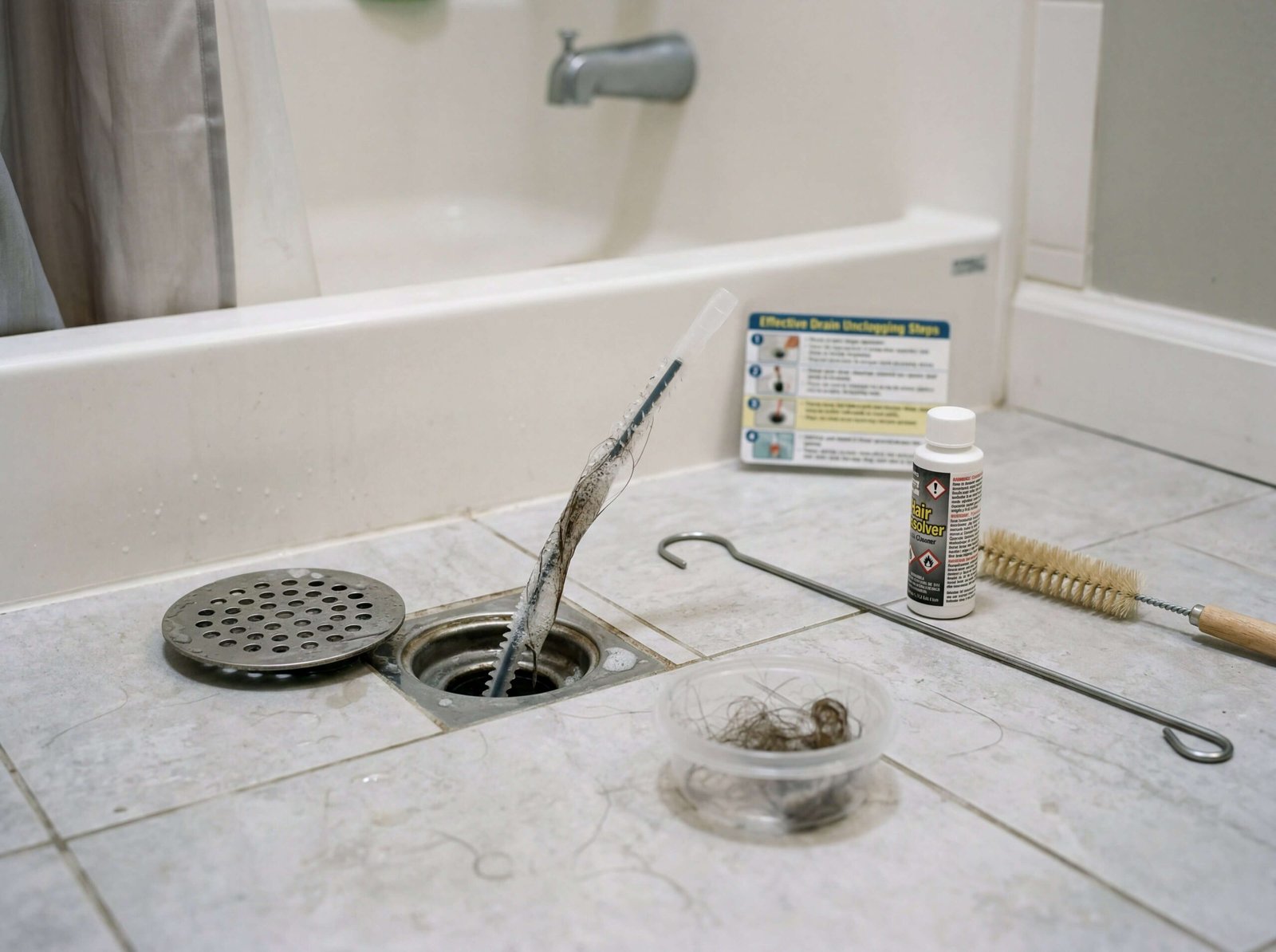
Hair is one of the most common causes of shower drain clogs, but what makes it difficult is not just the amount of hair—it is how it behaves inside the pipe. Unlike food waste or debris that can break down or wash away, hair tends to wrap, tangle, and combine with soap residue to form dense clumps. Over time, these clumps stick to the inner walls of the pipe and start restricting water flow.
What makes this worse is that most people try to fix the problem by flushing it. Hot water, shampoo, or even chemical cleaners may seem to improve the flow temporarily, but they do not actually remove the hair. The clog remains inside the pipe and continues to grow. This is why shower drains often clog again even after they seem to be cleared.
Removing hair from a drain requires a different approach. It is not about pushing the blockage through—it is about pulling it out. That means using tools designed to grab, loosen, and extract the hair rather than just break it apart. When the right tool is used, the clog is removed at its source instead of being partially cleared.
There is also an important difference between simple DIY fixes and deeper problems. Surface-level hair clogs can usually be handled with basic tools, but when hair has built up further inside the pipe or combined with other materials, stronger tools or different methods may be required.
Understanding this difference is what helps you choose the right approach. When you treat hair clogs as something that needs to be physically removed—not just flushed—you get more complete results and avoid dealing with the same problem repeatedly.
What This Page Covers
ToggleWhy Hair Clogs Are Different From Other Blockages
Hair clogs behave very differently from other types of drain blockages, and this is the main reason why common “quick fixes” often fail. To remove them effectively, you need to understand how hair interacts with your plumbing system and why it becomes such a persistent problem.
How Hair Behaves Inside Pipes
When hair enters the drain, it does not flow smoothly like water or dissolve like some organic waste. Instead, it starts to wrap around itself and anything it can catch onto inside the pipe. This includes rough pipe surfaces, joints, and existing debris.
Over time, hair forms a tangled structure that acts like a net. As water continues to flow, soap residue, dirt, and small particles get trapped in this net. This gradually turns a loose collection of hair into a dense, compact clog.
This is why hair clogs often start small but become more restrictive over time. The longer they sit in the pipe, the more material they collect, and the harder they become to remove.
Why Water or Chemicals Alone Don’t Work
A common mistake is trying to solve hair clogs by flushing them away. Hot water, soap, or chemical cleaners may temporarily improve drainage, but they do not remove the hair itself.
Hair does not break down easily. Even when chemicals are used, they may weaken the clog slightly but rarely dissolve it completely. In many cases, the hair remains in place and continues to trap debris.
What often happens is that a small channel opens through the clog, allowing water to pass. This gives the impression that the problem is solved, but the main mass is still inside the pipe. Over time, it builds up again and causes another blockage.
Why Physical Removal Is Necessary
Because of how hair behaves, the most effective solution is to physically remove it from the pipe. This means using tools that can grab, hook, or pull the hair out instead of trying to push it further down.
Once the hair is fully extracted, the drain is actually cleared rather than temporarily opened. This is the key difference between a short-term fix and a long-term solution.
Understanding this behavior changes how you approach the problem. Instead of relying on methods that only improve flow for a short time, you focus on removing the root cause. That is what prevents the clog from returning quickly and keeps the drain functioning properly.
What Hair Removal Tools Actually Do
Hair removal tools are designed with a very specific purpose: to remove the clog from the pipe, not just improve water flow. This distinction is important because many drain issues seem fixed when water starts draining again, but the actual blockage is still inside. The right tool focuses on removing the source of the problem completely.
Pulling vs Breaking vs Flushing
Different tools approach hair clogs in different ways, and understanding this helps you choose the right one for the situation.
- Pulling tools are designed to grab and extract hair from the pipe. These are the most effective because they physically remove the clog rather than disturbing it.
- Breaking tools loosen or cut through dense clumps, making them easier to remove or flush out. These are useful when the clog is too compact to pull in one piece.
- Flushing methods help move smaller, loosened debris through the pipe after the main clog has been removed.
Each method has its place, but relying only on flushing usually leads to incomplete results. Hair needs to be removed, not just shifted.
Why Physical Removal Is the Most Effective Approach
Hair clogs are held together by tangling and buildup, which makes them resistant to simple flow-based solutions. When you physically pull the hair out, you remove the structure that is trapping everything else inside the pipe.
This has two key advantages. First, it restores proper flow immediately because the obstruction is gone. Second, it reduces the chance of the clog forming again quickly, since the base of the buildup has been removed.
Tools that are designed for extraction allow you to reach into the pipe, hook onto the clog, and pull it out in sections or as a whole. This is much more effective than pushing the blockage deeper, which can make it harder to access later.
Clearing the Path vs Removing the Cause
Many quick fixes only clear a small path through the clog. Water starts flowing again, but the majority of the hair remains in place. This creates a temporary improvement that does not last.
Hair removal tools focus on removing the cause instead of just creating a passage. When the clog is fully extracted, the pipe is actually cleared, not just partially opened.
This difference is what separates a short-term fix from a complete solution. When you use the right tool with the right approach, you are not just restoring flow—you are preventing the same problem from returning again soon.
Basic Household Tools (Fast DIY Solutions)
For most shower drain clogs, the problem starts near the surface. Hair collects just below the drain opening or around the trap, making it accessible with simple tools. These basic household tools are designed for quick, direct removal and are often enough to solve the issue without needing advanced equipment.
Zip Tool / Plastic Hair Remover
The zip tool is one of the simplest and most effective tools for hair removal. It is a thin plastic strip with small barbs along its edges, designed to catch and pull hair out of the drain.
It works best for clogs that are close to the surface. The tool is inserted into the drain and then pulled out slowly. As it comes back up, the barbs grab onto hair and bring it out with minimal effort.
This tool is inexpensive, easy to use, and requires no setup. However, its reach is limited, and it may not be effective for deeper or more compact clogs.
Manual Drain Snake (Hair Snake)
A manual drain snake is a flexible tool that can reach further into the pipe than a plastic zip tool. It is usually made of metal or reinforced material and is designed to both grab and loosen hair clogs.
Unlike the zip tool, which mainly pulls hair near the surface, a drain snake can be guided deeper into the pipe. By rotating or moving it carefully, it can latch onto clumps of hair and bring them back up.
This makes it more effective for clogs that are slightly deeper or more compact. It provides better control and reach while still being manageable for DIY use.
Gloves and Hand Removal
In some cases, the clog is visible right below the drain cover. When this happens, the simplest method is to remove it manually using gloves.
This approach works best when:
- The hair is close to the surface
- The clog is not tightly compacted
While this method is straightforward, it has clear limits. It cannot reach deeper clogs, and forcing your hand further into the drain can be unsafe or ineffective.
Boiling Water and Dish Soap
Hot water combined with dish soap is not a primary removal method, but it plays a supporting role. After hair has been physically removed, this combination helps loosen remaining residue and flush out smaller particles.
It works by breaking down soap buildup and allowing any leftover debris to move more freely through the pipe. However, it should not be relied on as the main solution, since it does not remove hair clogs on its own.
When Basic Tools Are Enough
These tools are most effective when the clog is:
- Close to the drain opening
- Made primarily of hair and light residue
- Not deeply compacted
Using the right basic tool at the right time can completely clear the problem without needing stronger methods. The key is recognizing when the clog is still within reach and acting before it becomes more severe.
Intermediate Tools (Better Reach and Control)
When basic tools stop working, it usually means the clog is deeper, denser, or more compacted than it appears from the surface. At this stage, you need tools that provide more reach and control. Intermediate tools are designed to go further into the pipe, apply more force in a controlled way, and handle clogs that cannot be removed with simple pulling methods.
Hand Auger (Manual)
A hand auger is one of the most reliable tools for deeper hair clogs. It consists of a coiled cable inside a drum, with a handle used to rotate the cable as it moves through the pipe.
The key advantage of a hand auger is control. As you feed the cable into the drain, you can rotate it to help it navigate bends and latch onto the clog. Once it connects with the hair buildup, you can either pull it back out or break it into smaller sections.
This tool works well when the clog is beyond the reach of plastic tools but still manageable without power. It provides a balance between strength and precision, making it a practical step up from basic tools.
Drill-Powered Auger
A drill-powered auger adds rotation speed and power to the same basic concept. Instead of manually turning the cable, a drill drives the rotation, allowing the tool to cut through tougher and more compact clogs.
This makes it effective for situations where the hair has combined with soap residue and formed a dense blockage. The added power helps the cable move through resistance more easily.
However, this tool requires more control. Too much force or speed can damage pipes or push the clog further down instead of removing it. It is important to use steady, controlled movement rather than relying on speed alone.
Wet/Dry Vacuum
A wet/dry vacuum can be used to pull loose hair and debris upward through the drain. It works by creating suction at the drain opening, which can remove clogs that are not tightly stuck in place.
This method is most effective when:
- The clog is relatively close to the surface
- The hair is not heavily compacted
- There is enough suction to lift the material
It is not a primary solution for dense clogs, but it can be useful as a first step or as a cleanup method after loosening the blockage with another tool.
When to Move Beyond Basic Tools
Intermediate tools become necessary when:
- The clog is deeper than a few inches below the drain
- Basic tools pull out only small amounts of hair without fully clearing the drain
- Water flow improves temporarily but quickly slows again
At this point, continuing with basic tools often leads to repeated partial results. Using a tool with more reach and control allows you to address the full extent of the clog.
Why Control Matters More Than Force
With intermediate tools, the goal is not to apply maximum force but to maintain control. Moving too aggressively can push the clog further down or damage the pipe.
A steady, controlled approach allows the tool to work with the shape of the pipe and the structure of the clog. This leads to more effective removal and reduces the risk of making the problem worse.
These tools bridge the gap between simple DIY fixes and more advanced solutions, giving you the ability to handle more stubborn clogs without immediately moving to professional-level equipment.
Intermediate Tools (Better Reach and Control)
When basic tools stop working, it usually means the hair clog is deeper, more compact, or combined with soap buildup. At this stage, you need tools that offer more reach, better grip, and controlled force. Intermediate tools are designed for this exact situation—they bridge the gap between simple DIY solutions and heavy-duty professional equipment.
Hand Auger (Manual)
A hand auger is one of the most reliable tools for deeper hair clogs. It uses a flexible cable with a rotating mechanism that allows you to push into the pipe and hook onto the clog.
As you turn the handle, the cable spins and works its way into the hair mass. This allows it to either break the clog apart or latch onto it for removal. Unlike plastic tools, a hand auger has enough strength to deal with denser clogs without bending or losing control.
It is especially useful when the clog is beyond the reach of surface tools but still within a manageable depth. With proper handling, it can remove most stubborn hair blockages effectively.
Drill-Powered Auger
A drill-powered auger takes the same concept as a manual auger but adds motorized rotation. This allows the cable to spin more consistently and with greater force, making it easier to penetrate compact clogs.
This tool is useful when:
- The clog is tightly packed
- Manual rotation is not enough to break through
- The pipe has longer sections to navigate
However, it requires careful handling. Too much force can push the clog deeper or damage the pipe. Control is more important than speed, and it should be used gradually rather than aggressively.
Wet/Dry Vacuum
A wet/dry vacuum works differently from augers. Instead of pushing into the pipe, it attempts to pull the clog out using suction. This can be effective when the hair is loose or partially detached.
It works best when:
- The clog is not tightly stuck
- The blockage is near the drain opening
- There is enough seal to create suction
While it is not as reliable as extraction tools, it can be a useful option in specific situations. It is often used as a secondary method after loosening the clog with another tool.
Why Intermediate Tools Matter
These tools are important because they allow you to handle clogs that basic tools cannot reach or remove completely. They provide:
- Greater depth access
- More control over movement
- Enough strength to deal with compact buildup
At this stage, the approach becomes more controlled and deliberate. Instead of quick fixes, you are working deeper into the system to remove the clog properly.
Choosing the right intermediate tool depends on how far the clog is and how tightly it is formed. When used correctly, these tools can resolve most hair clogs without needing advanced or professional-level equipment.
Preventive Tools (Stop Hair Before It Clogs)
The easiest hair clog to fix is the one that never forms. Most shower drain problems can be avoided entirely if hair is stopped before it enters the pipe. Preventive tools are simple, but they play a major role in long-term drain health because they reduce buildup at the source.
Shower Drain Hair Catchers
Hair catchers are placed directly over or inside the drain opening. Their purpose is to trap hair as water flows through, preventing it from entering the pipe.
These tools work because they intercept hair at the point of entry. Instead of allowing it to travel into the drain and combine with soap residue, they collect it where it can be easily removed.
They are most effective when cleaned regularly. If hair is allowed to accumulate on the catcher, it can start restricting water flow at the surface. However, this is still much easier to manage than dealing with a clog inside the pipe.
Drain Covers with Fine Mesh
Fine mesh covers provide an extra level of filtration. They are designed to catch even smaller strands of hair that might pass through standard catchers.
These are especially useful in households where:
- Long hair is common
- Hair shedding is frequent
- Drains clog repeatedly
By capturing finer debris, they reduce the amount of material entering the pipe over time. This leads to less buildup and fewer clogs forming deeper in the system.
Why Prevention Is More Effective Than Removal
Once hair enters the pipe, it begins to collect and trap other materials. Even small amounts can start the buildup process. Preventive tools stop this from happening, which means the pipe stays cleaner for longer.
This changes the approach from reacting to clogs to avoiding them altogether. Instead of using tools to remove buildup, you reduce the need for those tools in the first place.
Making Prevention Part of Routine
Preventive tools only work if they are used consistently. This means:
- Keeping a hair catcher in place at all times
- Cleaning it regularly before buildup becomes excessive
- Replacing it if it becomes worn or less effective
These small habits significantly reduce the chances of dealing with a clogged drain later.
Long-Term Impact
Using preventive tools creates a noticeable difference over time. Drains remain clearer, water flows more smoothly, and the need for deeper cleaning tools becomes less frequent.
While removal tools are important, prevention is what keeps the system stable. When hair is stopped at the surface, the entire drainage system functions more reliably with minimal effort.
Advanced Tools (For Severe Hair Clogs)
When hair clogs go beyond surface-level buildup, they often become tightly compacted and mixed with soap residue, grease, and debris. At this stage, basic and intermediate tools may only provide partial results. Advanced tools are designed to handle these deeper, more stubborn situations where stronger methods are required.
Electric Drain Snake
An electric drain snake is a powered version of a manual auger. It uses a motor to rotate a flexible cable, allowing it to move through dense clogs with consistent force. This makes it effective for hair blockages that have built up deeper in the pipe and become tightly packed.
The strength of this tool lies in its ability to both break through and pull apart compact clogs. It can reach further into the system and maintain steady rotation without the effort required by manual tools.
However, with this added power comes greater responsibility. Using too much force or moving too quickly can damage pipes or push the clog further down the line. It requires a controlled approach and a clear understanding of how the pipe responds to the tool.
Hydro Jetting (When Hair Combines with Heavy Buildup)
Hydro jetting is a method that uses high-pressure water to clean the inside of pipes. It is not limited to removing a single clog—it clears the entire pipe by washing away buildup along the walls.
This becomes useful when hair is not the only problem. In many cases, hair combines with soap, grease, and other residue, forming a thick layer inside the pipe. Mechanical tools may create a path through it, but they do not fully remove it.
Hydro jetting removes this buildup completely, restoring the pipe to a cleaner condition. This leads to better flow and reduces the chances of the clog returning.
When Advanced Tools Are Necessary
Advanced tools are typically needed when:
- The clog is deep within the system
- Hair has combined with other materials to form a dense blockage
- Previous attempts with basic or intermediate tools have failed
- The drain continues to clog repeatedly
At this stage, continuing with smaller tools often leads to temporary results. Stronger methods are required to fully clear the system.
Why These Tools Require Caution
The effectiveness of advanced tools comes from their power, but that same power increases the risk if used incorrectly. Applying too much force, using the wrong technique, or working without understanding the pipe condition can lead to damage.
This is why these tools are often handled at a professional level. They are highly effective when used correctly, but they require careful control and proper judgment.
Moving From Removal to Full Cleaning
Basic tools remove hair clogs. Advanced tools go a step further by addressing the overall condition of the pipe. Instead of just clearing a blockage, they restore flow and remove buildup that contributes to recurring issues.
Understanding when to move to these tools is important. When the problem is no longer just a simple hair clog, using the right level of equipment ensures a more complete and lasting solution.
How to Choose the Right Tool
Choosing the right tool for a hair clog is not about picking the strongest option—it is about matching the tool to the situation. Using a tool that is too weak leads to incomplete removal, while using one that is too aggressive can push the clog deeper or damage the pipe. The goal is to select a tool that fits the depth, severity, and behavior of the clog.
Based on Clog Depth
The first factor to consider is how far the clog is inside the pipe. Surface-level clogs can be handled quickly, while deeper ones require more reach and control.
- Surface clogs (near drain opening) → zip tool, gloves, hair remover
- Mid-depth clogs (a few inches to trap area) → manual drain snake
- Deep clogs (beyond immediate reach) → hand auger or powered tools
If a tool cannot physically reach the clog, it will only remove part of it or fail completely. Depth determines the minimum capability required.
Based on Clog Severity
Not all hair clogs are the same. Some are loose and easy to extract, while others are tightly packed and combined with soap buildup.
- Light clogs (loose hair, early stage) → plastic tools or simple extraction
- Moderate clogs (denser buildup) → manual auger for better grip and control
- Heavy clogs (compact, recurring) → powered auger or advanced cleaning methods
The denser the clog, the more control and strength the tool needs. Choosing too light a tool often results in partial removal.
Based on Frequency of the Problem
How often the clog occurs is just as important as how severe it is. A one-time issue can be handled differently than a recurring problem.
- Occasional clog → basic tools are usually enough
- Frequent clogs → combine removal tools with preventive solutions
- Recurring deep clogs → consider stronger tools or deeper cleaning approach
Recurring clogs often indicate that the buildup is not being fully removed. In these cases, upgrading the tool or method becomes necessary.
Matching Tool to Situation
The right tool is the one that:
- Reaches the clog completely
- Has enough control to remove it
- Does not cause unnecessary force or damage
Using a stronger tool too early can make the situation worse, while using a weaker tool for too long leads to repeated failure. The decision should be based on what the clog requires, not just what is available.
Why Selection Matters
Most drain problems become frustrating because the wrong tool is used repeatedly. Each attempt may improve flow slightly, but the main clog remains. This creates a cycle of temporary fixes.
When the tool matches the problem, the clog is removed more completely. This reduces repeated work and leads to a more stable result. Choosing correctly at the start saves time, effort, and avoids unnecessary complications.
How to Use Hair Removal Tools Properly
Using the right tool is only part of the solution. How you use it determines whether the clog is fully removed or just partially disturbed. A controlled, step-by-step approach ensures that the hair is extracted properly without pushing it deeper or damaging the pipe.
Step-by-Step Process
- Remove the drain cover
Start by taking off the drain cover or stopper. This gives direct access to the pipe and prevents the tool from getting blocked at the surface. If there is visible hair, remove it first before inserting any tool. - Insert the tool slowly
Feed the tool into the drain gently. Do not force it. Let it follow the natural path of the pipe. Resistance at this stage usually means a bend, not the clog. - Engage the clog with control
Once you feel resistance that does not behave like a pipe bend, you are likely at the clog. At this point:- Rotate slightly if using a snake or auger
- Push gently to let the tool catch onto the hair
- Pull the tool out steadily
This is the most important step. Pull the tool out slowly and evenly. Sudden or aggressive pulling can break the clog apart and leave pieces behind. A steady motion helps bring the hair out in larger sections. - Repeat if necessary
Most clogs do not come out in one pass. Reinsert the tool and repeat the process until little or no hair is coming out. Each pass removes more of the buildup. - Flush with hot water
After the hair is removed, flush the drain with hot water. This clears remaining residue and confirms that water is flowing freely.
Tool-Specific Handling Tips
Different tools require slightly different handling, but the principle remains the same—control over force.
- Plastic zip tools → insert straight, pull slowly to avoid tearing hair
- Manual snakes/augers → use gentle rotation, not aggressive twisting
- Powered tools → keep speed low and steady, avoid forcing forward
Understanding how each tool interacts with the clog helps prevent incomplete removal.
Recognizing Resistance
Not all resistance means you have reached the clog. Pipes have bends and joints that naturally create resistance. The difference is in how it feels:
- Smooth resistance → likely a pipe bend
- Uneven or gripping resistance → likely a clog
Learning to recognize this prevents unnecessary force and helps you target the right area.
Avoiding Common Handling Errors
The most common mistake is using too much force. This can:
- Push the clog deeper
- Break it into smaller pieces that remain in the pipe
- Damage the pipe itself
A controlled approach is always more effective than an aggressive one.
Why Proper Use Matters
Even the best tool will fail if used incorrectly. Proper technique ensures that the clog is removed completely rather than partially cleared. This reduces the chance of the problem returning and keeps the drain functioning properly for longer.
When you focus on controlled insertion, steady extraction, and repeated passes, you turn a simple tool into an effective solution instead of a temporary fix.
Common Mistakes When Removing Hair
Hair clogs are simple in theory, but small mistakes during removal often lead to bigger problems. Most recurring drain issues happen not because the wrong tool was used, but because the tool was used incorrectly. Understanding these common mistakes helps you avoid turning a manageable clog into a deeper or more stubborn one.
Using Chemicals First
One of the most common mistakes is starting with chemical cleaners. These products may seem like an easy solution, but they rarely remove hair completely. At best, they weaken the clog slightly or create a small passage for water to flow.
The main problem is that the hair remains inside the pipe. Over time, it continues to trap debris and rebuild the clog. In some cases, chemicals can also make the hair mass softer and harder to grab with tools later.
Pushing the Hair Deeper
Another frequent mistake is pushing the clog further into the pipe instead of removing it. This usually happens when tools are inserted too aggressively or when pressure is applied without control.
Instead of hooking onto the hair, the tool compresses it and moves it deeper into the system. This makes the clog harder to reach and more difficult to remove, often requiring stronger tools later.
Using the Wrong Tool Size or Type
Not all tools are suitable for every clog. Using a tool that is too short, too weak, or not designed for hair removal leads to incomplete results.
For example:
- A plastic tool may not reach a deeper clog
- A weak tool may not grip dense buildup
- A tool designed for pushing may not extract hair effectively
This results in partial removal, where some hair is taken out but a significant amount remains inside the pipe.
Over-Forcing the Tool
Applying too much force is one of the quickest ways to create additional problems. When a tool is forced into the pipe, it can:
- Damage pipe walls or joints
- Break the clog into smaller pieces that stay inside
- Cause the tool to get stuck
Hair clogs respond better to controlled movement than brute force. A steady approach allows the tool to latch onto the clog and remove it more effectively.
Stopping Too Early
Many people stop once water starts draining again. While this may seem like success, it often means only part of the clog has been removed. The remaining hair will continue to collect debris and eventually cause another blockage.
Complete removal requires repeating the process until very little or no hair is coming out. This ensures that the root of the clog is actually cleared.
Why Avoiding These Mistakes Matters
Each of these mistakes leads to the same outcome—temporary improvement instead of a complete solution. The drain may work for a short time, but the problem returns because the main buildup was not removed.
Avoiding these errors changes the result entirely. Instead of repeatedly dealing with the same clog, you remove it properly and restore the drain to a more stable condition.
When These Tools Are Not Enough
Hair removal tools are effective in most situations, but there are limits to what they can handle. When a clog goes beyond simple hair buildup, continuing to use the same tools often leads to repeated partial results. Recognizing when tools are no longer enough is what prevents wasted effort and worsening the problem.
Signs of a Deeper Problem
Not all clogs are just surface-level hair. In some cases, the issue is deeper in the system or involves more than just hair.
- Clogs return quickly after removal
If the drain works for a short time and then slows again, it usually means part of the buildup remains deeper in the pipe. - Multiple drains are affected
When more than one drain shows slow flow or backup, the problem is likely further down the main line, not just in a single shower drain. - Water drains slowly even after removal attempts
If you have removed visible hair but flow is still restricted, there may be additional buildup beyond reach. - Unusual smells or gurgling sounds
These can indicate deeper blockages or airflow issues within the system, not just a simple clog near the surface.
When to Move to Stronger Methods
When basic and intermediate tools no longer solve the problem, stronger approaches may be required. This could include deeper-reaching tools or methods that clean the entire pipe instead of just removing a localized clog.
This step becomes necessary when:
- Hair has combined with soap, grease, or other residue
- The clog is too compact to pull out in sections
- The blockage is located further down the pipe
At this stage, continuing with smaller tools often pushes the clog around instead of removing it.
When the Problem Is Not Just a Clog
Sometimes the issue is not a clog at all. Structural problems such as pipe misalignment, damage, or buildup along the entire pipe can cause similar symptoms.
In these cases, no hair removal tool will fully solve the issue. The problem requires a different approach, often starting with proper inspection to understand what is happening inside the pipe.
Why Recognizing Limits Is Important
The biggest mistake at this stage is continuing to use the same method repeatedly. Each attempt may slightly improve flow, but the main issue remains unresolved.
Knowing when to stop and reassess saves time and prevents the problem from becoming more difficult to fix. It shifts the approach from trial-and-error to a more targeted solution.
Moving Toward the Right Solution
When tools are no longer enough, the next step is not just using more force—it is choosing a better method. This may involve deeper cleaning, inspection, or a different type of tool altogether.
Understanding this transition is what allows you to move from temporary fixes to a more complete and lasting solution.
Cost of Hair Removal Tools (U.S.)
The cost of hair removal tools varies based on how much reach, control, and durability you need. Most shower drain clogs can be handled with low-cost tools, but as the problem becomes deeper or more frequent, the need for better equipment increases. Understanding the cost range helps you choose the right level of investment without overspending.
Basic Tools (Low Cost, High Value)
Basic tools are inexpensive and designed for quick, surface-level clogs. These include plastic hair removers, simple drain snakes, and hair catchers.
- Typical cost: $5 to $20
- Best for: Occasional clogs near the drain opening
These tools offer the best value because they solve most common problems with minimal effort. They are also easy to replace if worn out. For most households, having one or two of these tools is enough for regular maintenance.
Mid-Range Tools (More Control and Reach)
Mid-range tools include manual augers and stronger drain snakes. These provide better reach and are designed to handle clogs that basic tools cannot fully remove.
- Typical cost: $20 to $80
- Best for: Deeper or more compact hair clogs
These tools are more durable and reusable. They are a good investment if clogs occur more frequently or if basic tools are not providing complete results.
Advanced Tools (Higher Cost, Specialized Use)
Advanced tools include electric drain snakes and more powerful equipment. These are designed for severe clogs or situations where hair is combined with other types of buildup.
- Typical cost: $100 to $400+
- Best for: Deep, recurring, or stubborn clogs
These tools are not usually necessary for standard shower drain issues. They are more suitable when simpler methods have failed or when the clog is part of a larger problem.
Buy vs Replace vs Upgrade
The decision to buy or upgrade depends on how often the problem occurs:
- Rare clogs → basic tools are enough
- Occasional recurring clogs → invest in a mid-range tool
- Frequent or severe issues → consider stronger tools or alternative methods
Replacing low-cost tools regularly is often more practical than investing in advanced equipment that may not be used often.
Cost vs Effectiveness
Spending more does not always mean better results. The effectiveness of a tool depends on how well it matches the problem. A low-cost tool used correctly can completely solve a surface-level clog, while an expensive tool may not be necessary.
The goal is not to buy the most powerful tool, but to choose one that removes the clog fully. Matching the tool to the situation ensures that you get the best result without unnecessary cost.
Tool-Based Hair Drain Maintenance Routine
Keeping your shower drain clear is not about reacting to clogs—it is about maintaining the system so clogs don’t form in the first place. Hair buildup is gradual, and if you remove it regularly, it never becomes a serious blockage. A simple routine using the right tools can prevent most drain problems entirely.
Weekly Routine (Prevent Surface Buildup)
Hair starts collecting at the drain opening almost immediately. If it is removed at this stage, it never gets the chance to travel deeper into the pipe.
- Remove and clean the hair catcher or drain cover
- Pull out any visible hair using a zip tool or by hand
- Run hot water for a short flush
This step takes only a few minutes but has the biggest impact. Preventive tools like hair catchers are widely recommended because they stop hair before it enters the pipe and forms clogs .
Monthly Routine (Light Deep Cleaning)
Even with prevention, some hair and residue will move into the pipe. A monthly cleaning helps remove early buildup before it becomes compact.
- Use a plastic hair remover or manual snake
- Insert it a few inches deeper than surface level
- Remove any trapped hair and debris
- Flush with hot water to clear remaining residue
This step ensures that small buildup does not turn into a dense clog. Tools like drain snakes are considered one of the most effective ways to physically remove hair from pipes .
Occasional Deep Check (Every Few Months)
If your household has long hair or frequent clog issues, a deeper check helps prevent recurring problems.
- Use a manual auger for deeper inspection
- Check if hair is collecting beyond the trap
- Remove any buildup before it compacts
This is especially useful if you’ve experienced clogs before. It keeps the system clean beyond just the visible area.
Emergency Readiness (When Flow Slows Down)
If you notice slow drainage, act immediately before the clog becomes worse.
- Use a zip tool or snake first (physical removal)
- Avoid starting with chemicals
- Repeat removal until flow improves fully
Physical tools are more effective for hair clogs because they extract the blockage instead of trying to dissolve it .
Why This Routine Works
Hair clogs form slowly, not suddenly. By removing hair regularly:
- You stop buildup before it becomes dense
- You avoid needing stronger tools later
- You reduce repeated clogs
This routine shifts the approach from fixing problems to preventing them. With consistent maintenance, most shower drains stay clear with minimal effort.
Long-Term Benefit
A simple tool-based routine keeps your drain system stable. Instead of dealing with frustrating clogs, you maintain steady flow with small, consistent actions.
When hair is removed regularly, the need for advanced tools or major cleaning methods becomes rare. That is what makes this approach practical, efficient, and reliable over time.
How Professionals Handle Hair Clogs Differently
The difference between a homeowner clearing a hair clog and a professional doing the same job is not just the tool—it is the approach. Professionals do not treat a clog as a one-time blockage. They look at how it formed, where it sits in the system, and what needs to be done to prevent it from returning.
Technique Over Tool
Professionals focus on controlled extraction rather than force. Even when using stronger tools, the goal is not to push through the clog but to remove it completely.
They work in stages:
- First, identify where the clog is located
- Then engage it carefully using the right tool
- Finally, extract it in sections or as a whole
This controlled method prevents breaking the clog into pieces that stay inside the pipe. It also reduces the risk of pushing the blockage deeper.
Combining Tools for Complete Removal
Instead of relying on a single tool, professionals often use a combination based on what the clog requires. For example, they may start with a snake to pull out hair and then follow with a flushing method to remove leftover residue.
This layered approach ensures that:
- The main clog is removed
- Remaining buildup is cleared
- Flow is fully restored
By combining methods, they avoid the common issue of partial removal that leads to recurring clogs.
Identifying the Root Cause
Professionals do not stop once the drain starts flowing again. They look at why the clog formed in the first place. This could be due to:
- Lack of a hair catcher
- Accumulation in a specific section of pipe
- Repeated buildup over time
Understanding the cause allows them to recommend changes that prevent the problem from returning.
Preventing Recurrence
A professional approach always includes prevention. Instead of just solving the current issue, they focus on reducing future clogs.
This may involve:
- Suggesting preventive tools
- Recommending regular maintenance
- Adjusting how the drain is used
This is what creates long-term results instead of repeated fixes.
Efficiency Through Experience
Experience allows professionals to recognize patterns quickly. They can tell the type of clog, its likely location, and the best method to remove it without multiple attempts.
This reduces:
- Time spent on trial-and-error
- Risk of using the wrong tool
- Chances of incomplete removal
What This Means for Homeowners
The key takeaway is not just to use better tools, but to adopt a better approach. Focus on:
- Controlled removal instead of force
- Using the right tool for the situation
- Removing the full clog, not just improving flow
When you apply this mindset, even basic tools become more effective. The result is fewer recurring clogs and a more reliable drain system over time.
Long-Term Strategy for Hair-Free Drains
Keeping a shower drain free from hair clogs is not about reacting each time the problem appears. The real solution is building a simple, consistent system that prevents buildup, handles early signs, and reduces the need for heavy tools. When you approach it this way, clogs become rare instead of recurring.
Build a Simple Home Toolkit
You do not need many tools to manage hair clogs effectively. A small, well-chosen set is enough to handle most situations.
A practical setup includes:
- A hair catcher or drain cover for daily prevention
- A plastic zip tool or hair remover for quick extraction
- A manual drain snake for deeper cleaning when needed
Having these tools available means you can act immediately when you notice slow drainage, instead of waiting for the problem to get worse.
Focus on Prevention First
Prevention should always be the primary strategy. Once hair enters the pipe, it begins to trap soap and debris. Stopping it at the surface avoids this entire process.
This means:
- Keeping a hair catcher in place consistently
- Cleaning it regularly before buildup increases
- Removing visible hair before it goes deeper
These small actions reduce the need for deeper cleaning and keep the system stable.
Address Problems Early
Hair clogs rarely appear suddenly. They develop over time, starting with small buildup that gradually becomes more restrictive.
Acting early makes a significant difference:
- Light buildup can be removed quickly with basic tools
- Early removal prevents dense, compact clogs
- Less effort is needed compared to handling a full blockage
Waiting too long allows the clog to strengthen, making removal more difficult.
Use the Right Tool at the Right Time
A long-term strategy also means knowing when to step up your approach. Not every clog requires a stronger tool, but ignoring deeper buildup leads to repeated issues.
- Start with basic tools for surface clogs
- Move to intermediate tools if the problem persists
- Avoid using excessive force when a better tool is needed
Matching the tool to the situation keeps the process efficient and reduces damage risk.
Create a Simple Routine
Consistency is what keeps drains clear over time. A simple routine prevents buildup from reaching a point where it becomes a problem.
- Weekly: clean hair catcher and remove visible hair
- Monthly: use a tool to remove early buildup
- As needed: respond quickly to slow drainage
This routine takes minimal time but prevents most clogs from forming.
Upgrade Only When Necessary
Most households do not need advanced tools. If your routine is consistent and preventive measures are in place, basic and intermediate tools are enough.
Only consider stronger tools when:
- Clogs become frequent despite maintenance
- The blockage is clearly deeper or more compact
- Basic tools no longer remove the buildup effectively
Upgrading should be based on need, not assumption.
Long-Term Result
When you combine prevention, early action, and the right tools, your drain system becomes predictable and stable. Instead of dealing with repeated clogs, you maintain steady flow with minimal effort.
The key is not doing more work—it is doing the right work at the right time. That is what keeps shower drains clear and reduces the need for constant fixes.
Final Thoughts
Hair clogs are one of the most common and frustrating drain problems, but they are also one of the easiest to control when approached correctly. The key is understanding that hair does not dissolve or wash away easily—it must be physically removed. Once you shift from trying to flush the clog to actually extracting it, the results become much more consistent.
The right tools make a big difference, but only when they are matched to the situation. A simple plastic remover can completely solve a surface clog, while deeper or compacted buildup requires more reach and control. Using the correct tool at the right stage prevents repeated attempts and avoids turning a small issue into a larger one.
At the same time, prevention plays an even bigger role than removal. Stopping hair before it enters the pipe reduces buildup and keeps the system functioning smoothly. A small habit like using and cleaning a hair catcher regularly can eliminate the need for deeper cleaning in many cases.
The most practical approach is to combine prevention with timely action. Remove hair early, use the right tool when needed, and avoid relying on quick fixes that only improve flow temporarily. This keeps the drain clear and reduces the chances of recurring clogs.
When you treat hair clogs as something to be removed completely—not just managed—you create a more reliable system. That shift is what turns a recurring problem into something that is easy to handle and maintain over time.