
A clogged drain does not always start as an emergency. Many drain problems begin with something that seems minor: water draining a little slower than usual, a toilet that needs a second flush, a shower that leaves a small puddle at your feet, or a sink that gurgles after use. The problem is that homeowners often judge the situation by how it looks in that moment instead of by how quickly it can escalate. In real homes, drain emergencies usually get worse when people continue using plumbing fixtures, try the wrong fix, or wait too long to respond.
The first few decisions matter more than most people realize. If the drain is already backing up, every gallon of additional water you send into the system can turn a manageable clog into an overflowing fixture, a contaminated cleanup job, or a house-wide drainage problem. That is why the right approach is not to panic and not to attack the clog aggressively. The right approach is to slow the situation down, reduce the amount of water entering the system, and figure out whether the problem is isolated to one fixture or connected to a larger drain line issue.
What makes a drain emergency stressful is that the homeowner is often dealing with incomplete information. You may not know whether the blockage is sitting near the fixture, deeper in a branch line, or out in the main sewer line. You may not know whether the standing water is simply dirty drain water or actual sewage contamination. And in the middle of that uncertainty, it is very easy to make things worse by flushing again, running another sink, pouring chemicals into the line, or trying to “see if it has cleared.”
This guide is built for that exact moment. The goal is not to turn you into a plumber in ten minutes. The goal is to help you make calm, correct decisions right away, limit damage, avoid unsafe actions, and recognize when professional help is the safest next step.
What Counts as a Drain Emergency
Not every clogged drain is an emergency. A bathroom sink draining slowly but still functioning is inconvenient, but that is not the same as a toilet overflowing onto the floor or sewage coming up in a basement drain. The difference comes down to risk. Once a clog creates overflow, contamination, repeated backup, or signs that more than one fixture is involved, the situation moves out of the nuisance category and into emergency territory.
A true drain emergency usually includes one or more of the following conditions: water is backing up instead of draining, the fixture cannot be used at all, dirty or sewage-like water is entering the living space, multiple fixtures are reacting together, or the problem is spreading fast enough that damage to flooring, walls, cabinets, or finished areas is likely. That is especially true in basements, lower bathrooms, laundry areas, and any place where backup water can sit unnoticed long enough to damage materials underneath the surface.
The seriousness also depends on what kind of water is involved. Clean water from a sink overflow is one level of urgency. Dirty drainage water or sewage is another level entirely. Once wastewater or sewage is backing up, the situation is no longer just about clearing a line. It becomes a health and sanitation issue. That is where homeowners need to shift from “How do I unclog this?” to “How do I stop this from spreading and protect the house?”
Location matters too. A kitchen sink backup may stay localized for a while, especially if the blockage is near the trap or branch line. A basement floor drain backup, on the other hand, often points to a deeper system issue and carries a much higher risk of contamination and hidden damage. A toilet overflow can sometimes be a simple local clog, but if flushing one toilet causes water movement in a tub or floor drain, that is often a warning that the blockage is farther down the system.
The simplest way to think about it is this: a clogged drain becomes an emergency when it creates immediate risk to health, safety, sanitation, or property.
Common Emergency Clogged Drain Situations
One of the most common drain emergencies is a toilet that clogs and begins overflowing. This often happens because the homeowner flushes once, sees the bowl rise, then flushes again hoping to force the waste through. If the clog is still present, that second flush often turns a contained problem into floor cleanup, water damage, and contamination around the toilet base. In a true overflow situation, the priority is not more flushing. The priority is stopping the water and containing the spread.
Another frequent emergency is a shower or bathtub backing up with dirty water that will not drain. If the water level rises while someone is showering and then stays in place, that may still be a localized drain clog. But if water appears in the tub after flushing a toilet or using another sink, that suggests a deeper drainage issue. When dirty water enters a bathing fixture from another part of the system, the situation is more serious than a simple hair clog.
Kitchen sink emergencies are a little different. Some start as routine grease or food buildup and then suddenly stop draining altogether. In other cases, the sink fills rapidly, backs into the second bowl, or overflows into cabinets or onto flooring. If the sink is connected to a garbage disposal, people often make the mistake of continuing to run water and the disposal at the same time, which can pack the blockage tighter or push more water into a line that already has nowhere to send it.
Basement floor drain backups deserve special attention. In many homes, the basement floor drain is the lowest visible opening in the drainage system. When there is a deeper line problem, that is often where backup water shows up first. If you see standing water, sewage smell, or bubbling in a basement drain after using an upstairs sink, shower, or toilet, you should treat that as a potentially serious system-wide warning sign.
Sewage coming up through a tub, shower, or floor drain is one of the clearest drain emergencies a homeowner can face. Once wastewater starts entering the home through a fixture, the issue is no longer just inconvenience. It means the system is failing to move waste away from the house as intended. That requires fast containment, minimal fixture use, and usually professional service.
Multiple fixtures backing up at once is another major warning pattern. If the toilet gurgles when the shower drains, if the tub fills when the washing machine runs, or if several drains are slow and unstable at the same time, you are likely dealing with more than one isolated clog. That pattern often points to a blockage farther down the line, and continued use typically makes it worse.
Outdoor drain overflow can also become an emergency when it threatens to send water back toward the foundation, garage, basement entry, or lower part of the home. While exterior drainage issues are not always part of the sanitary drain system, flooding near the house can quickly become a property protection problem and should not be ignored.
Warning Signs the Problem Is Escalating
Drain emergencies rarely arrive with no warning at all. In many homes, there are signs that the system has been struggling before the actual backup occurs. The problem is that these signs are often dismissed as minor annoyances until the day the drain stops working completely.
One of the clearest warning signs is water backing up instead of draining away normally. That may start with a sink that takes longer to empty or a tub that holds water for a few minutes after use. If that slow drainage becomes frequent, more severe, or starts affecting other fixtures, the problem is moving in the wrong direction.
Gurgling in more than one fixture is another important clue. A single fixture making noise is not always an emergency. But if the toilet gurgles when the sink drains, or a tub makes bubbling sounds after a flush, that may mean trapped air is being forced through the system because the drainage path is partially blocked. In real homes, those sounds often show up before a larger backup.
Repeated clogs in a short period should also be taken seriously. If you keep plunging the same toilet every few days, or the same sink keeps stopping up even after temporary relief, that usually means the underlying problem has not been resolved. What many homeowners think of as “just one stubborn drain” is sometimes an early stage of a bigger line issue.
Water appearing in an unexpected drain is one of the most useful warning patterns. If running a bathroom sink causes movement in a tub, or flushing an upstairs toilet causes water to appear in a basement floor drain, that tells you the system is struggling downstream from those fixtures. That is not a normal local clog pattern. It often means the water is looking for the next lowest place to go because the main path is blocked or restricted.
Sewer odor combined with drainage issues is another sign that should move the situation up your urgency list. Odor alone does not always mean an emergency, but when foul smell appears along with bubbling, backup, or repeated poor drainage, it often indicates that waste is not moving through the line the way it should.
How to Judge the Severity Quickly
When a drain problem starts turning urgent, the first question is simple: is this one fixture, one section of the house, or the broader drain system? You do not need professional equipment to begin answering that. You just need to look at the pattern.
If only one fixture is affected and nothing else in the home is reacting, the problem may be local. A single bathroom sink that drains poorly while the toilet, tub, and nearby fixtures work normally often points to a clog near that sink line. A toilet that clogs but causes no response in nearby drains may still be just a toilet-level blockage. These can still be urgent if overflow is happening, but they are usually more limited in scope.
If one bathroom fixture is acting up and nearby fixtures begin reacting too, the problem may be in a branch line. For example, if the toilet and tub in the same bathroom affect each other, the blockage may be farther down that shared section of piping. At that point, homeowners should be much more careful about continued use because sending more water into one fixture may push backup into another.
If multiple fixtures in different parts of the home are slow, noisy, or backing up together, the chance of a main-line or deeper drainage problem increases. The biggest clues are these:
- Water shows up in the lowest drain first
- Toilet and tub react together
- Basement floor drain becomes active during upstairs use
- Several drains become unstable in a short period
- Temporary relief disappears almost immediately
A helpful way to triage the urgency is to sort the problem into three levels.
- Minor urgency
One fixture is slow or partially clogged, no overflow is happening, and no other drains are reacting. The situation needs attention, but it is not yet a full drain emergency. - Urgent backup
One fixture has stopped draining completely, water is rising or threatening overflow, or nearby fixtures are starting to react. Use should stop until the scope is clearer. - Full emergency
Sewage is backing up, multiple fixtures are affected, contaminated water is entering the home, or property damage is spreading. At this point, the focus is containment and professional escalation.
That quick triage keeps you from treating every clog the same way. It also helps you avoid wasting time on light DIY steps when the pattern clearly points to a deeper blockage.
What to Do Immediately
When a drain emergency starts, the first priority is to stop making the problem bigger. Most serious backups worsen because the home continues sending water into a system that has already lost its ability to drain. That means your first move is not to experiment. It is to pause.
Follow these steps in order:
- Stop using the affected fixture immediately.
Do not run more water to test the drain. Do not flush again to see whether it clears. Do not turn on the faucet “just for a second.” If the line is blocked, even a small amount of additional water may raise the water level and push overflow where you do not want it. - Stop using nearby fixtures until you understand the scope.
If the problem might be deeper than one drain, the sink in the next room, the upstairs shower, or the washing machine may all contribute to the same blocked line. This matters especially when toilets, tubs, and floor drains are involved. - Shut off water if active overflow is happening.
If a toilet is rising toward the rim, remove the tank lid and push the flapper closed if you can do so safely. Then turn off the toilet supply valve near the base if needed. If an appliance or fixture is still feeding water into the problem area, stop the flow at the nearest shutoff point. - Protect the surrounding area.
Move rugs, baskets, paper goods, toiletries, floor mats, and small furniture away from the affected zone. Use towels to block spread into nearby rooms if the water is relatively clean. If contamination is suspected, focus on limiting contact and spread rather than trying to save everything at once. - Keep people and pets out of the area.
Dirty backup water and especially sewage should be treated as unsafe. Children and pets can track contamination quickly through the house. Restrict the area early. - Observe and document the symptoms.
Before conditions change, note which fixtures are affected, whether water backs up after using another drain, whether odor is present, and whether the lowest drain is involved. This information helps both your own decision-making and any plumber who needs to diagnose the issue.
This is the stage where homeowners often make their best money-saving decision: they stop escalating the problem before the cleanup becomes larger than the clog itself.
Safe Actions You Can Take Right Away
Homeowners can take useful steps during a drain emergency, but those steps need to match the situation. Good emergency action is about containment, protection, and limited troubleshooting. It is not about forcing a solution at any cost.
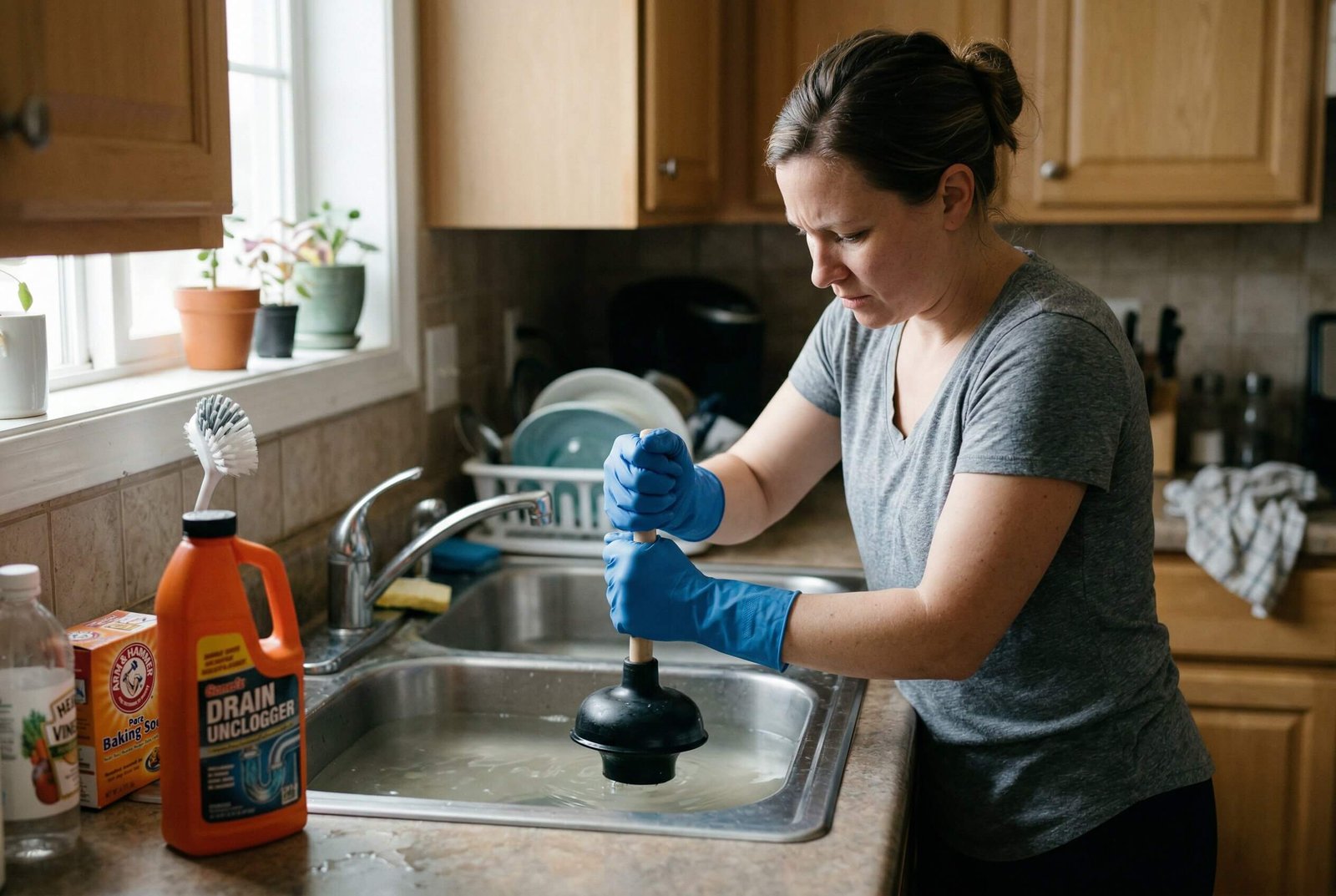
If the problem appears isolated to one toilet and there are no signs that other drains are reacting, plunging may be appropriate. Use the right toilet plunger, create a good seal, and work steadily rather than violently. A controlled plunging attempt can clear common toilet-level clogs. But if the bowl overflows repeatedly, sewage is involved, or nearby drains are reacting, stop. That is not the moment for repeated aggressive plunging.
Containment measures are often more helpful than people expect. Towels, absorbent cloths, and shallow containers can prevent water from spreading into hallways, cabinets, and adjacent flooring. In a kitchen or bathroom, that can significantly reduce cleanup and material damage. In a basement, it can help direct water away from stored items or vulnerable finished surfaces.
You can remove visible debris from the surface if it is safe and clearly reachable. Hair at a shower drain opening, food scraps sitting in a kitchen strainer, or debris caught right at the visible entry point may be removed with gloves. What you should not do is dig blindly into a drain opening with bare hands or attempt disassembly in a contaminated area without understanding what is inside the system.
Protective gear matters more than many homeowners think. Gloves, washable footwear, and old clothes reduce how much contamination travels with you. If the water appears dirty or sewage-like, avoid kneeling directly in it and avoid touching your face until you have cleaned up properly.
Ventilation can also help if odor is strong, but it should be done safely. Open windows or increase airflow when possible. In a sewage backup, better ventilation makes the area easier to work around and reduces how oppressive the situation feels, though it does not remove the contamination risk itself.
One useful habit during the first response is to watch what the water does after you stop fixture use. If the level drops and stays down, the system may have partial movement. If it drops and quickly returns with the next small use elsewhere, the blockage is still active. If the level keeps rising even after fixture use stops, the issue may be larger or still receiving drainage from another source.
What Not to Do During an Emergency Clogged Drain
Some of the worst drain emergency damage comes from actions that feel logical in the moment but are actually counterproductive. People want confirmation. They want to test whether the drain is really clogged, whether it has started moving again, or whether one more attempt might solve it. That instinct is understandable, but it causes many overflows.
Do not keep running water to test the drain. If you already know drainage is compromised, testing with more water does not give you helpful information at the cost it creates. In a marginally blocked line, the first sign of trouble may be slow drainage. The second sign may be water on the floor. By the time you “confirm” the drain is clogged, you may have created a bigger cleanup.
Do not keep flushing a toilet that is already unstable. A toilet bowl that rises slowly, drains sluggishly, or refills into a bowl that is not clearing normally is warning you that the path is restricted. Continued flushing is one of the fastest ways to turn a manageable clog into contaminated floor overflow.
Do not pour chemical drain cleaners into an active backup. These products do not work well in standing water emergencies, and they create additional hazards if the line still needs to be opened mechanically later. They can splash, sit in the fixture, damage some surfaces, and expose anyone working on the line afterward to harsh chemicals mixed with dirty water.
Do not snake aggressively unless you understand what you are dealing with. A basic hand auger has its place in limited situations, especially in a simple toilet or shallow fixture clog. But forcing a snake into a line you do not understand can compact soft blockages, get the cable stuck, damage older piping, or create a false sense that the issue is solved when it is only temporarily relieved.
Do not take apart traps or fittings in areas where sewage contamination is possible unless you know exactly what you are doing. Once wastewater is involved, opening plumbing blindly can spread contamination faster, release trapped water, and make cleanup harder.
And do not ignore electrical risk. Wet floors near outlets, appliances, extension cords, laundry areas, sump equipment, or basement utility spaces require caution. Water and electricity together turn a drain emergency into a larger safety problem very quickly.
How to Tell if It Is a Local Clog or a Bigger Drain System Problem
This is one of the most important distinctions a homeowner can make, because it changes the right response. A local clog usually affects one fixture or one very small area. A bigger drain system problem affects multiple fixtures, reacts across different locations, or shows up in the lowest drains first.
A local clog often looks like this: one sink is slow, one tub is holding water, or one toilet is clogged while the other plumbing in the home behaves normally. In these cases, the issue may be close to the fixture itself. That does not make it harmless, but it does mean limited DIY response may be reasonable if there is no overflow and no contamination.
A broader line problem often creates a pattern. When the toilet and shower in the same bathroom influence each other, that may indicate a shared branch line blockage. When the basement floor drain responds to upstairs water use, or several fixtures on different levels begin bubbling or backing up, the issue is likely farther down. The lower the backup point, the more cautious homeowners should be.
A major clue is whether the lowest drain is involved. Drainage systems follow gravity. When the normal route is blocked downstream, waste water often shows up first at the lowest opening available. That is why basement floor drains, shower drains, and lower tubs are often the first visible evidence of a deeper problem.
Another clue is what happens after temporary relief. If you plunge a toilet and it seems better, but then the tub gurgles, the sink backs up, or the toilet clogs again almost immediately, the problem may not have been that toilet alone. Temporary improvement does not always mean true resolution. In many emergency drain backups, it only means the blockage shifted slightly.
When DIY Stops Being Safe or Useful
There is a point in many drain emergencies where homeowner action should shift from fixing to containing. Knowing where that line is can save time, reduce damage, and prevent unsafe cleanup situations.
DIY is no longer a smart path when sewage is backing up into the home. Once contaminated water is entering tubs, showers, floor drains, or living areas, the homeowner’s job is no longer to force the line open. The job is to stop fixture use, protect people and the house, and limit spread until proper service can be performed safely.
Repeated overflow is another red line. If a toilet, sink, or floor drain keeps backing up after a reasonable attempt at clearing it, continued DIY usually adds more mess than progress. The same is true when multiple fixtures are involved. One localized clog may be something you can address. Several reacting fixtures usually point to a deeper line issue that requires better diagnosis and better equipment.
Water damage spreading into finished flooring, baseboards, cabinets, drywall, or stored items is also a sign to stop experimenting. At that point, every additional minute spent guessing at the clog may increase cleanup cost. The focus needs to move toward control and professional correction.
Suspected root intrusion, broken pipe, or line collapse is outside normal homeowner repair territory. Signs include backups that return very quickly, chronic main-line symptoms, outdoor drainage irregularities, or a pattern of repeated severe blockages with no obvious fixture-level cause.
In practical terms, DIY is useful only while the problem still appears limited, safe, and clean enough to manage. Once the problem becomes contaminated, repeated, widespread, or structurally suspicious, professional help is usually the safer and cheaper path.
When to Call a Plumber Immediately
Call a plumber immediately when active overflow cannot be controlled, when sewage is entering the home, when more than one fixture is backing up, or when lower drains respond every time the house uses water. Those symptoms point beyond a simple nuisance clog.
You should also call right away when the problem returns almost immediately after temporary relief. Many homeowners lose hours repeating the same basic step over and over because the drain looked better for ten minutes. In real emergency line problems, that temporary improvement often disappears as soon as the system sees normal water use again.
A plumber should be involved quickly when the likely next step requires equipment you do not have. That may include a proper drain machine, a camera inspection, or more advanced diagnosis to determine whether the problem is grease buildup, wipes, roots, sludge, scale, or structural failure in the line. The goal is not just to restore short-term flow, but to understand why the emergency happened and whether it is likely to happen again.
What a Professional Usually Does in an Emergency
When a plumber arrives for a true drain emergency, the first job is diagnosis. The visible symptom is not always the actual location of the blockage. A good plumber looks at which fixtures are involved, where the lowest backup point is, whether the issue is isolated or system-wide, and what type of water is present.
From there, the plumber usually determines whether the blockage is at the fixture, in a branch line, or farther down in the main drain. That distinction guides the equipment choice. A shallow clog may be handled with a hand or powered auger. A deeper line problem may require heavier cable equipment or inspection to understand what is physically blocking the line.
Camera inspection becomes especially important when the pattern suggests roots, recurring blockage, pipe damage, or uncertainty about the cause. It allows the plumber to see whether the line is dealing with grease buildup, wipes, sludge, settled debris, root intrusion, offset pipe sections, or collapse. That matters because not all emergencies are solved the same way, and not all cleared drains stay cleared.
The best emergency service does two things: it restores immediate function and it helps the homeowner understand recurrence risk. Clearing a line is only half the job if the blockage pattern says the issue is likely to return.
Health and Safety Risks Homeowners Should Take Seriously
One reason drain emergencies need calm, fast decisions is that the risk is not only the clog itself. It is also what backup water can do to people, surfaces, and hidden materials in the home.
Sewage contamination is the most obvious concern. Wastewater backing into a shower, floor drain, or bathroom floor should be treated as unsafe contact water. That means limited exposure, careful cleanup, and good separation between the affected area and the rest of the house.
Slip hazards are another common problem. Even clean overflow can create dangerous footing on tile, laminate, concrete, or vinyl. Dirty water adds another layer of risk because homeowners often rush, bend, or carry items while trying to contain the spread.
Hidden material damage is easy to underestimate. Water that gets under baseboards, vanity edges, flooring seams, cabinet toe-kicks, or stored boxes may continue causing trouble after the visible mess is gone. Delayed drying can lead to swelling, odor retention, staining, and eventually mold growth.
Electrical risk deserves serious attention in basements, laundry areas, garages, and utility spaces. If water is spreading near outlets, appliances, extension cords, or powered equipment, caution is essential. A drain emergency should never become an electrical accident because the homeowner was focused only on the water.
What to Do After the Immediate Emergency Is Under Control
Once the backup has stopped and the line is either cleared or stabilized, the next step is cleanup and follow-up. This stage matters because many homeowners treat the emergency as over the moment the water goes down. In reality, that is just the transition from active problem to recovery.
Start by cleaning and disinfecting the affected area appropriately based on the type of water involved. Dirty water and sewage require more caution than clear overflow. Materials that absorbed contaminated water may need deeper cleaning or disposal depending on exposure.
Dry the area as quickly as possible. Towels, airflow, and moving damp items out of the area help reduce lingering damage and odor. Pay attention to corners, wall edges, cabinet bottoms, mats, stored items, and anything sitting directly on the floor during the event.
Over the next few days, watch for signs that the problem was not fully resolved. Slow drainage returning, gurgling, odor, or water movement in nearby fixtures may indicate that the line still has a significant underlying issue. This is where follow-up inspection can be very valuable, especially after a main-line style emergency.
Then step back and think through likely cause. Was it a one-time misuse issue, a buildup problem, a repeated warning sign you had been seeing for months, or a symptom pattern that suggests an aging drain line? A homeowner who learns from the emergency is much less likely to repeat it.
How to Reduce the Chance of Another Emergency Clogged Drain
Most drain emergencies are easier to prevent than they are to manage once active. Prevention does not mean obsessing over every drain. It means paying attention to patterns and respecting the warning signs before the system forces the issue.
Take recurring slow drains seriously. A drain that keeps getting a little worse is often giving you advance notice. Do not wait until that fixture overflows or starts affecting others. Small service at the right time is almost always easier than emergency service at the wrong time.
Avoid the common misuse habits that create repeat trouble. Grease in kitchen lines, wipes in toilets, heavy paper products, hygiene items, and careless disposal habits create many avoidable emergency drain backups. Homes with older lines, recurring root intrusion, or past main-line issues need even more discipline in this area.
Pay attention to lower-level drains. Basement floor drains, laundry drains, and low shower drains often reveal deeper line trouble before upper fixtures do. If these drains smell, gurgle, or respond to water use elsewhere, do not ignore it.
Older homes or homes with repeated backup history may benefit from proactive inspection. If the same type of emergency keeps coming back, the right question is not “How do I clear it again?” but “Why does this system keep failing under normal use?” That is where proper inspection saves money long term.
Finally, keep a simple emergency response plan. Know where the fixture shutoffs are. Keep gloves, towels, a proper plunger, a flashlight, and basic cleanup supplies available. In a real drain emergency, preparation reduces panic.
Final Thoughts
A clogged drain becomes dangerous not because every clog is severe, but because the wrong response lets a limited problem grow into contamination, water damage, or a house-wide backup. That is why the goal in an emergency is not to do everything yourself. The goal is to act in the right order.
Stay calm. Stop adding water. Figure out whether the problem is local or deeper. Contain what you can safely contain. Avoid risky shortcuts that make the situation worse. And when the symptoms clearly point beyond a simple fixture clog, escalate early instead of late.
That is how homeowners handle drain emergencies well. Not by guessing harder, but by making better decisions sooner.