
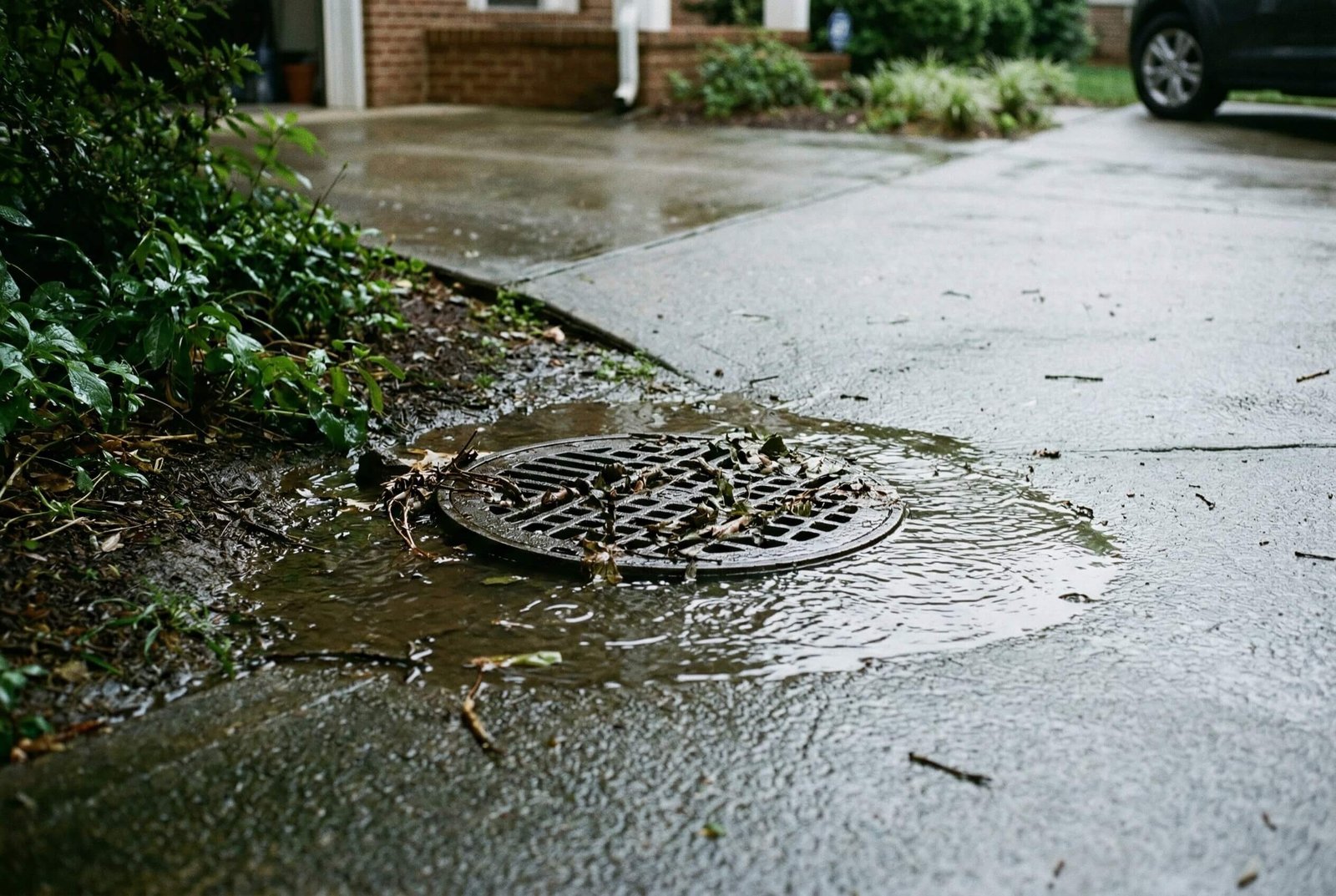
Outdoor drain overflow after heavy rain is one of those situations that often looks harmless at first—but in real homes, it can turn into a serious drain emergency faster than most homeowners expect. What begins as a little pooling water near a yard drain or driveway grate can quickly build pressure in the drainage system, especially when the ground is already saturated. Once that pressure has nowhere to go, water starts backing up, spreading outward, and in many cases, moving toward the home.
The real risk is not just the visible water. It is what that water represents. When an outdoor drain stops handling rainwater properly, it often means there is a restriction somewhere in the line. That restriction may be debris at the surface, but in many cases, it is deeper—roots, sludge buildup, or even partial pipe collapse. As rain continues, the system gets overwhelmed, and the overflow becomes more aggressive. This is when water can start finding unintended paths, including into basements, garages, or through foundation-level openings.
Quick decisions matter in this type of emergency. Acting too slowly allows water to spread and soak into areas that are difficult and expensive to dry later. Acting incorrectly—such as forcing debris into the drain or ignoring early warning signs—can actually make the blockage worse. The goal is not to panic or try to “fix everything” immediately. The goal is to understand what is happening, reduce the pressure on the system, and control where the water goes.
The most important thing to remember is that outdoor drain overflow is a containment problem first, and a repair problem second. If you can slow down the spread of water and keep it away from your home, you buy yourself time. That time is what prevents a manageable situation from turning into indoor flooding or a full sewer drain emergency.
What This Page Covers
ToggleWhat Counts as a Drain Emergency in Outdoor Drain Overflow
When outdoor drains overflow after heavy rain, not every situation is immediately a drain emergency. Some cases are simply the system struggling to keep up with volume. Others signal a deeper failure that needs urgent attention. The key is knowing the difference early, because the response changes depending on what you’re dealing with.
When overflow is just surface water vs a true drain emergency
During heavy rainfall, it’s normal for some water to temporarily collect around outdoor drains, especially if rain intensity exceeds drainage speed. If the water level rises slightly but continues to move down over time, even slowly, the system is still functioning. This is a capacity issue, not necessarily a blockage.
A true emergency begins when water stops draining altogether or starts rising instead of falling. That shift—from slow movement to no movement—is critical. It usually means the drain is no longer handling water, either due to a blockage or because the downstream system is overwhelmed. At that point, the situation is no longer about “waiting it out.”
When outdoor overflow becomes dangerous
Outdoor overflow becomes a real concern when water begins moving toward areas it shouldn’t reach. In real homes, the biggest red flags are not the drain itself, but where the water is going.
You are dealing with a drain emergency when:
- Water is flowing toward your home’s foundation, walls, or entry points
- Water begins entering garages, basements, or lower-level rooms
- The overflow water looks dirty, cloudy, or carries a sewage smell
- Multiple drains (outdoor and indoor) start reacting together
These signs indicate that the problem is no longer isolated. The system is either blocked deeper in the line or backing up under pressure.
Why rain-related drain emergencies escalate quickly
Heavy rain changes how drainage systems behave. Under normal conditions, drains move water at a steady pace. But during storms, three things happen at once: the soil becomes saturated, debris gets pushed into drains, and the overall system—sometimes even the municipal line—gets overloaded.
When soil is saturated, it cannot absorb additional water, so everything depends on drainage lines. At the same time, rain carries leaves, mud, and debris directly into outdoor drains, increasing the chance of blockage. If the main line or city system is already near capacity, water has nowhere to go and begins reversing direction.
This is why outdoor drain overflow can go from “a little pooling” to “water spreading across the yard” in a short time. It is not just about how much rain is falling—it is about how much pressure the system is under and whether it can still move water away.
Understanding this distinction early helps you avoid one of the most common mistakes homeowners make: assuming the problem will resolve once the rain stops. In many cases, if the drain has already stopped functioning properly, the overflow will continue—or even worsen—until the underlying issue is addressed.
Most Common Outdoor Drain Overflow Situations After Heavy Rain
When outdoor drain overflow turns into a drain emergency, it usually follows a few predictable patterns. The location of the overflow and how the water behaves tells you a lot about what’s actually going wrong inside the system. In real homes, these situations are rarely random—they’re tied to how water flows across your property and how your drainage system handles pressure.
Yard drain or catch basin overflowing
This is one of the most common scenarios after heavy rain. Water collects in low areas of the yard and is supposed to move into a catch basin or yard drain. When that drain gets clogged—usually with leaves, mud, or organic debris—the water has nowhere to go and begins pooling around it.
At first, it may look like the drain is just “slow,” but if the water level continues rising and spreads outward, that’s a sign the system is no longer functioning. In many cases, the blockage starts at the surface but can also extend a few feet into the pipe where debris has compacted under pressure. If left unchecked, this kind of overflow can start moving toward the home, especially if the yard slopes in that direction.
Driveway or patio drain flooding
Driveways and patios are designed to direct water toward linear or point drains. During heavy rain, these areas collect large volumes of fast-moving water. If the drain cannot keep up—either due to partial blockage or poor slope—water begins to accumulate quickly.
The danger here is speed. Unlike yard pooling, driveway flooding can build up in minutes and start pushing water toward garages or entryways. If water begins reaching thresholds or door seals, it can enter the home even without a complete blockage. In many real cases, this type of overflow is caused by a combination of debris buildup and design limitations in how the water is channeled.
Storm drain backing up near the property
Sometimes the issue is not inside your property at all. During intense rainfall, municipal storm systems can become overloaded. When that happens, water can back up through nearby outdoor drains or even street-level storm grates.
This type of overflow often looks more aggressive—water may surge upward or carry debris with it. The key difference is that clearing your own drain may not resolve the issue because the pressure is coming from downstream. If you notice water pushing upward rather than simply failing to drain, it’s often a sign of system-wide overload rather than a local clog.
Outdoor drain causing indoor backup
One of the more serious situations is when outdoor overflow starts affecting indoor plumbing. This happens when water pressure builds in the main line and begins pushing back into the house.
You might notice water appearing in basement floor drains, or toilets and tubs reacting after heavy rain. In these cases, the outdoor overflow is just one symptom of a larger drain backup emergency. The system is no longer moving water away from the home—it’s reversing direction under pressure. This is where the situation shifts from inconvenience to urgent risk.
Standing dirty water that does not recede
After rain slows down, water should begin draining away within a reasonable time. If you’re left with standing water that stays in place, especially if it looks murky or smells unpleasant, that’s a strong indicator of a deeper blockage.
This type of situation often points to issues further down the line—grease buildup, root intrusion, or pipe damage. The important detail is persistence. If water remains long after rainfall decreases, the drain is not recovering, and the problem will likely repeat or worsen in the next storm.
Each of these situations reflects a different stage or type of drain emergency, but they all share one common factor: the system is no longer controlling water effectively. Recognizing which pattern you’re seeing helps you decide whether you’re dealing with a surface issue you can manage temporarily, or a deeper problem that requires immediate escalation.
Warning Signs That Outdoor Drain Overflow Is Becoming an Emergency
Most serious drain emergencies don’t start suddenly—they build up through warning signs that are easy to overlook, especially during heavy rain. The challenge is that these signs often appear before visible flooding begins. If you recognize them early, you can act before the situation turns into uncontrolled overflow or indoor damage.
Early warning signals before visible flooding
In many homes, the first signs show up quietly. You may notice that water around outdoor drains is taking longer than usual to disappear during light or moderate rain. At this stage, the system is still working, but not efficiently. Something is starting to restrict flow.
You might also hear subtle gurgling sounds from nearby indoor fixtures like sinks or toilets when water is draining outside. This happens when air is being displaced unevenly in the drainage system, often due to partial blockage. Another early sign is small amounts of water collecting around drain openings instead of flowing directly in. These are early indicators that the system is under stress.
Escalating warning signs
As conditions worsen, the signs become more visible and harder to ignore. Water may begin to rise around the drain instead of draining away. You may see debris bubbling up from the drain opening, which indicates pressure building below the surface.
At this stage, the water often looks dirtier than normal rainwater. Mud, organic matter, or even foul-smelling water may appear. This suggests that the system is not just slow—it is struggling to push water through a partially blocked line. The longer this continues, the more likely the blockage becomes compacted and difficult to clear.
Critical emergency indicators
Once certain signs appear, the situation should be treated as a true drain emergency. These are the moments where delaying action can lead to property damage or contamination risks.
You are now in an emergency scenario if you notice:
- Water entering the home through doors, vents, or foundation-level openings
- Multiple drains reacting at the same time (for example, outdoor overflow combined with indoor gurgling or backup)
- Continuous overflow even after rainfall begins to slow down
- Strong sewage-like odor around the overflow area
These indicators mean the system is no longer just overwhelmed—it is failing to move water in the correct direction.
Understanding these stages helps you shift your mindset from “wait and watch” to “act and contain” at the right time. Many homeowners wait too long because they expect the situation to resolve once the rain stops. In reality, once these warning signs appear, the problem often continues until the blockage or pressure issue is addressed directly.
How to Assess Severity: Is This a Minor Issue or a Drain Emergency?
When outdoor drains overflow after heavy rain, the most important decision you make is not how to fix it—it’s how serious the situation actually is. Misjudging severity is what causes most damage. If you assume it’s minor when it’s not, water spreads and enters the home. If you assume it’s severe when it’s not, you may take unnecessary or risky actions.
The goal here is to quickly read the situation like a plumber would: by observing behavior, not just appearance.
Signs of a manageable outdoor drainage issue
Some overflow situations look dramatic but are still within normal limits of a stressed system. In these cases, the drain is working, just slower than the rain intensity.
You are likely dealing with a manageable situation if:
- Water is pooling but gradually lowering over time
- Only one outdoor drain is affected
- There is no impact on indoor plumbing
- The water appears relatively clean (typical rainwater with minor debris)
In real-world terms, this means the system still has flow. It may be partially restricted or temporarily overwhelmed, but it hasn’t failed. Your focus here should be monitoring and light surface clearing, not aggressive intervention.
Signs of a true drain emergency situation
A drain emergency begins when the system stops recovering and starts losing control of water movement. This is where damage risk increases quickly.
You are dealing with a true emergency if:
- Water levels are rising instead of falling
- Overflow is spreading toward your home or structure
- Multiple drains (indoor or outdoor) are reacting together
- Water looks dirty, contaminated, or has a sewage smell
At this point, the system is no longer draining—it is backing up or blocked under pressure. Waiting for rain to stop will not solve the issue because the restriction remains.
Real-world decision checkpoints
Instead of guessing, you can assess severity using three simple checkpoints that plumbers rely on in the field:
- Time factor
Watch how the water behaves over 10–15 minutes. If levels are slowly dropping, the system is coping. If levels are stable or rising, it’s failing. - Spread factor
Look at where the water is going. If it stays contained near the drain, risk is lower. If it starts moving toward your home, garage, or foundation, urgency increases immediately. - Contamination factor
Clean rainwater behaves differently from contaminated backup. If the water is murky, smells bad, or carries debris from inside the system, treat it as a higher-risk situation with possible sewer involvement.
This kind of assessment keeps you grounded during a stressful moment. You’re not reacting emotionally—you’re reading the system. Once you understand whether you’re dealing with a manageable overflow or a true drain emergency, your next actions become much clearer and much safer.
What to Do Immediately During Outdoor Drain Overflow
When you’re in the middle of an outdoor drain overflow, the priority is not to “fix the drain.” The priority is to control the movement of water. In real emergency situations, the difference between minor inconvenience and serious property damage comes down to how quickly you redirect and contain water in the first few minutes.
The mistake many homeowners make is focusing too much on the drain itself, instead of the direction and spread of water. You need to think in terms of flow control—where the water is going, and how to keep it away from your home.
Step-by-step emergency response to reduce damage
Follow this sequence in order. Each step is designed to stabilize the situation before it worsens.
- Stop additional water from contributing to the problem
If possible, redirect any controllable water sources away from the affected area. This could include temporarily blocking runoff paths or diverting downspouts if they feed directly into the overflowing drain. The goal is to reduce pressure on the system. - Clear visible debris from the drain surface
Look at the drain opening and remove leaves, mud, or debris sitting on top of the grate. This is one of the few safe and effective actions you can take immediately. Do not dig deep or force anything into the pipe—just remove what is clearly visible and loose. - Create temporary drainage paths away from the home
If water is pooling and spreading, use simple methods to guide it elsewhere. This might mean using a shovel to create a shallow channel in soil, or repositioning objects to direct flow away from foundations, doors, or low entry points. - Protect vulnerable entry points
Focus on areas where water can enter the home—garage doors, basement vents, door thresholds, or low windows. Use towels, barriers, or any available material to slow or block water from crossing those points. - Monitor water level changes continuously
After taking action, don’t walk away. Watch how the water behaves over the next several minutes. If levels begin to drop, your actions are helping. If water continues rising or spreading, you’re likely dealing with a deeper blockage or system overload.
If water is approaching your home
This is where urgency increases. Once water gets close to the structure, your focus shifts fully to protection, not drainage.
Prioritize stopping water from entering. Even small amounts of water entering a home can lead to long-term issues like hidden moisture damage or mold. Move any nearby items away from the risk area, and reinforce barriers as needed. At this stage, even slowing the water down can make a meaningful difference.
If overflow continues despite surface clearing
If you’ve cleared visible debris and the situation does not improve, it’s a strong indication that the problem is not at the surface. The blockage is likely deeper in the line, or the system is overwhelmed beyond its capacity.
This is the point where you stop trying to “fix” the drain and start preparing for escalation. Continue managing water flow and protecting your property, but recognize that further improvement will likely require professional intervention.
Handling this stage correctly is what prevents an outdoor overflow from turning into an indoor drain backup emergency. You’re buying time, reducing damage, and keeping control of the situation until a proper solution can be applied.
Safe Emergency Actions Homeowners Can Take
Once you’ve stabilized the situation and slowed the spread of water, the next step is taking controlled, low-risk actions that actually help. This is where many homeowners either do too little—or try to do too much. The key is to stay within actions that reduce pressure and manage water, without interfering with the drainage system in a way that could make things worse.
Containment strategies that actually help
At this stage, your goal is to control where the water goes, not force it through the drain. Simple containment methods are often the most effective during a drain emergency.
You can use temporary barriers like sandbags, bricks, or even tightly packed soil to redirect water away from your home. The idea is not to block water completely, but to guide it toward safer areas where it can spread without causing damage. Even small changes in direction can prevent water from reaching critical entry points.
If water is flowing across a surface like a driveway or patio, adjusting its path slightly can reduce buildup near the drain and lower the risk of overflow spreading.
Surface-level clearing only
Clearing debris is helpful—but only at the surface. Remove anything sitting on or directly over the drain opening, such as leaves, twigs, mud, or trash. This can restore partial flow and relieve pressure in the system.
What you should avoid is trying to reach into the drain or push debris further down. In real situations, forcing material deeper often compacts the blockage and makes it harder to clear later. If the water does not improve after basic surface clearing, the issue is likely beyond what can be safely handled at this level.
Protective measures during response
Outdoor drain overflow water is not always clean. It can carry bacteria, chemicals, and debris, especially if the system is backing up from deeper lines. Protecting yourself is part of managing the emergency.
Wear gloves if you have them, and use waterproof footwear to avoid direct contact with standing water. Avoid touching your face during cleanup, and wash thoroughly afterward. These precautions may seem minor, but they matter—especially if contamination is present.
Monitoring and controlling spread
Even after taking action, your job isn’t done. Drain emergencies evolve quickly, and conditions can change as rain intensity shifts or blockages shift within the line.
Keep watching how the water moves. If your redirection efforts are working, you’ll see water spreading away from the home and reducing around the drain. If not, adjust your approach—create new flow paths, reinforce barriers, or move protection to more critical areas.
The goal is continuous control, not a one-time fix.
Safe emergency actions are about staying effective without taking unnecessary risks. You’re helping the system where you can, but more importantly, you’re preventing the situation from escalating while staying within what’s actually safe for a homeowner to handle.
Actions to Avoid During Outdoor Drain Overflow
In a drain emergency, what you don’t do is just as important as what you do. Many situations become worse not because of the original blockage, but because of well-intentioned actions that increase pressure, spread contamination, or damage the system further. Staying disciplined during this stage protects both your home and the plumbing itself.
Common mistakes that make the situation worse
When water is overflowing, the instinct is often to “help it drain faster.” But certain actions actually push the system in the wrong direction.
Avoid these common mistakes:
- Running additional water (hoses, taps, or flushing) to test if the drain clears
- Pushing debris into the drain opening to “force” it through
- Ignoring overflow assuming it will resolve after the rain stops
Adding more water increases pressure on an already struggling system. Pushing debris deeper often compacts the blockage instead of clearing it. And waiting too long allows water to spread into areas that are harder to protect later.
Dangerous actions during flooding
Some actions are not just ineffective—they are unsafe.
Do not enter deep or fast-moving standing water without knowing what’s underneath. Outdoor overflow water can hide sharp objects, uneven surfaces, or open drain covers. There’s also a real risk of contamination if the system is backing up from deeper lines.
Avoid removing drain covers or opening pipes during active overflow. When water is under pressure, opening the system can release sudden surges, making the situation harder to control and potentially causing injury.
Misjudging the problem
One of the most costly mistakes is treating a deeper drainage issue like a simple surface clog. If you assume it’s minor and keep interacting with the drain aggressively, you can make a main-line problem worse.
Another critical mistake is continuing to use indoor plumbing when outdoor overflow is present. If the issue is connected to the main line, using sinks, toilets, or washing machines adds more water into a system that is already failing. This can trigger indoor backup—turning an outdoor drain overflow into a full sewer drain emergency inside the home.
Avoiding these actions keeps the situation from escalating unnecessarily. During a drain emergency, restraint is a form of control. You’re protecting the system from added stress while focusing on containment and safety.
How to Tell If the Problem Is Surface-Level or Main-Line Related
One of the most important judgments you can make during an outdoor drain overflow is whether the problem is happening at the surface—or deeper in the main drainage line. This distinction changes everything. A surface issue might be manageable for now. A main-line issue is where true drain emergencies begin.
The challenge is that both can look similar at first. Water is overflowing, pooling, and not draining properly. But if you pay attention to patterns—not just the overflow—you can usually identify where the problem is coming from.
Surface-level blockage indicators
Surface-level problems are typically caused by debris collecting at or just below the drain opening. These are common after heavy rain, especially in yards, patios, and driveways where leaves and dirt are easily washed into drains.
You are likely dealing with a surface-level issue if:
- Water begins to drain after you remove visible debris
- The overflow is limited to one specific drain
- There are no unusual reactions from indoor plumbing
- The problem appears suddenly during rain but improves shortly after
In real situations, this means the pipe itself is still clear. The restriction is local and shallow. Once the immediate obstruction is removed, the system starts recovering, even if slowly.
Main-line or system-level blockage indicators
Main-line problems behave differently. The system is not just slow—it is unable to move water away from your property. This is where pressure builds and water starts backing up.
You are likely dealing with a main-line issue if:
- Multiple drains are affected at the same time (outdoor and indoor)
- Water continues overflowing even after clearing the surface
- Water appears in places it shouldn’t, like basement drains or tubs
- Overflow water looks dirty, carries debris from inside the system, or smells like sewage
In these cases, the issue is deeper—often several feet or more into the drainage system. It could be caused by root intrusion, grease buildup, collapsed piping, or even a blockage in the municipal connection.
Patterns that signal deeper issues
Beyond the immediate situation, patterns over time often reveal the real cause. Plumbers rely heavily on these patterns to diagnose problems quickly.
If you’ve noticed any of the following, it strongly suggests a deeper issue:
- Overflow happens repeatedly during heavy rain events
- Drains are slow even during normal conditions
- The same area floods every time it rains heavily
- Previous temporary fixes didn’t last
These patterns indicate that the system has an underlying weakness or restriction that hasn’t been properly resolved.
Understanding whether the problem is surface-level or main-line related helps you avoid wasted effort and risky actions. If it’s surface-level, your focus stays on clearing and monitoring. If it’s main-line related, your priority shifts to containment and preparing for professional intervention.
Making that distinction early is what keeps a drain overflow from turning into a much larger and more damaging emergency.
When DIY Is No Longer Safe or Effective
There’s a point in every drain emergency where continuing to handle it yourself stops helping—and starts increasing risk. Knowing where that line is matters. Most homeowners don’t cause damage because they act too quickly, but because they continue trying to fix something that has already moved beyond what’s safe to handle.
In outdoor drain overflow situations, this transition can happen quietly. The water is still outside, so it feels manageable. But once certain conditions appear, the issue is no longer about surface control—it’s about system failure underneath.
Situations where homeowner action should stop
You should step back from DIY intervention when the situation shows signs of escalation beyond surface-level control.
Stop DIY efforts if:
- Water is entering the home through doors, vents, or foundation-level openings
- The overflow does not improve after clearing visible debris
- Multiple drains are reacting together (outdoor overflow plus indoor symptoms)
- The water appears contaminated or has a sewage odor
These are all indicators that the problem is deeper in the system. At this stage, additional attempts to clear or manipulate the drain are unlikely to solve the issue and may make it worse.
High-risk conditions that require caution
Some scenarios carry higher risk not just to your home, but to your safety.
If you suspect root intrusion, pipe collapse, or a blockage deep in the line, avoid any aggressive intervention. These situations require specialized tools and controlled techniques. Trying to force a solution—whether by pushing tools into the drain or applying pressure—can damage pipes or worsen the blockage.
Repeated flooding events are another warning sign. If the same overflow has happened more than once, the system already has an unresolved issue. Temporary fixes in these cases don’t address the root cause and often lead to more severe emergencies later.
Why delaying professional help increases damage
One of the most costly decisions homeowners make is waiting too long to escalate. It’s easy to assume that once the rain stops, the problem will settle. But if the drainage system has already failed under pressure, the damage is often just beginning.
Water that lingers near the foundation can seep into structural areas you can’t see. Moisture trapped in soil or around walls increases the risk of long-term damage, including weakening of materials and mold growth. What could have been a straightforward drain clearing can turn into structural repair if left unresolved.
Recognizing when to stop is not giving up—it’s making a smart decision based on how drainage systems actually behave. At this point, your role shifts from trying to fix the problem to protecting your home and preparing for proper resolution.
What a Plumber Usually Does in This Type of Drain Emergency
When a professional arrives for an outdoor drain overflow after heavy rain, their approach is very different from typical DIY attempts. They are not just trying to “clear water”—they are diagnosing why the system failed under pressure and making sure it doesn’t happen again the next time it rains.
Understanding what a plumber actually does helps you set realistic expectations and recognize why certain problems cannot be solved from the surface.
Emergency diagnosis process
The first step is always identifying where the blockage or restriction exists. A plumber will look at patterns—where the overflow occurred, whether indoor fixtures were affected, and how the system behaved during the rain.
They may check multiple access points, including outdoor drains, cleanouts, or basement connections. The goal is to determine whether the issue is localized near the drain or deeper in the main line. In many real cases, outdoor overflow is only a symptom of a larger problem further down the system.
They also assess whether the issue was caused by temporary debris buildup or something structural, such as root intrusion or pipe damage. This distinction is critical because it determines whether a simple clearing will solve the issue or if further work is required.
Tools and methods used
Once the problem area is identified, the plumber selects the right method based on the type and severity of the blockage.
For basic obstructions, they may use a drain snake (auger) to break through and restore flow. This works well for compacted debris, minor root intrusion, or sludge buildup within the line.
If the issue appears deeper or more complex, a camera inspection is often used. This allows them to see inside the pipe and confirm whether the problem is grease buildup, roots, a foreign object, or structural damage like a cracked or collapsed section.
In more severe cases, especially where heavy debris or buildup is involved, hydro jetting may be used. This process uses high-pressure water to fully clear the inside of the pipe, not just punch a hole through the blockage. It is especially effective when repeated overflows have left residue lining the pipe walls.
Restoring proper drainage flow
Clearing the blockage is only part of the job. A good plumber will also verify that the system can handle normal water flow again. This often involves testing the line after clearing to ensure water moves freely and does not back up under load.
They may also point out risk factors that contributed to the problem—such as improper slope, recurring debris entry, or signs of aging pipes. In cases where the issue is likely to repeat, they may recommend follow-up actions like periodic maintenance or further inspection.
What matters most is that a professional approach focuses on both restoring flow and preventing recurrence. Outdoor drain overflow during heavy rain is rarely just a one-time event. It’s usually a signal that something in the system needs attention before the next storm puts it under pressure again.
Emergency Health and Safety Risks Homeowners Should Understand
When dealing with an outdoor drain overflow, most homeowners focus on water damage—but the hidden risks are often just as important. In real drain emergencies, the danger isn’t only where the water goes. It’s what that water contains, what it touches, and how long it stays.
Understanding these risks helps you make better decisions during the situation, especially when choosing what actions are safe and what areas to avoid.
Contamination risks
Not all overflow water is clean rainwater. Once a drainage system becomes overwhelmed or blocked, water can mix with contaminants from inside the pipes. This can include bacteria, organic waste, and debris that has been sitting in the system.
If the overflow has a foul smell, looks murky, or carries visible debris, you should assume contamination is present. Direct contact with this water can expose you to harmful microorganisms, especially if you have cuts or are handling debris without protection.
This is why even simple actions—like clearing a drain or moving items out of the way—should be done carefully. Avoid direct contact whenever possible, and treat the water as potentially unsafe until proven otherwise.
Physical hazards
Overflow situations create unstable and unpredictable conditions. Surfaces that are normally safe—like patios, driveways, or lawns—can become slippery and uneven when covered with water and debris.
There is also the risk of hidden objects beneath standing water. Sharp debris, displaced drain covers, or uneven ground can cause injury if you step into water without visibility. In some cases, fast-moving water across hard surfaces can also create enough force to affect footing, especially on slopes.
The key is to move carefully and deliberately. Never assume the ground beneath standing water is stable.
Structural and long-term risks
One of the most underestimated dangers of outdoor drain overflow is what happens after the visible water is gone. Water that pools near a home can seep into the ground and reach the foundation. Over time, repeated exposure weakens structural integrity and can lead to cracks or shifting.
If water enters enclosed spaces like basements or garages, even in small amounts, it creates conditions for mold growth and long-term moisture damage. These problems often develop slowly and are not immediately visible, which is why they are frequently ignored until they become expensive to fix.
Another important risk is electrical exposure. If water reaches areas with wiring, outlets, or utility equipment—especially in lower levels—it creates a serious hazard. In these cases, avoiding contact and keeping distance becomes more important than trying to manage the water directly.
Drain emergencies are not just about inconvenience—they involve real safety considerations. By understanding these risks, you can respond more carefully, avoid unnecessary exposure, and focus on actions that protect both your home and your health.
Drain Emergency Tools and Supplies Worth Keeping at Home
Outdoor drain overflow is one of those problems where preparation makes a noticeable difference. When heavy rain hits, you don’t have time to gather tools or figure out what you need. Having a small set of basic supplies ready allows you to respond quickly, stay safe, and control the situation before it spreads.
The goal is not to build a professional toolkit. It’s to have practical items that help you manage water flow, protect yourself, and stabilize the situation during a drain emergency.
Basic emergency readiness kit
Every homeowner should have a few simple items that can be used immediately during overflow conditions. These are not specialized tools—they are practical, easy-to-store essentials that support quick response.
A pair of durable gloves is important for handling debris and avoiding direct contact with contaminated water. Waterproof boots or footwear help you move safely through wet areas without exposing your skin. A flashlight becomes useful during storms or low visibility, especially when inspecting drains or water movement.
Buckets and old towels may seem basic, but they are extremely useful for small-scale containment, especially near entry points like garage thresholds or basement access areas. These items help slow water movement and reduce spread in critical moments.
Outdoor-specific tools for quick response
For outdoor drain situations, a few additional items can make your response more effective. A simple drain grate cleaning tool—or even a sturdy stick or hand tool—can help you remove surface debris safely without reaching directly into the drain.
Sandbags or temporary water barriers are especially useful when water starts moving toward your home. They don’t need to be permanent solutions—just enough to redirect flow and reduce pressure on vulnerable areas.
If your property regularly experiences heavy rain, keeping these items accessible—not stored away in difficult-to-reach areas—can save valuable time during an emergency.
Why preparation matters more than equipment
In real drain emergencies, speed and clarity matter more than having advanced tools. Most homeowners don’t need complex equipment—they need the ability to act quickly and safely with what they have.
Preparation reduces hesitation. When you already know where your gloves, barriers, and basic tools are, you can focus on controlling the situation instead of searching for supplies. This alone can prevent water from reaching areas where damage becomes more difficult to manage.
Having the right tools is not about fixing the problem—it’s about buying time and reducing impact. In outdoor drain overflow situations, that time is often what separates a controlled response from a costly emergency.
Cost of Outdoor Drain Emergency Service in the U.S.
When an outdoor drain overflow turns into a drain emergency, one of the first questions homeowners have is cost. The answer depends heavily on how severe the situation is and how quickly it’s addressed. In real-world cases, the difference between early intervention and delayed action can significantly change the total expense.
Understanding how pricing works helps you make better decisions in the moment, especially when deciding whether to wait or call for help immediately.
Typical service cost breakdown
Emergency drain service is usually priced differently from standard scheduled work. When you call during or immediately after heavy rain, you are often paying for urgency, availability, and rapid response.
A basic service visit for a clogged outdoor drain may fall in the lower range if the issue is near the surface and can be cleared quickly. However, if the blockage is deeper in the line, costs increase due to the equipment and time required.
More advanced work—such as camera inspection to locate the problem or hydro jetting to fully clear buildup—adds to the total. These are not always required, but in many drain overflow emergencies, they become necessary to properly diagnose and resolve the issue.
Factors that affect pricing
Several real-world factors influence how much you’ll pay:
- Timing: After-hours calls, weekends, or storm-related emergencies typically cost more
- Severity: Surface clogs are cheaper than deep main-line blockages
- Equipment used: Basic snaking vs camera inspection or hydro jetting
- Accessibility: Hard-to-reach drains or buried lines increase labor time
- Recurring issues: Problems that require deeper investigation or repeat visits
In many cases, what looks like a simple outdoor overflow may actually involve the main line, which increases both complexity and cost.
Why delaying can increase total repair cost
It’s common for homeowners to wait, hoping the situation will resolve once the rain stops. But if the overflow is caused by a blockage, the problem doesn’t disappear—it remains in the system.
Water that continues to pool near the home can lead to foundation moisture issues, while repeated overflows weaken the system over time. What might have been resolved with a single service call can turn into multiple visits or even structural repair if ignored.
From a practical standpoint, early intervention is often less expensive—not because emergency service is cheap, but because it prevents larger and more complex damage from developing.
Drain emergency costs are not just about the service itself—they reflect the condition of the system and how far the problem has progressed. Acting at the right time helps you control both the situation and the long-term expense.
What to Do After the Overflow Is Controlled
Once the water has stopped rising and the immediate pressure on the system is reduced, it’s easy to feel like the problem is over. In reality, this stage is just as important as the emergency response. What you do after the overflow determines whether the issue stays resolved or returns during the next heavy rain.
The focus now shifts from control to recovery, inspection, and prevention.
Immediate cleanup and sanitation
Start by removing any remaining standing water and debris from the affected area. Even if the water looks like rainwater, it may contain contaminants from the drainage system. Clearing out mud, leaves, and residue helps prevent lingering odors and reduces the chance of bacteria buildup.
If water reached areas near the home, such as garage edges or entry points, dry those areas thoroughly. Moisture left behind can seep into materials over time, leading to damage that isn’t immediately visible. Proper drying is just as important as removing the water itself.
Post-event inspection
After cleanup, take time to observe how the drain behaves under normal conditions. This is where you begin identifying the real cause of the overflow.
Check whether the drain appears clear at the surface and whether water flows normally when tested lightly (not aggressively). Look for signs of recurring restriction, such as slow drainage or leftover debris that suggests buildup inside the line.
Also consider what happened during the overflow. Did water spread quickly? Did multiple drains react? These details help determine whether the issue was surface-level or part of a deeper system problem.
Monitoring for recurring symptoms
Drain emergencies rarely happen without warning signs beforehand—and they often leave signs afterward as well. Over the next few days or weeks, pay attention to how your drainage system behaves.
If you notice slow drainage during normal use, minor pooling during light rain, or repeated buildup around the same drain, it’s a sign that the issue has not been fully resolved. These patterns often indicate a partial blockage that will worsen over time.
Identifying the likely cause
Based on what you observed, try to narrow down the cause. If clearing surface debris improved the situation significantly, the issue may have been localized. If the overflow persisted despite clearing, the blockage is likely deeper.
Recurring issues after heavy rain often point to root intrusion, sediment buildup, or limitations in the drainage system’s capacity. Understanding the likely cause helps you decide whether simple maintenance is enough or if further inspection is needed.
Deciding whether follow-up inspection is needed
If the situation felt severe, involved multiple drains, or showed signs of deeper blockage, it’s worth considering a professional inspection—even if things appear normal afterward.
A camera inspection, for example, can confirm whether there is buildup or structural damage inside the pipe. Addressing these issues early prevents repeated emergencies and reduces long-term repair costs.
Creating a prevention plan
Finally, use this experience to prepare for the next heavy rain event. Identify what worked during your response and what could be improved. Keep necessary tools accessible, and make sure you know which areas of your property are most vulnerable.
Drain emergencies are rarely one-time events. They are usually signals that the system needs attention. Turning this into a learning moment helps you respond faster and more effectively in the future.
Handling the aftermath correctly ensures that the problem doesn’t quietly return. You’re not just cleaning up—you’re resetting your drainage system and reducing the chances of facing the same emergency again.
How to Reduce the Chance of Future Outdoor Drain Emergencies
Once you’ve experienced an outdoor drain overflow, the goal shifts from reacting to preventing. Most drain emergencies don’t happen without warning—they build over time through small, repeated issues that go unnoticed or unaddressed. Prevention is about catching those early signals and reducing the conditions that lead to system overload.
Maintenance habits that prevent overflow
Outdoor drains fail most often because of buildup, not sudden blockage. Leaves, dirt, and organic debris gradually collect at the surface and just inside the pipe. During heavy rain, that buildup gets pushed together and forms a compact obstruction.
Regularly clearing drain grates and the surrounding area reduces this risk significantly. This doesn’t require deep cleaning—just consistent attention. After storms, check for debris accumulation and remove it before it settles deeper into the system.
Also pay attention to how quickly water drains during normal conditions. If you notice that it’s slowing over time, even slightly, that’s an early warning sign. Addressing it early is far easier than dealing with a full drain emergency later.
Managing water flow around your property
Prevention is not just about the drain—it’s about how water moves across your property. Poor drainage patterns can overload even a properly functioning system.
Make sure water is directed toward drains, not toward your home. Check slopes in your yard, driveway, and patio areas. If water naturally collects near the foundation, even a small blockage can turn into a serious problem.
Downspouts should discharge water away from the home and not directly into already stressed drainage areas. During heavy rain, concentrated water flow can overwhelm a single drain point, even if it’s technically clear.
Watching for early warning signs
Drain emergencies almost always give advance signals. The key is recognizing them and acting before they escalate.
Watch for:
- Slow drainage during light or moderate rain
- Water collecting briefly around drains instead of flowing directly in
- Recurring debris buildup in the same location
- Minor gurgling sounds from nearby fixtures during heavy water flow
These signs indicate that the system is beginning to struggle. Addressing them early—through cleaning or inspection—prevents pressure from building during the next heavy rain.
Reducing the chance of future drain emergencies is not about doing more—it’s about paying attention to how your system behaves over time. Small, consistent actions and awareness of early warning signs are what keep a manageable system from turning into a recurring emergency.
Long-Term Emergency Prevention Strategy
Preventing outdoor drain emergencies is not just about occasional cleaning—it’s about understanding how your specific property behaves during heavy rain and building a simple system around that knowledge. Homes don’t all fail the same way. Each property has its own weak points, and once you identify them, prevention becomes much more effective.
Know which drains are most vulnerable
Every property has areas that take the most water load. It could be a yard drain in a low spot, a driveway channel that collects runoff, or a drain near a slope where water naturally flows.
Pay attention to where water accumulates first during rain. These are your high-risk zones. If a drain in that area slows down even slightly, it becomes the first point of failure under pressure.
Once you know which drains are most vulnerable, you can prioritize them for regular checks, especially before and after heavy rain. This targeted awareness is far more effective than treating all drains equally.
Keep basic emergency supplies ready
Preparation reduces response time, and response time is what limits damage. Keeping simple supplies accessible—gloves, barriers, basic tools—means you can act immediately when overflow begins.
The key is accessibility. These items should not be stored in a place that’s difficult to reach during a storm. When water is already spreading, every minute matters. Being able to respond without delay helps you control the situation before it escalates.
Learn your home’s warning signs
Every drainage system gives signals before it fails. Over time, your home will show consistent patterns—specific drains that slow down first, areas where water collects, or certain rainfall levels that trigger overflow.
These patterns are valuable. They allow you to predict when a situation is likely to become a drain emergency. Instead of reacting late, you can act early—clearing drains, adjusting flow paths, or preparing barriers before the problem fully develops.
Understand when recurring symptoms need attention
If the same issue happens repeatedly, it is no longer a surface problem. Recurring overflow during heavy rain is a strong indicator of a deeper issue, such as buildup inside the line, root intrusion, or structural limitations in the drainage system.
Ignoring repetition is one of the biggest mistakes homeowners make. Each event may seem manageable on its own, but over time, the underlying issue worsens and leads to more severe failures.
Recognizing patterns and acting on them—through inspection or maintenance—is what prevents recurring emergencies from becoming costly repairs.
Treat small warning signs seriously
Minor issues are often dismissed because they don’t cause immediate damage. Slow drainage, brief pooling, or occasional debris buildup may seem insignificant, but these are the early stages of system stress.
When heavy rain arrives, these small issues combine under pressure and create full overflow conditions. Addressing them early is what keeps your system stable when it matters most.
A long-term prevention strategy is about awareness and consistency, not complexity. When you understand how your drainage system behaves and respond to early signals, you shift from reacting to emergencies to preventing them altogether.
Final Thoughts
Outdoor drain overflow after heavy rain can feel chaotic in the moment, but it becomes manageable when you understand how the system behaves and what your role is during the situation. The goal is not to solve every problem immediately—it’s to make the right decisions in the right order.
Most drain emergencies follow a pattern. There are early warning signs, a point where the system starts to fail, and a stage where damage risk increases quickly. If you recognize those stages and respond early, you can prevent a large percentage of the damage that typically occurs during these events.
What matters most is staying focused on control, not reaction. When water begins to overflow, your first priority is always to manage where it goes and keep it away from your home. Simple actions taken early—clearing surface debris, redirecting flow, protecting entry points—are often more effective than aggressive attempts to “fix” the drain.
At the same time, knowing your limits is just as important. When signs point to a deeper blockage or system failure, stepping back and preparing for professional help protects both your property and your safety. Trying to push beyond what’s safe or effective is what often turns a manageable situation into a costly one.
Over time, the most valuable takeaway is awareness. Once you’ve experienced how your drainage system reacts to heavy rain, you can begin to predict and prevent future problems. Regular observation, basic maintenance, and a simple response plan make a significant difference.
Drain emergencies are not completely avoidable, but they are controllable. When handled early and correctly, they stay contained. And when they stay contained, they stay manageable.