
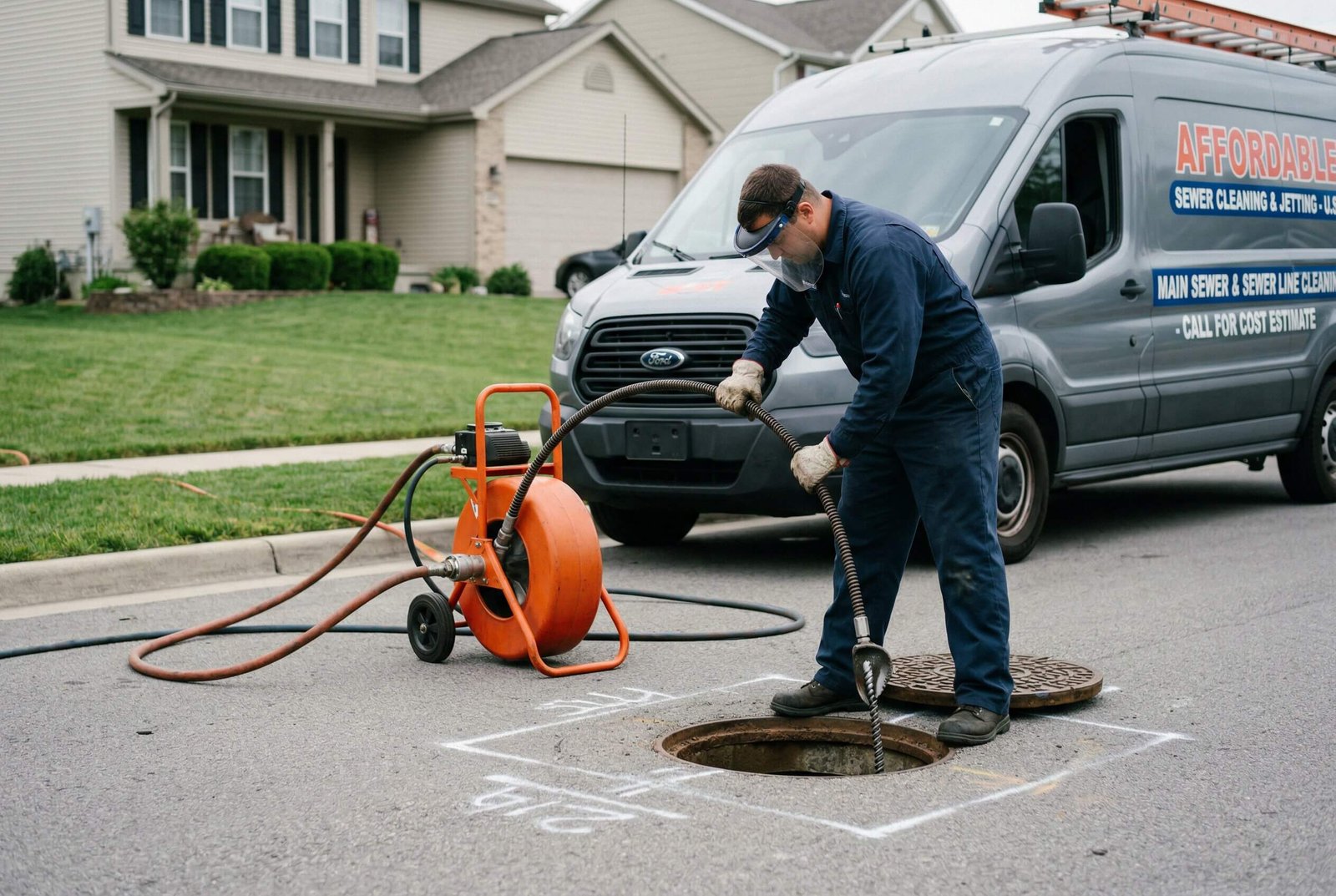
Main sewer line problems are very different from typical drain clogs, and that difference is what drives the cost.
When a kitchen sink or shower drain gets blocked, the issue is limited to one fixture. But when the main sewer line is involved, the entire home is affected. Every drain in the house depends on that single line to carry wastewater away. If it slows down or gets blocked, problems start appearing in multiple places at once.
From a plumber’s perspective, this is no longer a simple cleaning job. It becomes a system-level issue.
A sewer line clog is usually deeper in the plumbing system, often several feet away from any visible fixture. That means it takes more time to reach, more powerful equipment to clear, and more care to avoid damaging the pipe. In many cases, the plumber is working through a cleanout or accessing the line from outside the home, which adds another layer of complexity.
This is why sewer line cleaning costs are higher than standard drain cleaning. You are not just paying to remove a blockage—you are paying to restore the main pathway that every drain in your home relies on.
Another important difference is how these problems develop. Sewer line issues often build up over time. Grease, debris, or even tree roots can slowly restrict the pipe until it reaches a point where water can no longer pass freely. By the time symptoms become obvious, the blockage is usually more advanced.
That is why pricing varies so much. A minor main line slowdown caught early may still be manageable at a lower cost. But a fully blocked sewer line affecting multiple fixtures requires more work, more equipment, and more time, which increases the price.
Understanding this helps set realistic expectations. Sewer line cleaning is not priced like a simple drain service because the problem itself is not simple. Once you recognize that, it becomes much easier to understand why quotes vary and what you are actually paying for.
What This Page Covers
ToggleAverage Main Sewer Line Cleaning Cost in the U.S.
Main sewer line cleaning sits in a higher price category because the work involves deeper pipes, larger volumes of waste, and more complex access. Unlike a sink or shower drain, the main line is not immediately accessible and usually requires more time to reach and clear.
Most residential sewer line cleaning jobs fall within a broad but predictable range based on how severe the problem is.
Typical National Cost Range (Explained Properly)
- Minor main line blockage: $200 – $400
- Moderate blockage: $400 – $700
- Severe or recurring blockage: $700 – $1,200+
These ranges reflect how much work is required to restore proper flow through the main line.
A minor blockage usually means the line is partially restricted but still functioning. Water may drain slowly, but the system is not fully backed up. These jobs are often resolved with standard equipment and less time.
Costs move higher when the blockage is deeper, more compacted, or affecting multiple fixtures. In these cases, the plumber needs more time and may have to use stronger tools to break through the obstruction.
The highest costs are typically associated with severe or recurring issues. These situations often involve heavy buildup, tree roots, or long sections of the pipe being affected. The goal is not just to open the line, but to restore proper flow across the system.
What “Average Sewer Cleaning Cost” Actually Includes
When homeowners hear an “average” price, it usually refers to a standard main line cleaning service that includes:
- Initial assessment of the problem
- Accessing the sewer line through a cleanout
- Using a motorized auger to clear the blockage
- Verifying that water flow has been restored
This type of service typically falls in the $300 to $600 range, depending on how easily the blockage can be cleared.
However, this average assumes that the line is accessible and the clog can be removed without additional complications.
Why Sewer Line Costs Are Higher Than Regular Drains
Sewer line cleaning costs more because of the scale and difficulty of the work.
The pipes are larger and longer, which means more material to clear and more distance to cover. The blockage is often located farther from the entry point, requiring more time to reach.
There is also more risk involved. Clearing a main line improperly can cause backups inside the home or put stress on the pipe. This requires a more controlled approach, which adds to the time and cost.
In some cases, additional steps like inspecting the line or using stronger cleaning methods are necessary, which further increases pricing.
Real-World Baseline Expectation
A practical way to estimate your cost is to think in terms of severity and impact:
- If only one drain is slow and there are no backups elsewhere, the issue may still be early-stage and closer to the lower range
- If multiple fixtures are affected or water backs up in lower drains, the cost typically moves into the mid to higher range
- If the problem keeps returning or involves deeper obstructions, expect higher costs due to more advanced cleaning methods
Instead of focusing on a single number, it is more useful to understand where your situation falls within these levels. That gives you a more realistic expectation before you call a plumber.
Cost by Sewer Problem Type
The type of problem inside the main sewer line has a direct impact on cost. Unlike simple drain clogs, sewer line issues are often more complex and vary significantly based on what is causing the blockage.
A plumber does not price sewer cleaning based only on the location. The cause of the blockage—what is actually inside the pipe—plays a major role in how difficult the job will be.
Grease or Sludge Buildup in Main Line
Grease and sludge buildup is common in homes where kitchen waste gradually accumulates in the sewer line. Over time, this material sticks to the pipe walls and reduces flow.
- Typical cost: $300 – $700
This stays on the lower to mid-range when the buildup is still soft or partially restricting the pipe. A motorized auger can often break through the blockage and restore flow.
Costs increase when the buildup has hardened or spread across a longer section of the pipe. In these cases, simple snaking may not be enough, and more thorough cleaning may be required to fully remove the residue.
Tree Root Intrusion
Tree roots are one of the most common and expensive sewer line problems. Roots naturally grow toward moisture and can enter small cracks or joints in underground pipes.
- Typical cost: $500 – $1,200+
Once inside, roots expand and create dense blockages that are difficult to remove. Clearing them requires more powerful equipment and careful handling to avoid damaging the pipe.
Costs rise because removing roots is not just about clearing the blockage. It often involves cutting through tough material and ensuring the line is open enough to function properly again.
Recurring root problems can increase long-term costs because the issue may return if the pipe is not repaired or replaced.
Collapsed or Partially Blocked Sewer Line
In some cases, the issue is not just a clog but a structural problem within the pipe.
- Typical cleaning-related cost: $600 – $1,000+
If the pipe is partially collapsed or misaligned, debris can collect more easily, leading to repeated blockages. Cleaning may provide temporary relief, but it does not fix the underlying issue.
Costs increase because the plumber must work carefully in a compromised pipe. There may also be a need for inspection to confirm the condition of the line.
This is one situation where cleaning alone may not be a long-term solution, which is important for homeowners to understand before approving repeated service calls.
Multiple Fixture Backup Situations
When water backs up through multiple drains—such as toilets, showers, and sinks—it is usually a sign that the main sewer line is heavily blocked.
- Typical cost: $400 – $1,000+
These jobs are more complex because the blockage is affecting the entire system. The plumber must clear the line thoroughly to restore proper flow to all fixtures.
Costs increase due to:
- The severity of the blockage
- The need for more powerful equipment
- Additional time required to ensure the system is fully cleared
These situations often require more than a quick fix, especially if the problem has developed over time.
Scenario-Based Cost Breakdown
Looking at real-world situations helps clarify how pricing works:
- Early-stage main line slowdown: Usually stays in the $200 – $400 range if caught before full blockage
- Intermittent backups in one or two fixtures: Moves toward $400 – $700 due to deeper buildup
- Full system backup (multiple fixtures): Typically starts around $500 and increases based on severity
- Recurring sewer line issues: Often cost more over time because the root cause is not fully resolved
The key pattern is that sewer problems become more expensive as they spread and intensify. A minor restriction is easier to clear, but once the blockage affects the entire system or involves tougher materials like roots, the job becomes significantly more demanding.
Understanding the type of problem inside the sewer line gives you a clearer idea of why a certain price is being quoted—and whether it is reasonable.
Cost by Cleaning Method
The method used to clean a main sewer line has a major impact on cost. Unlike smaller drains, sewer lines often require heavier equipment and more deliberate work. The choice of method depends on how severe the blockage is and what is causing it.
A plumber does not select a method randomly. Each approach is chosen based on what will clear the line effectively without causing damage. That decision directly affects pricing.
Motorized Sewer Auger (Main Line Snaking)
This is the most common starting point for sewer line cleaning. A motorized auger feeds a strong cable deep into the pipe to break through blockages.
- Typical cost: $200 – $600
This stays in the lower range when the blockage is soft or moderate, such as grease buildup or debris that has not fully hardened. The auger can open a path through the clog and restore flow relatively quickly.
Costs increase when the blockage is more compacted or located farther down the line. The plumber may need more time to work through the obstruction, especially if the material keeps breaking apart instead of clearing cleanly.
Snaking is effective for restoring flow, but it may not fully clean the pipe walls. That means it solves the immediate issue but may not prevent future buildup if the line is heavily coated.
Hydro Jetting for Sewer Lines
Hydro jetting uses high-pressure water to clean the entire interior of the sewer pipe. Instead of just breaking through the blockage, it removes buildup along the pipe walls.
- Typical cost: $400 – $1,000+
This method is used when the blockage is severe, recurring, or spread across a longer section of the pipe. It is especially effective for grease, sludge, and root remnants.
The cost is higher because the process requires more setup, more time, and careful pressure control. Sewer pipes must be assessed before jetting to ensure they can handle the pressure safely.
While it costs more upfront, hydro jetting often provides a longer-lasting result because it restores the pipe closer to its original condition.
Camera Inspection for Sewer Lines
Camera inspection is often used alongside cleaning, especially when the cause of the blockage is unclear or the problem keeps returning.
- Typical cost: $150 – $400
A camera is inserted into the sewer line to locate the blockage and identify what is causing it. This helps determine whether the issue is grease, roots, a foreign object, or structural damage.
The added cost comes from the equipment and the time needed to perform the inspection. However, it can prevent unnecessary work by ensuring the correct method is used from the start.
In many cases, inspection helps avoid repeated service calls by identifying the root cause of the problem.
Method vs Cost Comparison
- Motorized auger: Lower cost, effective for breaking through blockages
- Hydro jetting: Higher cost, fully cleans pipe walls and handles severe buildup
- Camera inspection: Additional cost that improves accuracy and prevents guesswork
Why Method Affects Sewer Line Cost So Much
Sewer line cleaning is not just about clearing a blockage—it is about restoring a system that serves the entire home.
A basic auger may open the line quickly, but it does not always remove all buildup. Hydro jetting takes longer and costs more, but it cleans the pipe more thoroughly. Camera inspection adds precision, which can reduce unnecessary work.
This is why pricing changes depending on the method used. The more thorough and equipment-intensive the process, the higher the cost.
Understanding this helps you evaluate recommendations. A higher-cost method is not always unnecessary—it may be the more complete solution, especially for recurring or severe sewer line problems.
What Affects Main Sewer Line Cleaning Cost
Even within the same type of sewer problem, pricing can vary significantly. That is because sewer line work is highly dependent on conditions inside and around the pipe. A plumber is not just clearing a blockage—they are dealing with depth, access, risk, and system-wide impact.
Understanding these factors helps explain why one home may pay $300 while another pays $900 for what sounds like a similar issue.
Depth and Location of the Blockage
The deeper the blockage is in the sewer line, the more work it takes to reach and clear it.
If the clog is close to the cleanout or near the beginning of the main line, it can be accessed quickly. These jobs stay on the lower end because less cable length and less time are required.
If the blockage is farther down the line—especially toward the connection with the municipal sewer—it takes more effort. The plumber must feed more cable, work through longer distances, and spend more time locating and clearing the obstruction.
Deeper blockages almost always increase cost because they increase both time and difficulty.
Accessibility of the Sewer Line
Accessibility is one of the biggest hidden cost factors.
If your home has an accessible cleanout, the plumber can start working immediately. This keeps the job faster and more straightforward.
If there is no cleanout or access is limited, the job becomes more complicated. The plumber may need to access the line through a different point, which takes extra time and effort.
Outdoor access can also affect pricing. A buried or hard-to-reach cleanout increases setup time, which adds to the total cost.
Severity and Type of Obstruction
Not all sewer clogs behave the same way.
Soft blockages, such as grease or organic buildup, are easier to break through. These jobs require less effort and usually stay in the lower to mid-range.
Hard obstructions, like tree roots or compacted debris, are more difficult to remove. They require stronger equipment and more careful handling, which increases both time and cost.
Recurring blockages are another factor. If the same problem keeps coming back, it usually means the obstruction is not fully cleared or there is an underlying issue. This often leads to higher costs over time.
Time and Labor Required
Time is one of the most direct contributors to cost.
A sewer line that clears quickly will cost less because the plumber spends less time on the job.
If the blockage takes longer to remove—due to depth, resistance, or complexity—the cost increases accordingly. Sewer line jobs can sometimes take one to two hours or more, especially when the problem is severe.
Even when using similar tools, the time required can significantly change the final price.
Equipment Required
The type of equipment used reflects the difficulty of the job.
Basic augers are sufficient for many sewer blockages and keep costs lower.
More advanced equipment, such as hydro jetting machines or inspection cameras, adds to the cost because they require more setup, more expertise, and more careful operation.
The need for stronger or more specialized equipment is a clear indicator that the job is more complex.
Risk and Condition of the Pipe
Sewer line work often involves some level of risk, especially if the pipe is older or already damaged.
If the pipe is fragile, partially collapsed, or compromised, the plumber must proceed carefully to avoid making the situation worse. This slows down the work and may require additional steps, which increases cost.
In some cases, cleaning is only part of the solution, and further repairs may be needed. Understanding this upfront helps avoid unrealistic expectations.
Emergency vs Scheduled Service
Timing also affects sewer line cleaning costs.
A scheduled service during normal hours allows the plumber to plan the job efficiently, which keeps pricing more controlled.
An emergency call—especially during nights or weekends—adds cost because of urgency and availability. Sewer backups often require immediate attention, which increases the price compared to a planned visit.
Key Cost Drivers (Quick View)
- Deeper blockages require more time and effort
- Limited access increases labor and setup
- Hard obstructions need stronger equipment
- Longer jobs increase overall cost
- Fragile or damaged pipes require careful handling
- Emergency timing raises pricing due to urgency
When you understand these factors, a quote becomes easier to evaluate. Instead of focusing only on the number, you can see what is making the job more complex.
That understanding is what helps you recognize whether a sewer line cleaning cost is reasonable for your situation.
Emergency Sewer Line Cleaning vs Standard Pricing
Sewer line problems often turn into emergencies faster than most homeowners expect. Unlike a slow sink or shower drain, a main sewer issue can disrupt the entire home within a short period of time. When wastewater has nowhere to go, it starts backing up through the lowest points in the system, which can quickly lead to unsanitary conditions and potential property damage. This is why emergency sewer cleaning exists—and why it costs more than standard service.
What Qualifies as a Sewer Emergency
A sewer problem is considered an emergency when it goes beyond inconvenience and starts affecting the safety or usability of the home.
Common emergency situations include:
- Multiple fixtures backing up at the same time
- Water or sewage coming up through toilets, showers, or floor drains
- Complete blockage where no plumbing can be used
- Overflow situations that risk damaging floors, walls, or belongings
In these cases, waiting is not a practical option. The problem needs immediate attention because the longer it continues, the more damage it can cause. From a plumber’s perspective, these are high-priority situations that require fast response and careful handling.
Standard vs Emergency Cost Difference
- Standard scheduled sewer cleaning: $200 – $600
- Emergency sewer cleaning: $400 – $1,200+
The actual cleaning work may not always be drastically different, but the way the service is delivered changes the pricing. Standard service allows the plumber to plan the job during normal working hours, manage time efficiently, and approach the work in a controlled manner.
Emergency service, on the other hand, requires immediate response. The plumber may need to leave another job, extend their working hours, or respond during nights or weekends. That level of availability is built into the cost.
Why Emergency Sewer Work Costs More
Emergency pricing reflects more than just urgency—it reflects how disruptive the situation is to both the homeowner and the service provider.
First, there is the availability factor. Being ready to respond outside regular hours means additional labor costs and scheduling challenges. Plumbers often have to reorganize their day or work beyond normal hours to handle urgent calls.
Second, there is the nature of the problem itself. Sewer emergencies are usually more severe. A system-wide backup or overflow requires quicker decision-making, more caution, and sometimes additional cleanup considerations. The plumber is not just clearing a line—they are preventing further damage while restoring function.
Third, there is the pressure to resolve the issue quickly. In emergency situations, there is less flexibility to delay or plan, which increases the intensity of the job and contributes to higher pricing.
When Emergency Cost Is Unavoidable
There are situations where paying for emergency service is the right decision, even if the cost is higher.
If sewage is actively backing up into your home, delaying the repair can lead to contamination, damage to flooring or walls, and more expensive restoration work later. In these cases, the cost of emergency service is often far less than the cost of the damage it prevents.
Similarly, if the entire plumbing system is unusable, immediate service becomes necessary for basic living. Waiting is simply not practical, and emergency pricing reflects that urgency.
When You Can Avoid Emergency Pricing
Not every sewer issue requires immediate action, especially in its early stages.
If you notice slow drainage in one fixture or occasional gurgling sounds without active backup, the problem may still be developing. Scheduling a standard service visit during normal hours can keep costs lower and allow the plumber to address the issue before it becomes severe.
Catching the problem early is one of the most effective ways to avoid emergency pricing. Once the situation escalates into a full backup, the cost naturally increases due to urgency and complexity.
Typical Differences in Real Situations
- A slow main line detected early and handled during regular hours usually stays within a controlled cost range
- The same line, if ignored until it causes a full backup at night, can cost significantly more due to emergency response
- Scheduled cleaning allows for a more thorough and planned approach
- Emergency cleaning focuses on immediate resolution, often under more challenging conditions
Understanding the difference between emergency and standard sewer line pricing helps you make better decisions about timing. Acting early when signs first appear can keep the job simpler and more affordable. Waiting until the situation becomes urgent often limits your options and increases the overall cost.
How to Avoid Overpaying for Sewer Line Cleaning
Sewer line work is one of the areas where homeowners are most likely to overpay—not necessarily because plumbers are overcharging, but because the problem itself is often misunderstood. When you do not know what should be simple and what should be complex, it becomes difficult to judge whether a price is reasonable.
The key is not to look for the cheapest option, but to understand when a job should stay within a certain range and when a higher cost is actually justified.
When a Sewer Line Job Should Stay in the Lower Range
Not every sewer line issue is severe. In some cases, the problem is caught early before it turns into a full system blockage.
If you are dealing with:
- A slow main line with no active backups
- Occasional drainage issues in one area
- No history of recurring sewer problems
then the job is often still manageable with basic methods. In these situations, the blockage is usually partial and has not yet spread across the entire system. A motorized auger can often restore flow without requiring more advanced or expensive methods.
These types of jobs should generally stay in the lower to mid-range because the time, effort, and equipment involved are limited. If a high-cost method is suggested immediately in these situations, it is reasonable to ask why.
Signs of Potential Overcharging or Unnecessary Upselling
High pricing is not automatically wrong, but unclear reasoning is a concern. Sewer line work should always be tied to a clear explanation of what is happening inside the pipe.
Watch for situations where:
- A price is given without identifying the cause of the blockage
- Expensive methods are recommended before attempting simpler solutions
- There is no mention of inspection or diagnosis
- The explanation focuses on urgency without explaining the actual condition of the line
A professional approach typically involves diagnosing the problem first, then explaining why a specific method—and cost—is necessary. Without that clarity, it becomes difficult to justify higher pricing.
When Higher Cost Is Justified
There are many situations where a higher cost is not only reasonable but necessary.
For example:
- Tree roots have entered the sewer line and created a dense obstruction
- The blockage is deep and affecting multiple fixtures
- The problem keeps returning, indicating buildup along the pipe walls
- Hydro jetting is needed to fully clean the line instead of just opening it
- The pipe condition requires careful handling to avoid damage
In these cases, paying more often results in a more complete and lasting solution. Choosing the cheapest option may only provide temporary relief, leading to repeated service calls and higher total costs over time.
How Small Sewer Problems Become Expensive
Sewer line issues rarely appear suddenly. They usually develop gradually, starting with small signs that are easy to ignore.
Early symptoms might include slow drainage, occasional gurgling sounds, or minor backups in one fixture. At this stage, the blockage is still manageable and easier to clear.
As time passes, buildup increases or roots expand further into the pipe. Eventually, the line becomes fully restricted, affecting multiple drains and causing backups throughout the home.
At that point, the job becomes more complex. Stronger equipment, more time, and sometimes additional inspection are required, which increases the cost significantly.
Practical Ways to Keep Sewer Line Costs Low
- Address slow drainage issues early instead of waiting for full backups
- Avoid disposing of grease, oils, and heavy food waste into drains
- Be cautious about what is flushed, especially non-degradable items
- Schedule regular maintenance if your home has a history of sewer issues
- Choose standard service timing whenever possible instead of waiting for emergencies
These habits reduce the likelihood of severe blockages and help keep most sewer line work within a manageable cost range.
Red Flags and Smart Decision-Making
- Clear diagnosis and explanation usually indicate fair pricing
- A step-by-step approach starting with simpler methods shows practical judgment
- Detailed reasoning behind higher-cost solutions builds trust
- Pressure to approve expensive work without explanation should be questioned
The goal is not to avoid spending money—it is to spend it where it actually solves the problem. When you understand how sewer line cleaning is priced and what drives those costs, you can make decisions with confidence.
That understanding is what prevents overpaying and ensures you are choosing the right solution, not just the fastest one.
Final Thoughts
Main sewer line cleaning is one of those services where the price only makes sense once you understand the problem behind it. On the surface, it may seem like just another clogged drain, but in reality, it is the central system that everything in your home depends on.
That is why costs are higher and more variable. You are not just clearing a blockage—you are restoring the entire drainage system so that every sink, shower, and toilet can function properly again.
The biggest takeaway is that sewer line pricing follows the complexity of the job. A minor restriction caught early can often be handled with basic tools and a reasonable cost. But once the problem becomes deeper, spreads across multiple fixtures, or involves tougher obstructions like roots or heavy buildup, the work becomes more demanding—and the cost reflects that.
It is also important to understand that not all higher prices are unnecessary. In many cases, they are tied to more thorough solutions that prevent the problem from returning. At the same time, not every situation requires the most expensive method. The right approach depends on what is actually happening inside the pipe.
In practical terms, there are a few clear principles to keep in mind:
- Early-stage sewer issues are almost always cheaper to fix
- System-wide backups require more time, equipment, and cost
- Clear explanations are the strongest indicator of fair pricing
When you focus on the reasoning behind the price instead of just the number, everything becomes easier to evaluate. You can ask better questions, understand the recommendations, and make decisions that solve the problem properly.
Sewer line issues are never something homeowners want to deal with, but with the right understanding, they do not have to feel unpredictable or confusing. Knowing what drives the cost puts you in control—and helps ensure you are paying for the right solution, not just a temporary fix.