
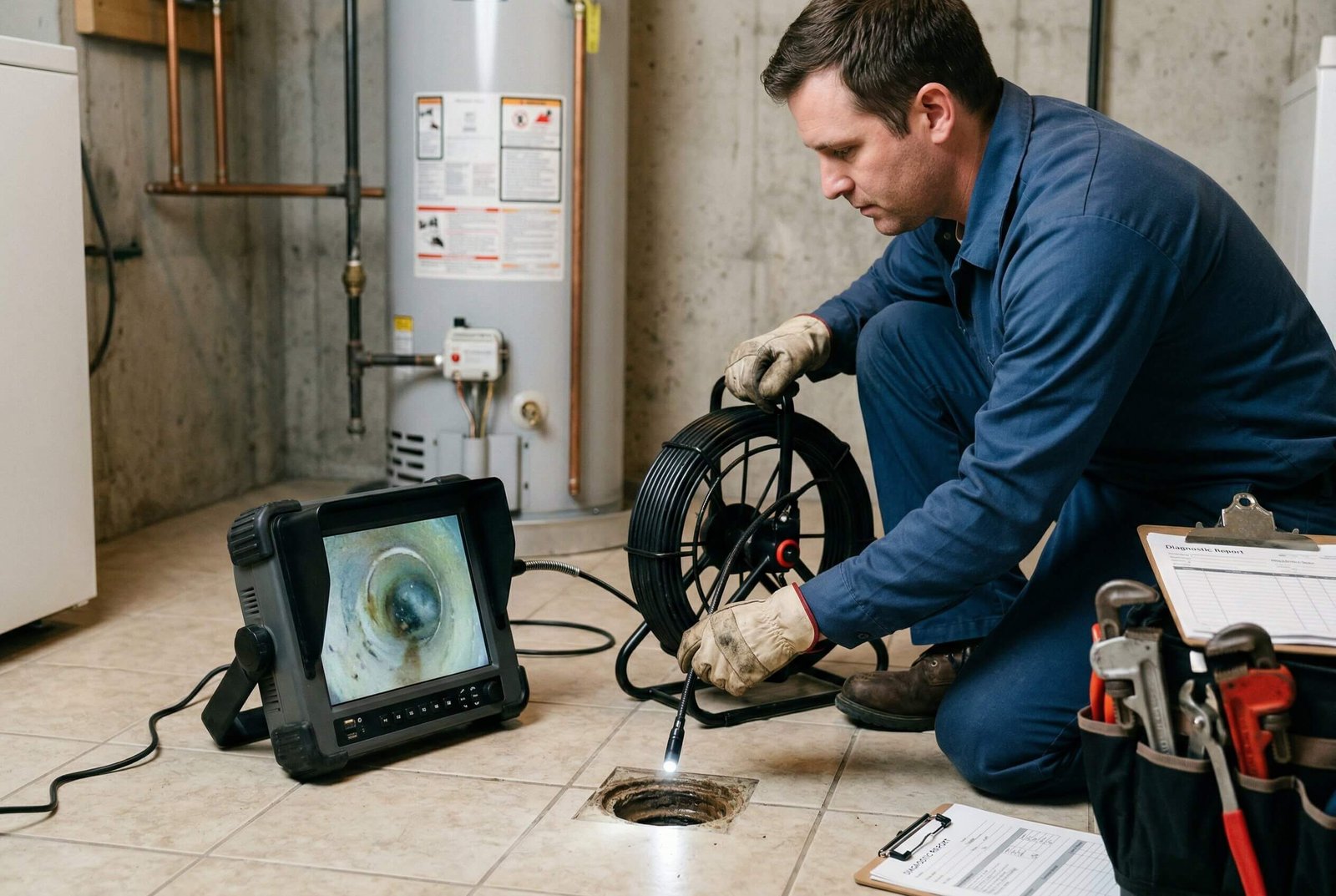
A drain camera inspection is one of the most reliable ways a plumber can understand what’s actually happening inside your pipes. Instead of guessing where a clog is or what’s causing it, a small waterproof camera is fed into the drain line, giving a real-time view of the pipe’s condition. This removes trial-and-error and helps identify the exact problem from the start.
Most homeowners only hear about this when something doesn’t feel normal anymore. A sink that clogs repeatedly, a shower that drains slowly no matter what you try, or multiple fixtures backing up at once—these are situations where basic cleaning isn’t enough. At that point, a plumber needs to see inside the pipe to understand whether it’s buildup, a deeper blockage, or something more serious like pipe damage.
The cost of a camera inspection varies because not every inspection is the same. In some homes, it’s a quick check through an accessible cleanout that takes only a few minutes. In others, the plumber may need to run the camera deep into the sewer line, trace the problem, and spend time diagnosing what’s going on. The more time, effort, and detail required, the higher the cost tends to be.
Understanding this before you agree to the service helps you make smarter decisions. It prevents you from paying for an inspection when a simple fix would have been enough, but it also helps you recognize when skipping it could lead to repeated clogs, multiple service visits, and higher costs later. When used at the right time, a camera inspection isn’t just an extra charge—it’s what makes sure the problem is solved properly the first time.
What This Page Covers
ToggleAverage Drain Camera Inspection Cost in the U.S.
In most homes across the U.S., a drain camera inspection typically costs between $100 and $500, but that range only makes sense once you understand what’s included and why prices vary. This isn’t a flat service with a fixed fee. The final cost depends on how simple or involved the inspection is, how long it takes, and whether it’s done as part of another service or on its own.
- $100–$250 → Quick inspections or add-on with cleaning
- $250–$400 → Standard standalone inspections
- $400–$500+ → Complex or extended inspections
On the lower end, the price usually stays around $100–$250 when the inspection is quick and tied to another job. For example, if a plumber is already clearing a drain and wants to confirm the blockage is gone, they may run a short camera check. Because the setup is already done and the inspection takes only a few minutes, the cost stays low—and sometimes it’s included at no extra charge.
The $250–$400 range is where most homeowners fall when they request an inspection specifically to diagnose a problem. In this case, the plumber is not just confirming a fix—they’re taking time to run the camera deeper into the pipe, locate the issue, and explain what’s happening. This takes more effort and time, which is why the cost increases compared to a quick check.
Once you move into the $400–$500+ range, the inspection usually involves more complexity. This could mean inspecting a long main sewer line, tracing a difficult or hidden blockage, or identifying the exact location of a problem underground. In some cases, the plumber may also provide recorded footage or a more detailed evaluation, which adds to both time and cost.
It’s also important to understand that “average cost” doesn’t always mean you’ll be charged separately. Many plumbers bundle camera inspections with larger services like hydro jetting or major drain cleaning. But if you request it as a standalone service without any cleaning work, you’ll usually pay the full price.
Cost by Situation (When You Actually Need It)
The cost of a drain camera inspection often depends more on the situation than the tool itself. Plumbers don’t use cameras randomly—they use them when the problem isn’t clear, keeps coming back, or may be deeper in the system. The more investigation required, the higher the cost tends to be.
Recurring Clogs That Keep Coming Back
When the same drain keeps clogging again and again, a camera inspection is used to find the root cause instead of repeatedly clearing the symptom. In these cases, the cost usually falls in the $200–$350 range because the plumber needs to spend time tracing where the issue starts.
This stays on the lower side if the blockage is close and easy to identify. But if the problem is deeper in the pipe or spread across a longer section, the inspection takes longer, which increases the cost.
Suspected Main Sewer Line Problems
If multiple drains in the house are slow or backing up at once, the issue is often in the main sewer line. Inspections here typically cost $300–$500+ because the camera has to travel farther and the plumber needs to carefully trace the problem.
The higher cost comes from the level of detail required. The plumber may be checking for tree roots, pipe damage, or structural issues, which takes more time than a simple clog inspection.
After a Failed Drain Cleaning Attempt
When a drain has already been cleaned but the problem remains, a camera inspection becomes the next step. These usually cost $150–$300, especially if done immediately after the cleaning.
The cost stays lower because the plumber already has access to the drain and doesn’t need additional setup. However, if the issue turns out to be deeper or more complex, the inspection can take longer and push the cost upward.
Slow Drains With No Clear Cause
In situations where a drain is slow but there’s no obvious blockage, inspections usually fall in the $200–$400 range. The plumber has to explore different sections of the pipe to understand what’s causing the restriction.
This increases cost because there’s no clear starting point, which means more time is spent investigating rather than going directly to a known problem area.
Home Buying or Pre-Purchase Inspection
For home buyers, a camera inspection is often used to check the condition of the sewer line before purchase. These inspections typically cost $300–$600+.
The price is higher because it’s not just about finding a problem—it’s about evaluating the entire line. The plumber may record video, provide detailed feedback, and ensure there are no hidden issues, which adds time and value to the service.
Cost by Cleaning Method
The method used during a drain inspection—or alongside it—has a direct impact on the total cost. A camera inspection on its own is one thing, but when it’s combined with cleaning or diagnostic work, the pricing changes based on the tools, time, and purpose of the job.
Camera Inspection Only (Diagnosis)
When the camera is used purely to identify the problem, the cost usually stays within the standard range of $100–$400. This depends on how far the camera needs to go and how long it takes to locate the issue.
This stays on the lower side when the plumber can quickly access the pipe and find the problem within a short section. But if the inspection involves tracing a deeper issue or locating an exact point underground, the time increases—and so does the cost.
Camera + Drain Snaking
When a clog is cleared using a drain snake and then checked with a camera, the total cost typically falls between $150 and $450 combined.
- Snaking only → $100–$300
- Snaking + camera check → $150–$450
The inspection portion is often cheaper in this scenario because the plumber is already working on the drain. The camera is used to confirm that the blockage is fully cleared or to check if anything remains. This combination is common for standard clogs that may have deeper buildup.
Camera + Hydro Jetting
When hydro jetting is involved, the total cost increases significantly, often ranging from $400 to $1,000+ including inspection.
- Hydro jetting → $300–$800+
- Jetting + camera inspection → $400–$1,000+
The reason for the higher cost is that hydro jetting is a more intensive cleaning method used for heavy buildup, grease, or tree roots. The camera is usually used before and after the process—to identify the blockage and confirm it has been fully cleared. This adds both time and value to the job.
Camera Inspection with Location (Advanced Diagnostic)
In some cases, the plumber doesn’t just inspect—they also locate the exact position of the problem underground. This type of inspection usually costs $300–$600+.
This is more expensive because it requires additional equipment and precision. The plumber uses a locator device to map where the issue is beneath the surface, which is especially useful if digging or repairs are needed. The extra time and accuracy involved are what drive the cost higher.
The method matters because it determines how much work is actually being done. A quick inspection alone is relatively inexpensive, but when combined with cleaning or detailed diagnostics, the total cost reflects the full scope of the job—not just the camera itself.
What Affects Drain Camera Inspection Cost
The price of a drain camera inspection isn’t random—it’s based on how much effort it takes to actually find and understand the problem. Two homeowners can both request a “camera inspection” and end up paying very different amounts because the situation inside the pipe is completely different. What you’re really paying for is time, access, and the level of investigation required.
Length of Pipe Being Inspected
The farther the camera has to travel, the more time the inspection takes. A short inspection inside a kitchen or bathroom drain may only take a few minutes, which keeps the cost low. But when the plumber has to run the camera through a long main sewer line, especially from the house to the street, it takes significantly more time to reach the problem and trace it properly.
Longer runs also increase the chance of encountering multiple issues, which means the plumber may need to stop, reassess, and continue inspecting further—adding to the overall cost.
Accessibility of the Drain Line
Easy access keeps costs down. If there’s a cleanout (a direct access point to the drain line), the plumber can quickly insert the camera and begin the inspection. This reduces setup time and makes the process more efficient.
If there’s no cleanout, the plumber may need to remove a fixture, access the pipe through a more difficult point, or spend extra time setting up. This additional effort increases the cost, even if the inspection itself isn’t very long.
Severity and Type of Blockage
A simple blockage that’s easy to identify keeps the inspection quick and affordable. But if the pipe has heavy buildup, tree roots, or damage, the plumber has to spend more time navigating the camera and understanding the situation.
More complex problems often require slower, more careful inspection to avoid missing important details. This added time is one of the biggest reasons costs increase.
Time Required to Locate the Problem
Some inspections are straightforward—the plumber inserts the camera and finds the issue quickly. Others require tracing multiple sections of pipe, checking different directions, and confirming exactly where the problem begins and ends.
The longer it takes to locate the issue, the higher the cost. This is especially true when there’s no clear starting point, such as with general slow drainage or intermittent problems.
Equipment and Technology Used
Not all camera systems are the same. Basic inspections use standard cameras, while more advanced setups can include high-resolution imaging, recording capabilities, and location tracking.
If the inspection includes video recording, detailed diagnostics, or locating the exact position of a problem underground, the cost increases because of the equipment and expertise involved.
Standalone vs Add-On Service
One of the biggest cost differences comes down to whether the inspection is done on its own or as part of another job. If a plumber is already working on your drain, adding a camera inspection is quicker and often cheaper.
But if you call specifically for an inspection without any cleaning or repair work, you’ll usually pay the full standalone price. This is because the plumber still has to travel, set up equipment, and dedicate time just for the inspection.
All of these factors come down to one thing: how much work it takes to get a clear answer. The more time, effort, and detail required to diagnose the problem, the higher the inspection cost will be. Understanding these factors helps you see why one quote may be higher than another—and whether that higher cost is actually justified.
Emergency vs Standard Inspection Pricing
The cost of a drain camera inspection can change noticeably depending on when you call for the service. The inspection itself doesn’t become more complicated at night or on weekends—but the timing of the job adds to the price because of how plumbing services are scheduled and staffed.
- Standard scheduled inspection → $100–$400
- After-hours or weekend inspection → $200–$600+
During regular business hours, pricing stays in the normal range because the job is planned, scheduled, and handled within standard working time. The plumber can allocate time properly, and there’s no urgency pressure, which keeps costs predictable and lower.
Emergency inspections—late nights, weekends, or urgent same-day calls—cost more because you’re asking for immediate service outside normal scheduling. Plumbers often have to rearrange their day, travel urgently, or respond after hours, which adds a service premium on top of the inspection itself. Even if the inspection takes the same amount of time, the availability and urgency increase the cost.
The price goes even higher when the inspection is part of a larger emergency situation. For example, if sewage is backing up into the house or multiple drains are overflowing, the plumber isn’t just inspecting—they’re prioritizing quick diagnosis to prevent damage. This urgency often leads to faster response times and extended working hours, both of which increase the total cost.
That said, not every situation needs emergency pricing. Many slow drains, recurring clogs, or suspected issues can safely be scheduled during normal hours without making the problem worse. Choosing a scheduled inspection instead of an urgent call can often save a significant amount.
Emergency pricing is justified when delaying the inspection could lead to property damage, contamination, or worsening of the issue. But if the situation is stable, waiting even a few hours or a day can keep the cost much lower without affecting the outcome.
How to Avoid Overpaying (Most Important Section)
A drain camera inspection can either be a smart investment or an unnecessary expense—it depends entirely on when and why it’s used. The key to not overpaying is understanding whether the inspection is actually solving a problem or just being added without clear value.
One of the biggest mistakes homeowners make is agreeing to a camera inspection for a simple, first-time clog. In many cases, a standard drain cleaning is enough. If the blockage clears easily and the drain flows normally afterward, there’s usually no need to inspect the pipe. In this situation, adding a camera inspection only increases the bill without providing meaningful benefit.
On the other hand, when a problem keeps coming back, the inspection becomes worth the cost. Repeated clogs, multiple slow drains, or issues that return shortly after cleaning are signs that something deeper is wrong. In these cases, skipping the inspection often leads to multiple service calls, repeated charges, and higher total costs over time. Paying for one proper inspection can actually save money by solving the issue correctly.
It’s also important to recognize when the inspection should be included, not charged separately. If a plumber is already performing a major service like hydro jetting or extensive drain cleaning, a quick camera check is often part of doing the job properly. Charging full standalone pricing on top of that can be a red flag unless the inspection is detailed, extended, or involves additional diagnostics like locating the issue underground.
Another way to avoid overpaying is to ask a simple question before agreeing: “What will this inspection tell us that we don’t already know?” A good plumber will explain the purpose clearly—whether it’s to confirm a blockage is cleared, locate a deeper issue, or assess pipe condition. If the answer is vague or doesn’t add real value, the inspection may not be necessary.
Watch for signs of unnecessary upselling. If a plumber recommends a camera inspection immediately without attempting basic cleaning first (in a non-emergency situation), it may not be justified. In most cases, experienced plumbers try the simplest solution first and only move to inspection when the problem isn’t clear or doesn’t resolve.
At the same time, avoid going too cheap in situations where inspection is clearly needed. Skipping it to save money can lead to misdiagnosis—treating symptoms instead of the actual cause. This often results in repeat clogs, water damage, or more expensive repairs later. The goal isn’t to avoid the cost completely, but to make sure you’re paying for the right service at the right time.
In simple terms, a camera inspection should answer a question that cleaning alone cannot. If it does that, it’s worth the cost. If it doesn’t, it’s an expense you can often avoid.
Final Thoughts
A drain camera inspection isn’t something every homeowner needs—but when used at the right time, it becomes one of the most valuable tools in solving a drain problem properly. The cost itself isn’t high or low on its own—it depends on whether it’s being used to answer a real question or just added without purpose.
If your drain issue is simple and clears easily, keeping things basic will save you money. But when problems repeat, spread across multiple drains, or don’t make sense, that’s where an inspection earns its value. It replaces guesswork with clarity, and that clarity is what prevents repeated service calls, unnecessary cleaning, and bigger repairs later.
The key is not to focus only on the price, but on the outcome. A cheap fix that doesn’t solve the problem can end up costing more over time. On the other hand, a well-timed inspection can lead to a faster, more accurate solution—and often a lower total cost in the long run.
In simple terms, you’re not just paying for a camera. You’re paying to understand what’s actually happening inside your pipes. And once you understand that, you can make the right decision with confidence.