
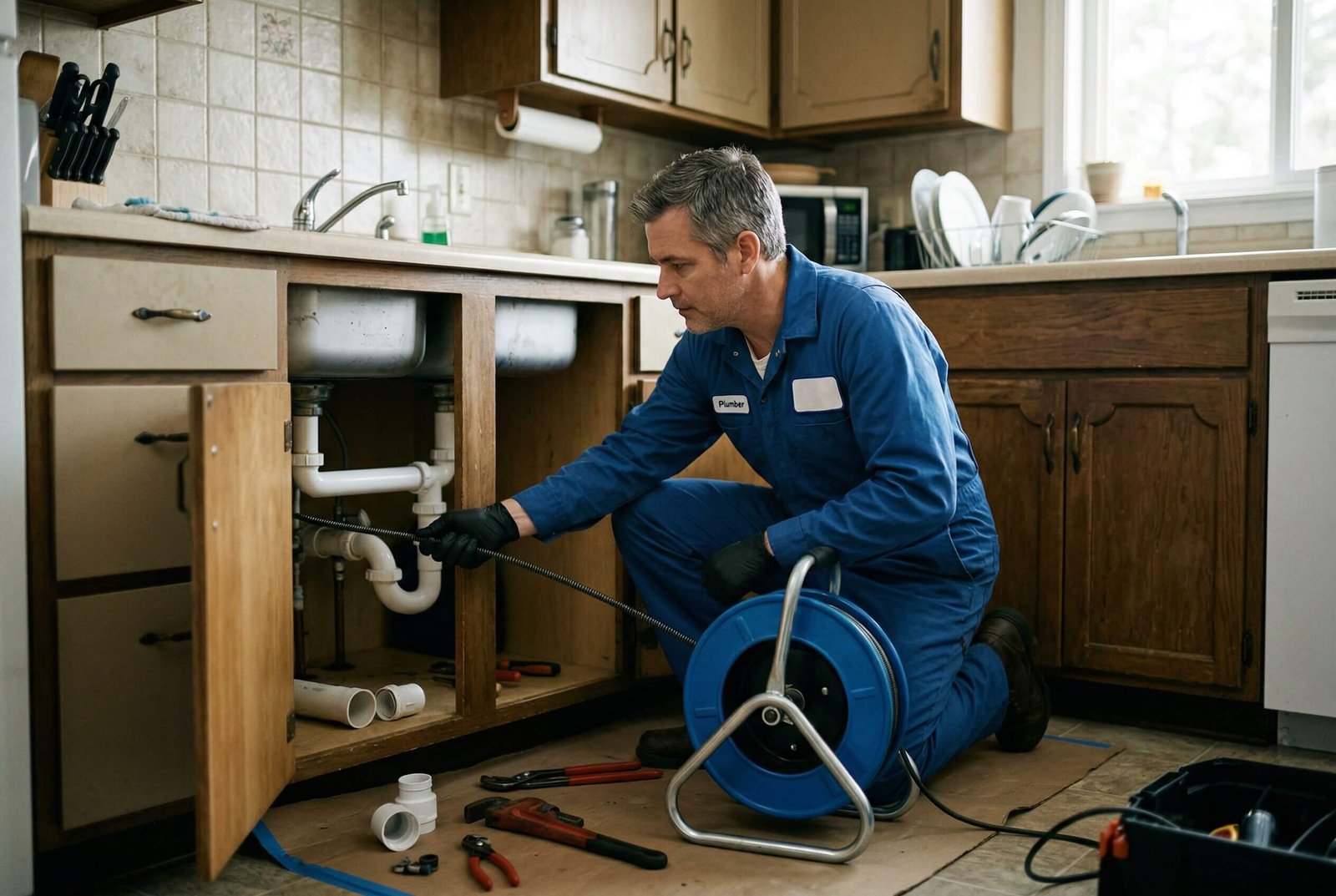
A recurring drain clog is one of the most frustrating plumbing problems a homeowner can deal with. You clear it once, everything seems fine for a few days or weeks, and then the same drain starts slowing down again—or worse, stops completely. It often feels like the problem never really goes away, no matter how many times you try to fix it.
In many homes, this cycle starts in common areas like the kitchen sink, where grease and food buildup slowly collect, or in bathroom drains, where hair and soap form dense blockages over time. At first, the clog seems minor and manageable. You might use a plunger, a store-bought cleaner, or even a basic drain tool, and it appears to work. But what’s actually happening inside the pipe is very different from what you see on the surface.
The reason recurring clogs happen is usually because the original blockage was never fully removed. Instead, a small path was opened through the buildup, allowing water to pass temporarily. The remaining material stays stuck to the pipe walls, continuing to trap debris with every use. Over time, that narrow path closes again, and the clog returns—often faster than before.
A recurring drain clog service focuses on solving this exact problem. Instead of just reopening the pipe, it targets the root cause—whether it’s grease buildup, compacted debris, mineral deposits, or even issues deeper in the system. Addressing it properly is what breaks the cycle and restores the drain so it works consistently, not just temporarily.
What This Page Covers
ToggleWhat Recurring Drain Clog Service Actually Means
A recurring drain clog service is focused on one thing most quick fixes miss—why the clog keeps coming back. At a surface level, it may look like the same problem repeating, but in reality, it’s usually the same buildup that was never fully removed in the first place.
In a one-time clog, the blockage is often localized and can be cleared completely with basic tools. Once removed, the pipe returns to normal flow. But in a recurring clog situation, the pipe is already partially restricted along its walls. Every time it’s “fixed,” only a narrow channel is opened through the center, leaving most of the buildup behind.
Why Recurring Clogs Keep Coming Back
Inside the pipe, materials like grease, soap, hair, or mineral deposits don’t just sit in one place—they coat the inner surface. When a temporary fix is applied, it pushes through the middle of that buildup, but the layers along the sides remain.
With daily use, those remaining layers start collecting new debris almost immediately. Water flow begins to slow again, and the cycle repeats. This is why the time between clogs often gets shorter with each occurrence.
Full Cleaning vs Partial Clearing
The key difference in a proper recurring drain clog service is the approach. Instead of opening a path, the goal is to restore the pipe’s full internal space.
- Partial clearing → Opens a small passage, problem returns
- Full cleaning → Removes buildup from pipe walls, restores flow
This often involves deeper drain cleaning methods that clean the entire pipe diameter, not just the center. In more complex cases, it may also reveal issues that go beyond buildup, such as early-stage problems in the main line or conditions that may eventually require sewer line repair.
When It’s More Than Just a Clog
Recurring clogs are sometimes a sign that the issue isn’t just about debris. If the pipe has scaling, improper slope, or structural wear, the flow may never return to normal with simple cleaning alone.
That’s why this type of service focuses not just on clearing the blockage, but on understanding the condition of the pipe itself. Fixing the symptom is easy—fixing the cause is what actually stops the problem from coming back.
What Causes Recurring Drain Clogs
Recurring drain clogs don’t happen by accident. When the same drain keeps clogging again and again, it usually means there’s an underlying condition inside the pipe that hasn’t been fully resolved. Instead of a one-time blockage, the pipe is already in a state where it continuously traps debris.
Grease Layer Build-Up (Kitchen Lines)
In kitchen drains, grease is one of the most common causes of recurring clogs. Even small amounts of oil or fat can stick to the inner surface of the pipe. Over time, this creates a thick, sticky layer that never fully washes away.
As food particles pass through the drain, they get caught in this layer, gradually building up into a dense restriction. Even if a clog is cleared temporarily, the grease coating remains, which is why the problem keeps coming back.
Hair and Soap Compaction (Bathroom Drains)
Bathroom drains often deal with hair, soap residue, and personal care products. Hair alone may not seem like a major issue, but when combined with soap, it forms a dense, tangled mass that sticks inside the pipe.
Each time water flows through, more hair and debris attach to the existing buildup. Even after a clog is partially removed, leftover material continues to trap new debris, leading to repeated slowdowns and blockages.
Partial Blockage Left Behind
One of the most common reasons for recurring clogs is incomplete cleaning. Many quick fixes—like plunging or basic snaking—only create a small opening through the blockage.
While this restores flow temporarily, most of the buildup remains along the pipe walls. Over time, that remaining material collects more debris and closes the gap again, causing the clog to return.
Pipe Scaling and Mineral Deposits
In some homes, especially those with hard water, minerals like calcium can accumulate inside the pipe. This creates a hard, rough surface that reduces the pipe’s internal diameter.
Unlike grease or hair, scaling doesn’t break apart easily. It also makes it easier for other debris to stick, accelerating the buildup process. This type of restriction often leads to repeated clogging unless properly cleaned.
Tree Roots in the Sewer Line
If the recurring clog is connected to the main drain, tree roots may be the cause. Roots can enter small openings in the pipe and grow inside, creating a web-like obstruction.
Even if part of the roots are cleared, they tend to grow back unless fully addressed. This leads to recurring blockages that feel like the same problem returning over and over.
Pipe Design or Slope Issues
In some cases, the issue isn’t just buildup—it’s how the pipe is designed or installed. If the slope is too flat or uneven, water doesn’t flow efficiently, and debris settles inside the pipe more easily.
This creates a condition where clogs form repeatedly, even after cleaning. Structural issues like this often require more than just clearing—they may need adjustments to how the pipe functions.
When You Actually Need Recurring Drain Clog Service
A recurring clog isn’t always obvious at first. Many homeowners treat it as a normal clog that just happens occasionally. But over time, patterns start to appear—and those patterns are what indicate the problem is deeper than it seems.
Signs It’s Not a One-Time Issue
One of the clearest signs is when the same drain clogs repeatedly within a short period. You fix it, it works for a while, and then the problem comes back without any major change in usage.
At first, the gap between clogs may be weeks or months. But as buildup continues inside the pipe, that gap gets shorter. Eventually, it becomes something you’re dealing with regularly, rather than occasionally.
Pattern-Based Symptoms
Recurring clogs often follow patterns, even if they’re not obvious right away. For example, the drain may clog after heavy use, like cooking or long showers. Or it may slow down gradually and then suddenly block again.
These patterns happen because the pipe is already partially restricted. It can handle light use, but when flow increases, the remaining opening gets overwhelmed. This causes the clog to reappear under certain conditions.
Multi-Drain Recurrence
When more than one drain starts showing similar issues—like repeated slowdowns or clogs—it usually means the problem is not isolated.
For example, the kitchen sink, bathroom sink, or tub may all start acting up around the same time. This often points to a shared line or early-stage restriction in the main drain system.
At this stage, recurring clogs are no longer just about individual drains—they’re a sign that the system itself needs attention. Addressing it early can prevent it from turning into a full blockage or even a backup situation.
How Recurring Drain Clog Service Is Performed (Step-by-Step)
Fixing a recurring clog is different from clearing a one-time blockage. The goal is not just to get water flowing again, but to understand why the clog keeps returning and remove that cause completely. This requires a more structured and thorough process.
Full System Inspection
The first step is looking at the problem as a pattern, not a single event. A plumber will ask how often the clog happens, which drains are affected, and what kind of usage triggers it.
They may test multiple fixtures to see how the system behaves as a whole. This helps determine whether the issue is isolated to one drain or connected to a shared line or deeper part of the system.
Camera Inspection
In recurring cases, visual inspection inside the pipe becomes important. A small camera is inserted into the drain to locate the exact problem.
This step reveals whether the issue is grease buildup, compacted debris, mineral scaling, root intrusion, or even pipe damage. It also shows how much of the pipe is affected—not just the point where water stops flowing.
Diagnosing the Root Cause
Once the inside of the pipe is visible, the actual cause of the recurring clog can be identified. This is where recurring clogs differ from simple ones.
The problem is often not just a blockage, but a condition—like buildup along the pipe walls or structural issues—that allows debris to keep collecting. Understanding this is what guides the next step.
Choosing the Proper Method
Based on the diagnosis, the right method is selected. For recurring clogs, stronger and more complete cleaning methods are often needed.
If the issue is heavy buildup, hydro jetting may be used to clean the pipe walls. If roots are involved, specialized cutting tools may be required. If the pipe has structural issues, a different type of repair may be necessary.
The goal is to match the method to the cause, not just the symptom.
Deep Cleaning or Repair
This is where the actual solution happens. Instead of just opening a narrow path, the pipe is cleaned or repaired so that debris no longer sticks and builds up in the same way.
In many cases, this means restoring the full internal diameter of the pipe so water flows freely. If structural issues are found, this step may involve correcting the pipe condition rather than just cleaning it.
Final Verification
After the work is done, the system is tested to make sure the issue is truly resolved. Water is run through the drains to confirm consistent flow.
In recurring clog situations, this step is important because it ensures the problem won’t return immediately. Sometimes, a follow-up inspection is used to confirm that the pipe is fully clear and functioning properly.
Methods Used for Recurring Drain Clogs
Recurring clogs require more than basic tools because the issue is not just a blockage—it’s a condition inside the pipe that allows buildup to keep forming. The methods used are focused on removing that condition completely so the drain stays clear over time.
Hydro Jetting (Primary Solution)
Hydro jetting is often the most effective solution for recurring drain clogs because it doesn’t just open a path—it cleans the entire pipe. High-pressure water is pushed through the line, removing grease layers, soap residue, sludge, and debris stuck along the walls.
What makes hydro jetting different is that it restores the pipe closer to its original internal diameter. Instead of leaving behind a rough or sticky surface where debris can collect again, it smooths out the interior by clearing accumulated material.
In recurring clog situations, this matters because the problem is usually not a single blockage—it’s the buildup lining the pipe. When that buildup is removed completely, water flows more freely and the chances of new debris sticking are significantly reduced.
However, hydro jetting is not used blindly. The condition of the pipe must be considered first. Older or fragile pipes may require inspection before using high pressure, which is why this method is often paired with camera inspection.
Drain Snaking (Limited Use)
Drain snaking is still used in recurring clog cases, but its role is more limited. It’s typically used as an initial step to break through a dense blockage and restore some flow before deeper cleaning is performed.
The auger can cut through compacted debris, hair, or localized clogs, making it useful when the pipe is completely restricted. But on its own, it does not solve the recurring issue because it doesn’t remove buildup from the pipe walls.
In many cases, snaking creates a temporary opening, which is why drains may seem fixed for a short time before slowing down again. For recurring clogs, it’s usually combined with more thorough methods rather than used as a standalone solution.
Root Cutting Tools
When tree roots are involved, specialized cutting tools are used to remove them from inside the pipe. These tools are attached to mechanical equipment and are designed to cut through root growth without completely damaging the pipe structure.
Roots are a common cause of recurring clogs in main lines because they don’t just block the pipe—they trap other debris like paper and waste. Even after partial removal, roots tend to grow back if the entry point remains.
That’s why root cutting is often followed by deeper cleaning, such as hydro jetting, to remove smaller root fragments and debris. In some cases, it also leads to further evaluation of whether the pipe needs repair to prevent future intrusion.
Descaling Methods
In pipes affected by mineral buildup, especially in hard water areas, descaling methods are used to remove the hardened deposits inside the pipe.
Scaling creates a rough, narrow surface that restricts flow and makes it easier for other debris to stick. Unlike grease or hair, mineral buildup doesn’t wash away easily and requires more targeted removal.
Descaling helps restore the pipe’s internal diameter and smoothness, which improves flow and reduces the chances of recurring clogs. This method is particularly important when slow drainage and recurring issues happen without obvious debris.
Camera Inspection (Verification and Diagnosis)
Camera inspection plays a key role in both diagnosing and confirming the solution for recurring clogs. By looking inside the pipe, it becomes clear whether the problem is fully resolved or if something remains.
Before cleaning, the camera helps identify the exact cause and location of the issue. After cleaning, it verifies whether the pipe is clear and whether there are any structural concerns that could lead to future problems.
In recurring clog situations, this step is often what separates a temporary fix from a long-term solution. It ensures that the root cause has been addressed rather than just improving flow for the moment.
DIY vs Professional (Decision Section)
Recurring clogs are where most homeowners start to realize the limits of DIY solutions. What worked the first time—plunging, basic drain cleaners, or small tools—stops working the same way. The reason is simple: the problem is no longer just a blockage, it’s a buildup condition inside the pipe that keeps recreating the clog.
Why DIY Fails for Recurring Clogs
In recurring situations, DIY methods usually only address the symptom, not the cause. When you use a plunger or a basic drain snake, it often creates a small opening through the clog, allowing water to pass again.
But inside the pipe, most of the buildup remains attached to the walls. This leftover material continues to trap debris every time the drain is used. Over time, that small opening closes again, and the clog returns—sometimes even faster than before.
Chemical cleaners can also give the impression of a fix, but they typically dissolve only part of the blockage. They rarely remove the full buildup and can leave behind residue that continues to cause problems.
When DIY Might Help Briefly
There are still situations where DIY can provide short-term relief, especially in the early stages of a recurring issue.
If the drain is just starting to slow down again and the buildup hasn’t fully compacted, basic tools might improve flow temporarily. For example, a light hair clog near the surface or mild grease buildup may respond to simple methods.
However, this is usually only effective for a short period. If the same drain has clogged multiple times before, it’s a strong sign that the underlying issue is still present.
Why Professional Approach Is Required
A professional approach focuses on removing the condition that allows clogs to keep forming. Instead of just opening a path, the goal is to clean or repair the pipe so debris no longer sticks and builds up in the same way.
This often involves methods that reach deeper into the system and clean the full pipe diameter. It may also include inspection to identify whether there’s a structural issue contributing to the problem.
In recurring clog situations, the difference between DIY and professional work is not just effectiveness—it’s permanence. One improves the symptom temporarily, while the other aims to stop the cycle completely.
Cost of Recurring Drain Clog Service in the U.S.
The cost of fixing a recurring drain clog is usually higher than a one-time clog because the work is more thorough. Instead of just opening the blockage, the goal is to remove the underlying buildup or condition that keeps causing the problem. That often requires better equipment, more time, and sometimes inspection.
Typical Cost Ranges
For mild recurring issues—where the buildup is not too deep and can be addressed with basic cleaning—the cost stays on the lower end. These are situations where the clog is repeating but hasn’t spread far into the system.
As the issue becomes more established, with thicker buildup or deeper restrictions, the cost increases because more advanced methods like hydro jetting or extended cleaning time are needed.
- Basic recurring clog cleaning: $150 – $300
- Moderate recurring issue (deeper buildup): $300 – $700
- Severe or main line recurring clog: $700 – $1,500+
These ranges are typical across many U.S. areas, though exact pricing can vary based on access and location.
What Affects the Cost
Recurring clogs are not priced just on the clog itself, but on what it takes to stop it from coming back. Several practical factors influence the final cost.
- Depth of the issue → Near the drain vs deep in the system
- Type of buildup → Grease, hair, scaling, or roots
- Method required → Snaking vs hydro jetting vs descaling
- Pipe condition → Healthy pipe vs damaged or worn pipe
- Accessibility → Easy cleanout vs difficult access points
If the recurring clog is caused by a structural issue—like improper slope or pipe damage—cleaning alone may not fully solve it. In those cases, the cost may increase because the solution involves correcting the pipe condition rather than just removing buildup.
Understanding these factors helps explain why recurring clog services are priced differently from standard drain cleaning. The goal is not just to fix the current problem, but to prevent it from returning again.
Cost of Recurring Drain Clog Service in the U.S.
Recurring drain clogs are usually more time-consuming to fix than one-time blockages because the goal is not just to restore flow, but to remove the underlying cause. That’s why costs can vary depending on how deep the issue is and what method is required to fix it properly.
Typical Cost Ranges
For recurring clogs that are still relatively mild—such as repeated buildup near the surface or within a short section of pipe—the cost tends to stay on the lower end. These cases may only require deeper cleaning than usual, but not extensive work.
As the problem becomes more established—like heavy grease buildup, mineral scaling, or recurring bathroom clogs—the cost increases because more thorough cleaning methods are needed to fully clear the pipe walls.
In more severe cases, where the clog is linked to the main line, tree roots, or deeper structural issues, the cost reflects the additional time, equipment, and complexity involved.
- Basic recurring clog cleaning: $150 – $300
- Moderate recurring issue (deeper buildup): $300 – $600
- Severe or main line recurring clog: $600 – $1,500+
These are general U.S. ranges and can vary based on location, accessibility, and pipe condition.
What Affects the Cost
The cost of fixing a recurring clog depends on what’s actually causing it and how difficult it is to fully resolve.
- Depth of the issue → Near the fixture vs deep in the system
- Type of buildup → Grease, hair, scaling, or roots
- Method required → Snaking vs hydro jetting vs descaling
- Pipe condition → Older pipes may require careful handling
- Access to the line → Easy cleanout vs difficult entry points
If the recurring clog is caused by a structural issue—such as pipe misalignment, damage, or root intrusion—cleaning alone may not be enough. In those cases, the solution may extend into sewer line repair, which involves a different scope and cost.
Understanding these factors helps explain why recurring clogs are often more expensive to fix than one-time blockages—but also why solving them properly prevents repeated service calls in the future.
Risks of Ignoring Recurring Clogs
A recurring clog is not just an inconvenience—it’s a sign that the drainage system is already struggling. Every time the clog comes back, it means the underlying issue is still present and often getting worse. Ignoring this cycle allows the problem to build deeper inside the pipe.
Full Blockage Over Time
What starts as a recurring slow clog will eventually turn into a complete blockage. Each time debris collects on top of existing buildup, the internal space of the pipe becomes smaller.
At some point, water can no longer pass through at all. This leads to standing water in sinks, tubs, or floor drains, and normal usage becomes difficult. Fixing a full blockage is usually more complex than addressing a recurring issue early.
Drain Backup Into the Home
As the blockage becomes more severe, water may stop draining entirely and begin reversing direction. This is when backups can occur.
Instead of flowing out, water may come up through other drains—especially the lowest points in the home. What was once a repeating clog in a single drain can turn into a multi-fixture problem affecting different areas at the same time.
Sewer Backup Risk
If the recurring clog is connected to the main drain or sewer line, ignoring it increases the risk of a full sewer backup. This is a more serious situation where wastewater, including contaminants, can enter the home.
At this stage, the issue goes beyond inconvenience and becomes a health and sanitation concern. The longer the problem is left unresolved, the higher the chance it escalates to this level.
Pipe Damage and Long-Term Wear
Buildup inside the pipe doesn’t just block flow—it can also affect the condition of the pipe itself. Over time, trapped debris and moisture can lead to corrosion or stress on pipe joints.
Repeated pressure from restricted flow can weaken certain sections, increasing the risk of leaks or structural damage. What could have been solved with proper cleaning may eventually require repair if the pipe condition deteriorates.
Where Recurring Clogs Commonly Occur
Recurring clogs tend to show up in areas where daily usage and specific types of waste create the right conditions for buildup. While any drain can develop a clog, certain locations in the home are far more prone to repeated issues because of what consistently goes through them.
Kitchen Drains
Kitchen drains are one of the most common places for recurring clogs, mainly due to grease, oils, and food particles. Even when rinsed with hot water, grease cools and sticks to the inner walls of the pipe, forming a layer that never fully washes away.
Over time, this layer traps small food particles and creates a thick buildup. Each time the drain is used, more material gets added, which is why kitchen clogs often come back even after being cleared once or twice.
Bathroom Drains
Bathroom drains—especially in showers and sinks—are another frequent source of recurring clogs. Hair, soap residue, toothpaste, and other products combine to form dense blockages.
Hair tends to bind everything together, while soap creates a sticky coating that helps debris cling to the pipe. Even if a clog is removed near the surface, remaining buildup deeper inside continues to collect more material, leading to repeated issues.
Laundry Drains
Laundry drains handle lint, detergent residue, and sometimes dirt from clothing. Lint is particularly problematic because it doesn’t dissolve and can accumulate over time inside the pipe.
Detergent can also contribute to buildup, especially when combined with minerals in hard water. Recurring clogs in laundry drains often develop slowly and may not be noticed until they begin affecting drainage during heavy use.
Main Sewer Line
When recurring clogs affect multiple drains in the home, the issue often points to the main sewer line. This is where all wastewater from the home eventually flows, so any restriction here impacts the entire system.
Common causes include grease buildup, tree root intrusion, or partial blockages that were never fully cleared. Recurring clogs in the main line are more serious because they can eventually lead to system-wide slowdowns or backups if not addressed properly.
Finding Help Locally
When you’re dealing with recurring clogs, the type of help you choose makes a big difference. Many homeowners have already tried basic fixes or even hired someone once before, only to see the problem return. That usually means the issue wasn’t fully addressed the first time.
Local plumbers who regularly handle recurring drain problems tend to approach the job differently. Instead of treating it like a one-time clog, they look at patterns—how often it happens, which drains are affected, and what type of buildup is likely inside the pipe. This helps them decide whether the solution should be simple cleaning or something more thorough like deep pipe cleaning or inspection.
Experience also matters because recurring clogs often involve more than just surface-level debris. It could be grease layers, compacted buildup, or even early signs of a main line restriction. Someone familiar with these situations can recognize the difference quickly and choose the right method instead of repeating temporary fixes.
Many homeowners also explore city-based plumber lists or comparison pages to find professionals who deal specifically with drain cleaning and recurring issues. This can help avoid providers who focus only on quick clearing methods.
At this stage, the goal is not just to get the drain working again—it’s to find someone who can stop the problem from coming back.
How to Choose the Right Recurring Drain Clog Service
When a clog keeps coming back, choosing the right service becomes more important than the fix itself. The difference between a temporary solution and a permanent one usually comes down to how the problem is understood and handled.
What to Look For
A reliable approach focuses on identifying why the clog keeps returning, not just clearing it again. The person handling the issue should be able to explain what’s happening inside the pipe in a way that makes sense, based on your specific situation.
Experience with recurring clogs is important because these problems behave differently from one-time blockages. The method used should match the cause—whether it’s buildup along the pipe walls, root intrusion, or something structural.
- Ability to explain the root cause clearly
- Use of proper methods for full pipe cleaning
- Focus on long-term solution rather than quick clearing
- Willingness to inspect the pipe when needed
Questions That Help You Understand the Service
Before the work starts, asking the right questions can help you understand whether the solution is complete or temporary.
- Is the cleaning removing buildup from the pipe walls or just opening the clog?
- What method will be used, and why is it appropriate for this issue?
- Is there a chance the clog will return, and what causes that?
- Will the pipe be inspected to confirm the problem is fully resolved?
These questions help you see whether the approach is focused on fixing the cause rather than repeating the same fix.
Common Mistakes and Red Flags
Recurring clogs often continue because of incomplete or surface-level solutions. Recognizing warning signs can help you avoid going through the same cycle again.
- Only breaking the clog without cleaning the full pipe
- No effort to identify why the clog keeps returning
- Recommending repeated visits instead of a complete solution
- Vague answers about cause, method, or long-term results
A proper recurring drain clog service focuses on restoring the pipe so it functions normally again. When the root cause is addressed, the need for repeated fixes usually disappears.
Final Thoughts
A recurring drain clog is one of the clearest signs that the issue is not just a blockage—it’s a condition inside the pipe that hasn’t been properly resolved. The repetition itself is the signal. Every time the clog comes back, it means something is still sitting inside the system, collecting more debris and narrowing the flow again.
What makes this problem different is that it rarely fixes itself. In fact, it usually gets worse over time. The gap between clogs becomes shorter, the drainage becomes slower, and eventually the system may reach a point where normal use is no longer possible without interruption.
The real solution is not in clearing the clog repeatedly, but in removing what allows it to form in the first place. Whether it’s grease buildup, compacted debris, mineral scaling, or a deeper issue in the system, addressing the root cause is what breaks the cycle.
Once the pipe is properly cleaned or corrected, the difference is noticeable—not just in how fast the water drains, but in how consistently it stays that way. That’s what turns a recurring problem into a resolved one.