
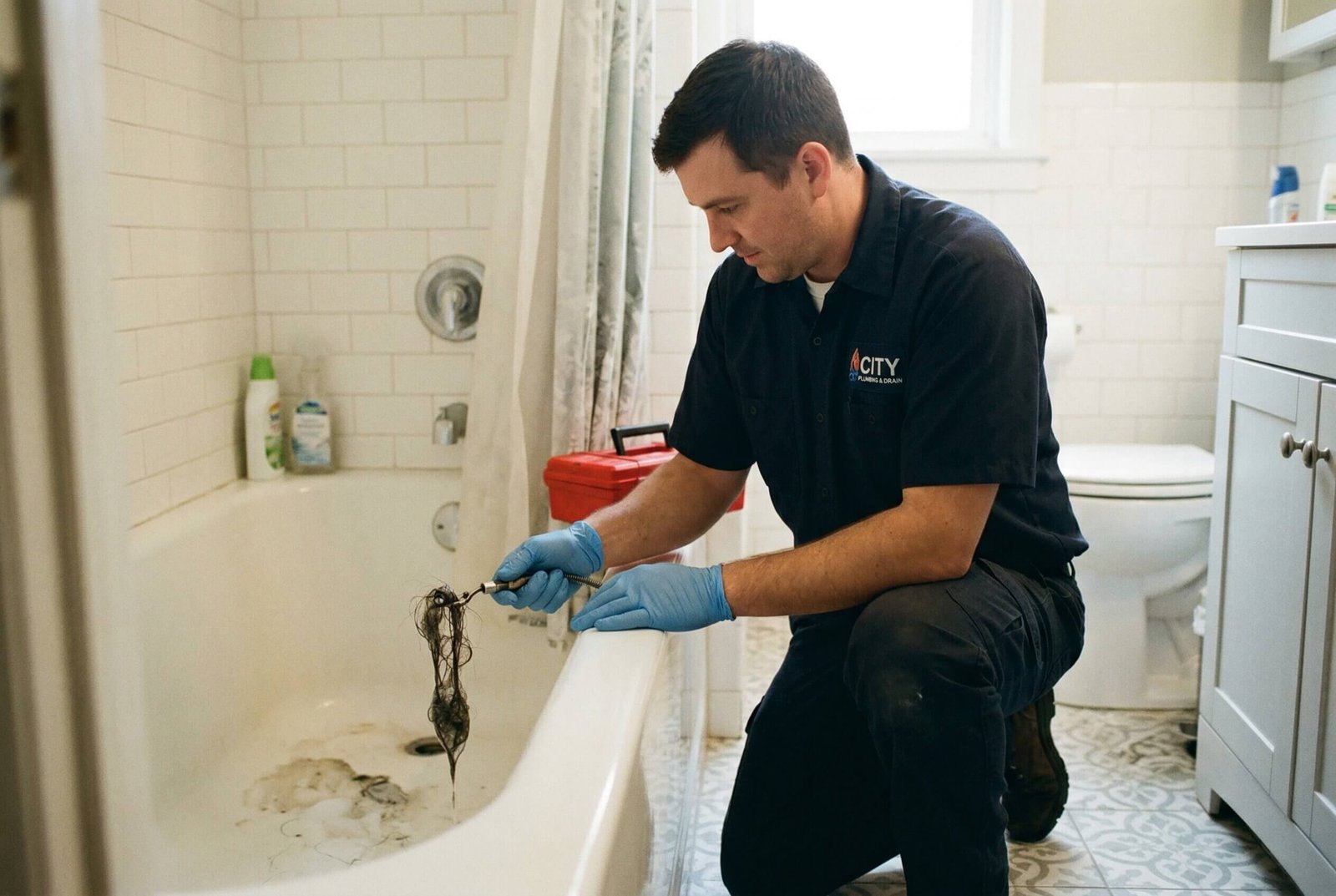
Hair clogs are one of the most common bathroom drain problems, and almost every homeowner deals with them at some point. It usually starts with a small change — water draining a little slower during a shower, or a sink that takes longer to empty after use. At first, it doesn’t seem like a serious issue, so it’s easy to ignore or fix temporarily.
What’s actually happening inside the drain is more gradual. Hair doesn’t just wash away. It gets caught along the inner parts of the drain, especially where there are bends or rough surfaces. Once a few strands stick, they begin to trap soap residue, oils, and other debris. Over time, this forms a tangled, sticky mass that restricts water flow more and more.
Hair clogs typically develop in shower drains, bathtub drains, and bathroom sinks where daily use creates consistent buildup. If left untreated, the clog becomes denser and moves deeper into the pipe, making it harder to remove. What starts as a slow drain can eventually turn into standing water or repeated blockages that basic cleaning methods can’t resolve.
What This Page Covers
ToggleWhat Hair Clog Removal Service Actually Means
Hair clog removal service is not just about pulling out a visible bunch of hair from the drain opening. In many cases, what you see at the surface is only a small part of the actual blockage. The real issue usually sits deeper inside the pipe, where hair has combined with soap scum, oils, and residue to form a dense, tangled mass.
Inside bathroom drains, hair behaves differently than other debris. It wraps around itself and sticks to pipe surfaces, especially in areas where water flow slows down. Over time, this buildup grows thicker and starts catching more material, gradually restricting the pipe from the inside.
How hair actually builds up inside pipes
Hair clogs don’t form instantly. They develop layer by layer as strands collect and bind together with other substances commonly found in bathroom drains.
This buildup typically includes:
- Hair strands tangled together into a net-like structure
- Soap residue that acts like a binding agent
- Oils and body products that make the clog sticky
- Dirt and debris that get trapped in the mass
As this mixture thickens, it reduces the available space inside the pipe, slowing down water flow and eventually leading to blockage.
What plumbers actually remove during the service
A proper hair clog removal service focuses on removing the entire blockage, not just the visible portion. Depending on how deep the clog is, the process involves reaching into the drain line and clearing out the accumulated mass.
This usually includes:
- Extracting hair buildup from the drain opening or deeper sections
- Breaking apart compacted clogs inside the pipe
- Removing residue that holds the clog together
- Clearing the pipe pathway to restore normal flow
The goal is to remove both the hair and the substances attached to it, so the drain doesn’t clog again quickly.
Surface clog vs deeper blockage
Not all hair clogs are located in the same place. Some sit just below the drain cover and are easy to access. Others form deeper in the pipe, especially in traps or horizontal sections where water slows down.
Surface clogs:
- Easier to remove with basic tools
- Often visible or reachable from the drain opening
- Usually cause mild to moderate slowdown
Deeper clogs:
- Located further inside the pipe system
- Harder to reach without proper tools
- More likely to cause recurring or complete blockage
Understanding this difference is important because deeper clogs often require more than simple removal — they need proper drain cleaning to clear the buildup fully.
Temporary clearing vs complete removal
Many DIY attempts focus on clearing a path through the clog so water can pass again. While this can restore flow temporarily, it doesn’t remove the full buildup inside the pipe.
That’s why the same issue often returns:
- Partial removal leaves hair and residue behind
- Remaining buildup continues to trap debris
- The clog reforms over time
A complete hair clog removal service addresses the entire blockage, reducing the chances of repeated problems and restoring the drain closer to its original capacity.
When You Actually Need Hair Clog Removal Service
Hair clogs usually don’t appear all at once. They build slowly, and the early signs are easy to ignore because the drain is still working — just not as efficiently as before. The problem is that once hair starts collecting inside the pipe, it rarely clears on its own. It continues to trap more debris, gradually turning into a thicker blockage.
Knowing when to act can help you avoid repeated clogs or a full blockage that disrupts daily use.
Early warning signs of hair buildup
In the beginning, the symptoms are subtle. The drain still works, but you can tell something isn’t quite right.
You may notice:
- Water draining slower during showers
- Small amount of water pooling around your feet
- Sink taking longer to empty after use
- Occasional gurgling sounds from the drain
At this stage, hair has already started accumulating, usually near the drain opening or in the trap below.
Recurring issues that signal a growing clog
As more hair and residue collect, the problem becomes repetitive. This is where many homeowners try multiple fixes, thinking it’s a new clog each time.
Common patterns include:
- Drain works after cleaning but slows down again quickly
- Need to remove hair frequently from the drain cover
- Water buildup returning within days or weeks
- Increasing resistance when water flows
This usually means the clog is deeper in the pipe and continuing to grow beyond the surface.
Clear signs you need professional hair clog removal service
There comes a point where the clog is no longer manageable with basic tools or cleaning methods. The blockage becomes dense enough that it restricts flow significantly or completely.
You should consider professional help when:
- Water pools and doesn’t drain properly
- Multiple bathroom drains start slowing down
- Plunging or basic tools stop working
- Strong odor develops from the drain
- The clog keeps returning despite repeated attempts
At this stage, the buildup has likely moved deeper into the system, requiring proper drain cleaning to fully clear the pipe.
Early vs late action — what changes
Handling the issue early means the clog is smaller, softer, and easier to remove. The process is quicker and usually less involved.
Delaying it leads to:
- Hair compacting into a dense mass
- Greater buildup of soap and residue
- Deeper blockage inside the pipe
- Increased effort needed to remove it
The difference between early and late action is not just convenience — it changes how complex the removal process becomes and how likely the problem is to return.
How Hair Clog Removal Service Is Performed (Step-by-Step)
Hair clogs are handled differently depending on where they are and how tightly they’ve built up. The process isn’t just about pulling out visible hair — it involves locating the clog, understanding how deep it goes, and removing the entire buildup so the drain doesn’t slow down again shortly after.
A proper approach focuses on clearing both the hair and the residue holding it together.
Initial inspection of the drain and flow
The process starts with observing how the drain is behaving. This helps determine whether the clog is near the surface or deeper in the pipe.
The plumber typically checks:
- How fast water is draining
- Whether water pools immediately or slowly
- If there’s backup when running water continuously
In many cases, the drain cover is removed to inspect for visible hair buildup near the opening.
Identifying the location of the clog
Once the surface is checked, the next step is figuring out where the blockage actually sits. Hair clogs often form in predictable areas, but the exact location matters for choosing the right method.
This helps determine:
- Whether the clog is just below the drain opening
- If it’s trapped in the drain trap under the fixture
- Whether it has moved further into the pipe
For recurring or unclear cases, a deeper look may be needed to confirm the clog’s position.
Checking depth and severity of buildup
Hair clogs can vary from loose strands to tightly packed masses. Understanding how compact the clog is helps decide how it should be removed.
At this stage, the plumber assesses:
- How dense and tangled the hair buildup is
- Whether soap and residue have hardened the clog
- If water can partially pass through or not at all
This evaluation prevents using a method that only partially clears the blockage.
Selecting the right removal method
Based on location and severity, the appropriate tool or method is chosen. This step ensures the clog is removed effectively without pushing it further down the pipe.
Depending on the situation:
- Surface clogs may be removed manually
- Mid-level clogs may require snaking tools
- Deeper or compact clogs may need more advanced cleaning
The method is always matched to the condition of the drain.
Extracting or breaking down the hair clog
This is the stage where the blockage is actually removed. If the clog is reachable, it’s pulled out directly. If it’s deeper, it may be broken apart first and then cleared.
The focus is on:
- Removing as much hair buildup as possible
- Breaking apart compacted sections
- Avoiding pushing the clog further into the system
Proper removal ensures that the drain doesn’t just open temporarily but is cleared more completely.
Flushing and clearing remaining residue
After the main clog is removed, the drain is flushed to clear out any leftover debris. Hair clogs often leave behind residue that can quickly start trapping new material if not cleaned properly.
This step helps:
- Remove soap and buildup left inside the pipe
- Prevent immediate re-clogging
- Restore smoother water flow
It’s a key part of making the cleaning last longer.
Final testing to confirm proper drainage
The last step is checking that the drain is working as expected. Water is run through the system to confirm that flow has been fully restored.
The plumber verifies:
- Water drains quickly and consistently
- No pooling or backup occurs
- The system handles continuous flow without resistance
Once this step is complete, it confirms that the clog has been properly removed and the drain is functioning normally again.
Methods Used for Hair Clog Removal
Hair clogs require a slightly different approach compared to grease or food-related blockages. Hair tends to tangle, bind with soap residue, and form a flexible but stubborn mass inside the pipe. Because of this, the goal is not just to break the clog — it’s to extract or fully clear it so it doesn’t reform quickly.
The method used depends on how deep the clog is and how tightly it has compacted.
Manual hair removal tools (hooks and extractors)
For clogs near the surface, manual tools are often the first and most effective option. These include small hooks, barbed tools, or extractors designed to grab and pull hair out of the drain.
They work by:
- Catching tangled hair near the drain opening
- Pulling out visible buildup directly
- Removing clogs without pushing them deeper
This method is simple but effective when the clog hasn’t traveled far into the pipe. It’s commonly used in showers and bathroom sinks where hair collects just below the drain cover.
Drain snaking for deeper hair clogs
When the clog sits further inside the pipe, a drain snake (or auger) is used. This flexible tool reaches deeper sections and either pulls out or breaks apart the hair mass.
It helps:
- Reach clogs beyond the surface level
- Break through compacted hair buildup
- Restore water flow through blocked sections
However, similar to other methods, snaking may not remove all residue attached to the pipe walls. It’s effective for clearing the blockage but may not fully clean the pipe.
Auger use for compact and stubborn buildup
For thicker, more compact hair clogs, a heavier-duty auger may be required. This tool provides more strength and reach, making it suitable for tougher blockages.
It’s typically used when:
- Hair is tightly packed with soap and debris
- The clog is resistant to basic tools
- The blockage is located further down the drain line
This method focuses on breaking apart the clog so it can be removed or flushed out.
Hydro jetting for severe or extended clogs
In cases where hair buildup has spread along the pipe or combined with other materials, hydro jetting may be used. This method uses high-pressure water to clean the inside of the pipe.
It helps:
- Break apart and flush out extended buildup
- Remove residue sticking to pipe walls
- Restore smoother internal pipe surfaces
Hydro jetting is less common for simple hair clogs but becomes useful when the issue has developed into a larger drain cleaning problem.
Use of drain camera inspection tools
For recurring or unclear issues, a drain camera may be used to inspect the inside of the pipe. This helps confirm the exact cause and location of the clog.
It allows:
- Identifying how deep the hair buildup is
- Detecting additional issues beyond hair (like debris or damage)
- Ensuring the clog has been fully cleared
This step is especially helpful when the same clog keeps returning.
Choosing the right method based on severity
The method used always depends on the condition of the clog. A light surface clog doesn’t need aggressive cleaning, while a deep or compact blockage requires more thorough removal.
In many cases, a combination of methods is used:
- Manual removal for surface buildup
- Followed by snaking for deeper sections
- And flushing to clear remaining residue
This layered approach ensures that the drain is not just temporarily cleared, but properly cleaned so the chances of recurrence are reduced.
DIY vs Professional Hair Clog Removal (Decision Section)
Hair clogs are one of the few drain problems where DIY methods can sometimes work — but only under the right conditions. The difficulty is that it’s not always obvious whether the clog is still near the surface or has already moved deeper into the pipe. This is why some attempts work immediately, while others seem to fail no matter what you try.
Understanding that difference helps you avoid pushing the clog further down or repeating the same temporary fixes.
When DIY removal can actually work
If the clog is close to the drain opening and hasn’t compacted deeply, basic tools can often remove it effectively.
DIY methods may work when:
- Hair is visible or reachable near the drain
- The drain is slow but not completely blocked
- The problem has started recently
- There’s no recurring history of clogs
Using simple tools like a hair removal hook or manually clearing the drain cover can remove the buildup directly in these cases.
Why chemical cleaners usually fail with hair clogs
Hair doesn’t dissolve easily, especially when it’s tangled and mixed with soap residue. Chemical drain cleaners are often marketed as a solution, but they typically struggle to break down dense hair clogs completely.
In many situations:
- Chemicals only weaken part of the clog
- The main mass remains intact inside the pipe
- Flow improves temporarily but not fully
Repeated use can also create buildup of its own or affect certain types of pipes over time, especially if the clog isn’t being removed physically.
Risk of pushing the clog deeper
One of the most common issues with DIY attempts is unintentionally moving the clog further into the system. Tools used without proper technique can push the hair mass deeper instead of pulling it out.
This can lead to:
- A clog that becomes harder to reach
- Blockage forming in a deeper section of pipe
- Need for more advanced removal later
Once the clog moves beyond the reachable area, basic tools are no longer effective.
Signs the clog is beyond DIY reach
There are clear indicators that the problem is no longer at the surface and requires more than simple removal.
You may notice:
- The clog keeps returning after multiple cleanings
- Water drains very slowly or not at all
- No visible hair near the drain opening
- Multiple bathroom fixtures showing slow drainage
These signs usually mean the buildup has formed deeper inside the pipe and needs proper drain cleaning to be fully cleared.
When professional hair clog removal is the better option
Professional cleaning becomes necessary when the goal shifts from removing visible hair to clearing the entire blockage inside the pipe. This is especially important for recurring or deeper clogs.
A proper service helps:
- Remove compacted hair buildup from deeper sections
- Clear residue that causes repeat clogs
- Restore consistent water flow
- Prevent the problem from returning quickly
In some cases, if the clog extends further into the system, more advanced methods may be needed to fully resolve the issue.
The real decision point
The decision isn’t just about whether you can remove some hair — it’s about whether you’re solving the root problem.
If the clog is visible and recent, DIY can work. But if you’re dealing with repeated slow drains or a blockage that keeps coming back, it usually means the buildup is still inside the pipe.
Continuing with temporary fixes in that situation often delays the actual solution and allows the clog to become more compact and harder to remove over time.
Cost of Hair Clog Removal Service in the U.S.
The cost of removing a hair clog depends mostly on how deep the blockage is and how difficult it is to access. A simple clog near the drain opening is quick to handle, while a compacted clog deeper in the pipe takes more time, effort, and sometimes specialized equipment. That’s why pricing can vary even for what seems like the same “slow drain” issue.
In most cases, you’re paying not just for removing visible hair, but for clearing the buildup inside the pipe so the problem doesn’t return quickly.
Typical cost range for hair clog removal
For standard bathroom drain issues, most services fall within a general range.
You can expect:
- $75 – $200 for minor surface clogs (shower, sink, tub)
- $150 – $350 for moderate clogs deeper in the drain line
- $300 – $600+ for severe or compacted clogs requiring advanced tools
The price increases when the clog is harder to reach or more tightly packed.
Cost difference: surface clog vs deep blockage
Surface clogs are usually quicker to remove because they are accessible and haven’t spread far into the system. These can often be handled with basic tools and minimal time.
Deeper clogs:
- Require tools like drain snakes or augers
- May involve additional inspection to locate the blockage
- Take longer to fully clear
If the clog has moved further into the pipe or combined with other debris, the process becomes more involved, which affects the cost.
Emergency drain cleaning cost considerations
When the clog leads to standing water or complete blockage, homeowners may need urgent service. Emergency situations often come with additional charges due to immediate response and scheduling priority.
In these cases:
- Emergency service may add $100 – $250+
- After-hours or weekend visits cost more
- Severe blockages may require more extensive cleaning
Emergency costs are typically higher because both urgency and complexity increase.
Factors that affect the total cost
Several real-world factors influence pricing, and many of them are only clear after the clog is inspected.
Key factors include:
- Depth of the clog – surface vs deeper in the pipe
- Drain type – sink, shower, or bathtub
- Accessibility – easy access vs hidden or tight spaces
- Tools required – manual removal vs advanced equipment
- Time involved – quick extraction vs extended cleaning
Each of these elements contributes to how simple or complex the removal process will be.
Why pricing varies between homes
Even similar-looking clogs can differ in how they need to be handled. One home might have a simple hair buildup near the drain, while another may have a dense clog further down the line combined with soap and residue.
The difference in cost reflects:
- How much buildup needs to be removed
- How far into the system the clog has spread
- How much effort is required to restore proper flow
Understanding this helps set realistic expectations — the cost isn’t just for clearing a blockage, but for resolving the condition inside the pipe so it doesn’t keep happening again.
Risks of Delaying Hair Clog Removal
Hair clogs tend to worsen gradually, not suddenly. What starts as a minor slowdown can quietly develop into a more serious blockage if the buildup inside the pipe is left untreated. The issue isn’t just the hair itself, but how it continues to trap soap, oils, and debris over time, making the clog denser and harder to remove.
Many homeowners wait because the drain still works to some extent, but inside the pipe, the restriction is getting tighter with every use.
From slow drain to full blockage
In the early stage, hair buildup reduces the space inside the pipe, allowing water to pass but more slowly. As more material gets trapped, that space narrows further until water can barely move.
This progression usually leads to:
- Increasingly slow drainage
- Water pooling during use
- Complete blockage where water no longer drains
Once the pipe is fully blocked, even basic daily use becomes difficult, and simple fixes are no longer effective.
Water backup and bathroom disruption
When the clog becomes severe, water may start backing up instead of draining properly. This is especially noticeable in showers and bathtubs where water accumulates quickly.
You may experience:
- Standing water during showers
- Sink water draining extremely slowly or not at all
- Backup when multiple fixtures are used
In some cases, multiple bathroom drains may begin to show similar symptoms, indicating that the blockage has affected a larger section of the system.
Compacted buildup becoming harder to remove
The longer hair remains inside the pipe, the more compact it becomes. As it mixes with soap residue and other materials, it forms a tighter, more solid mass.
This leads to:
- Greater resistance to removal
- Need for stronger or more advanced tools
- Increased time required to clear the clog
What could have been removed easily earlier may require more involved drain cleaning later.
Odor and hygiene issues
Hair clogs trap organic matter, which begins to break down over time. This creates unpleasant smells and allows bacteria to develop within the drain.
Common signs include:
- Persistent foul odor from the drain
- Smell returning even after cleaning attempts
- Unpleasant bathroom environment
These issues often indicate that buildup is sitting inside the pipe rather than being fully cleared.
Moisture buildup and mold risk
Blocked or slow drains can cause water to linger in areas where it shouldn’t, especially in showers, bathtubs, or under sinks. Over time, this excess moisture can create conditions for mold growth.
Potential effects include:
- Damp surfaces that don’t dry properly
- Hidden moisture under flooring or cabinets
- Increased risk of mold in enclosed spaces
This is more likely when clogs lead to repeated water pooling or minor overflows.
What delaying really leads to
Hair clogs don’t stabilize — they expand. The longer the buildup remains, the more it grows and spreads within the pipe system.
Delaying removal usually results in:
- Thicker and more compact clogs
- Deeper blockage inside the drain line
- Higher effort and cost to remove
- Greater disruption to daily use
Addressing the issue early keeps it simple. Waiting allows the clog to become more complex, often turning a minor inconvenience into a problem that requires more time and proper cleaning to fully resolve.
Where Hair Clogs Commonly Occur in Homes
Hair clogs don’t form randomly — they develop in specific parts of the bathroom plumbing where water flow slows down and strands can get caught easily. Once a few hairs stick, they begin to collect more material, gradually forming a blockage that grows over time.
Understanding where these clogs usually form helps explain why the same drain keeps slowing down and why some clogs seem to come back even after cleaning.
Shower drains
This is the most common place for hair clogs. During showers, loose hair naturally falls and goes down the drain. Some of it gets caught just below the drain cover, especially if there are small openings or crossbars.
Over time:
- Hair collects near the surface
- Soap and shampoo residue bind the strands together
- A sticky mass forms that slows water flow
This is why water often starts pooling around your feet — the clog is forming right below the drain opening.
Bathtub drains
Bathtub drains behave similarly to shower drains, but the buildup may form slightly deeper due to how water flows and drains more slowly.
Common patterns include:
- Hair collecting in the drain opening and just below it
- Buildup forming in the pipe where water settles after draining
- Recurring clogs due to incomplete removal
Bathtubs often show repeated slow drainage because the clog isn’t fully cleared from the pipe.
Bathroom sink drains
Hair clogs in sinks are usually smaller but more compact because they mix with toothpaste, soap, and grooming products. These materials create a sticky environment that traps hair more easily.
You may notice:
- Slow drainage after washing hands or face
- Buildup forming in the drain stopper area
- Frequent need to clean the drain opening
These clogs often develop just below the sink or in the drain trap.
Drain traps under sinks
The drain trap (the curved pipe under the sink) is designed to hold water, but it also becomes a common place for hair and debris to settle. Because water slows down in this section, hair has more time to collect and tangle.
In this area:
- Hair combines with soap and residue
- Buildup becomes compact and harder to flush away
- Clogs can form even if the drain opening looks clear
This is why some clogs aren’t visible from above but still affect drainage.
Horizontal bathroom drain lines
Hair clogs often form in horizontal sections of the pipe where water flow is slower compared to vertical pipes. These sections allow hair and debris to settle and stick more easily.
These areas tend to:
- Accumulate buildup gradually over time
- Trap residue along the pipe walls
- Cause recurring clogs if not fully cleaned
Clogs in these sections are usually deeper and harder to reach with basic tools.
Older plumbing systems
Older homes are more prone to hair clogs due to pipe condition and design. Rough interior surfaces, narrower diameters, and aging materials make it easier for hair to stick and harder for it to wash away.
Contributing factors include:
- Corroded or uneven pipe surfaces
- Reduced internal pipe space over time
- Increased friction that traps debris
In these systems, hair clogs can develop faster and require more thorough drain cleaning to remove completely.
Hair clogs usually start in one of these areas but can extend further into the system if ignored. Knowing where they form helps explain why simple cleaning sometimes isn’t enough — the visible part of the clog is often only a small portion of what’s actually inside the pipe.
Finding Hair Clog Removal Help Locally
When a hair clog goes beyond a quick fix, most homeowners start looking for help nearby. At that point, the issue is no longer just about removing visible hair — it’s about clearing the buildup inside the pipe so the drain works properly again and doesn’t clog again soon after.
Local availability becomes important because bathroom drains are used daily, and even a partial blockage can quickly turn into a disruption if it worsens.
How homeowners typically search for bathroom drain help
In real situations, people search based on symptoms rather than technical service names. Most searches reflect what they’re experiencing at the moment.
Common searches include:
- “Shower drain clogged”
- “Hair clog in bathroom sink”
- “Bathtub not draining”
- “Drain cleaning near me”
These searches usually lead to local plumbers who handle drain cleaning and bathroom-related clogs.
Why local plumbers are important for hair clogs
Hair clogs may seem simple, but when they are deeper in the pipe, they require proper tools and inspection. Local plumbers are often better positioned to respond quickly and assess the issue directly.
Working with someone local helps because:
- They can inspect the clog in person instead of guessing
- They understand common residential plumbing setups
- They can respond faster if the issue becomes urgent
This is especially useful when the clog is affecting multiple fixtures or causing repeated problems.
Connecting to city-specific service pages
City-based service pages often provide more relevant information for homeowners compared to general plumbing content. These pages reflect local conditions and expectations.
They typically include:
- Typical pricing ranges in that area
- Common plumbing issues seen locally
- Availability of emergency services
This helps homeowners understand what to expect before scheduling a service.
When to look for urgent local help
Not every hair clog needs immediate attention, but some situations should not be delayed. If the drain is fully blocked or causing backup, it’s better to act quickly.
You should prioritize local help when:
- Water is not draining at all
- Standing water remains in the shower or sink
- Multiple drains are slowing down
- There is a noticeable odor from the drain
In these cases, searching for emergency drain cleaning or emergency plumbing services locally is usually the next step.
Finding help locally is not just about convenience — it’s about getting the issue properly diagnosed and cleared. A thorough approach reduces the chances of the clog returning and helps restore normal drainage without repeated short-term fixes.
How to Choose the Right Provider for Hair Clog Removal
Not every service handles hair clogs the same way. Some focus on quickly restoring flow, while others take the time to remove the full buildup inside the pipe. The difference often shows up later — either the drain stays clear, or the same clog comes back within a short time.
Choosing the right provider is about finding someone who understands how hair clogs actually form and how to remove them completely, not just temporarily.
What to look for in a hair clog removal service
A good provider will start by understanding the problem rather than jumping straight into clearing the drain. Hair clogs can be near the surface or deeper inside the pipe, and the approach depends on that.
You should expect:
- A clear explanation of where the clog is located
- Willingness to inspect before choosing a method
- Use of tools suited to the clog’s depth and severity
- Focus on full removal, not just restoring flow
A methodical approach usually leads to longer-lasting results.
Experience with bathroom drain issues
Hair clogs behave differently from other types of blockages. They tangle, bind with residue, and often sit in traps or bends in the pipe. Experience with these patterns helps ensure the clog is handled properly.
An experienced provider will:
- Recognize common clog locations in showers and sinks
- Understand how hair combines with soap and debris
- Choose methods that remove buildup rather than push it deeper
This reduces the chances of repeated issues after cleaning.
Tools and methods used
The type of tools used can indicate how thorough the cleaning will be. Basic tools may remove surface buildup, while deeper clogs require more capable equipment.
Look for providers who use:
- Proper extraction tools for surface clogs
- Drain snakes or augers for deeper blockages
- Inspection tools when needed to locate the clog
Having the right tools ensures that the service goes beyond a quick fix and moves toward proper drain cleaning.
Transparency in pricing and process
Clear communication is an important part of choosing the right service. Since the cost depends on the clog’s depth and severity, understanding the process helps set realistic expectations.
A reliable provider will:
- Explain what affects the cost
- Outline the steps before starting work
- Avoid vague or unclear pricing
This helps you understand what’s being done and why.
Emergency availability when needed
While many hair clogs can be scheduled, some situations require faster attention — especially when water is not draining at all or affecting daily use.
It’s helpful to check:
- Whether emergency services are available
- How quickly they can respond
- Whether they can handle more severe blockages if needed
This ensures you’re not left waiting if the situation worsens.
Common mistakes homeowners make
It’s easy to focus on speed or cost, but that can lead to repeated problems.
Common mistakes include:
- Choosing a quick fix instead of full removal
- Ignoring recurring clogs as separate issues
- Relying too heavily on chemical cleaners
These approaches often solve the symptom but not the underlying buildup.
Red flags to watch for
Certain signs suggest the service may not be thorough enough.
Be cautious if:
- No inspection is done before starting
- The same method is suggested for every clog
- The focus is only on opening the drain quickly
- There’s no explanation of the cause
Choosing the right provider helps ensure the clog is removed properly the first time. A careful, experience-based approach reduces repeat issues and restores the drain in a way that lasts longer than temporary fixes.
Final Thoughts
Hair clogs are one of the most familiar drain problems, but they’re often underestimated. What looks like a simple surface issue is usually a buildup that has already started forming deeper inside the pipe. The visible hair near the drain is often just a small part of what’s actually restricting the flow.
The key is recognizing whether the problem is isolated or recurring. If it keeps coming back, it’s not a new clog each time — it’s the same buildup continuing to grow. Removing only the surface layer may restore flow temporarily, but it doesn’t address what’s still inside the pipe.
Handling the issue early keeps things straightforward. The clog is smaller, easier to remove, and less likely to spread further into the system. Waiting allows the buildup to become denser and more compact, which increases the effort needed to clear it and the chances of repeated problems.
A proper drain cleaning approach focuses on removing the full blockage, not just creating a passage for water. Once the buildup is cleared, the drain returns to normal flow, and the likelihood of frequent clogging is significantly reduced.