
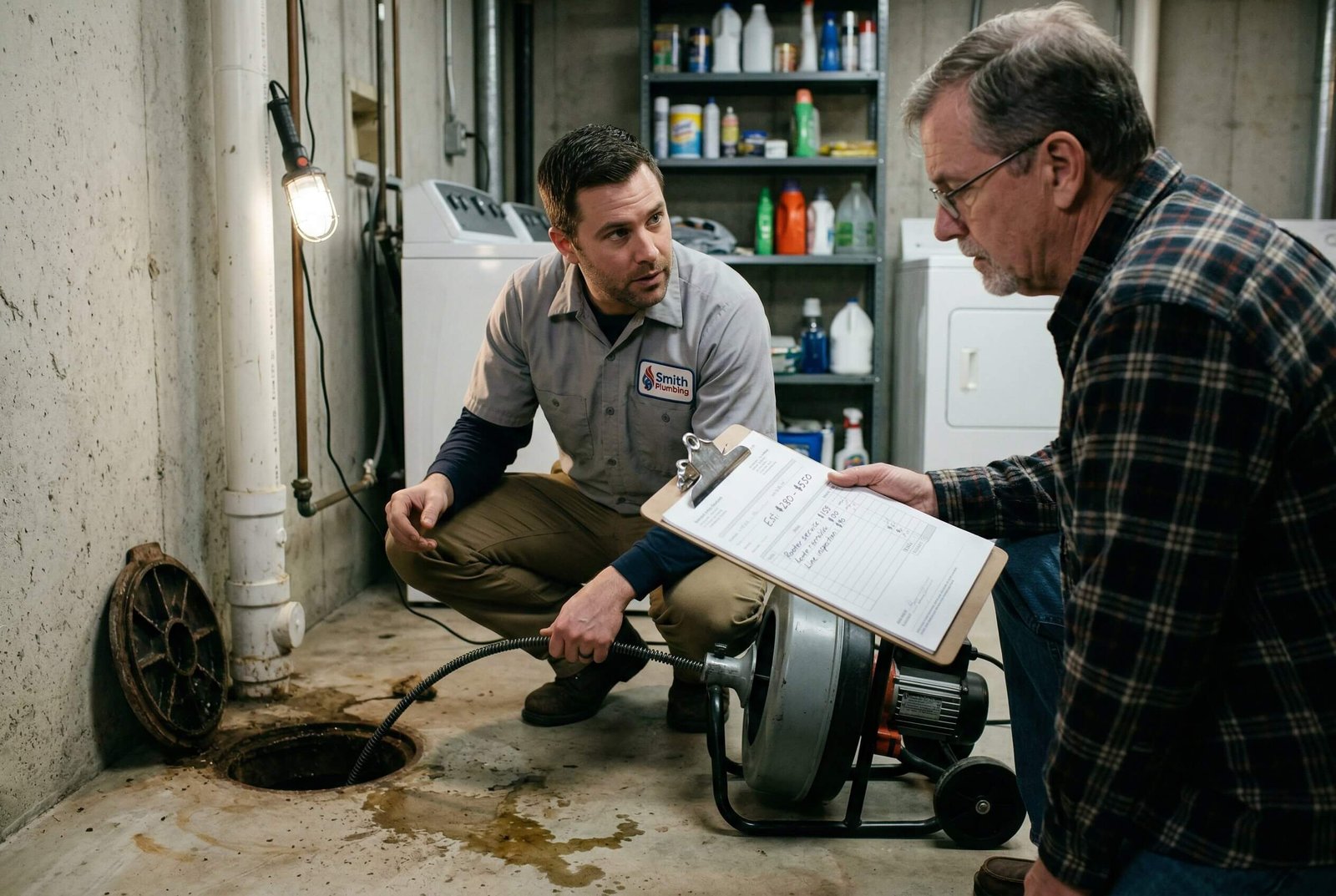
A drain backup is one of the clearest signs that a plumbing problem has moved beyond a simple clog. When water starts coming back up instead of draining away, it usually means the blockage is deeper in the system or affecting more than one part of the plumbing.
This is why fixing a drain backup often costs more than clearing a regular clog.
In a typical clog, water slows down but still flows. In a backup, the system is overwhelmed. Wastewater has nowhere to go, so it reverses direction and comes back through sinks, showers, or toilets. That shift changes how the problem is handled. It is no longer just about clearing a pipe—it is about restoring proper flow across the system and preventing further damage inside the home.
From a plumber’s perspective, a drain backup requires more careful assessment. The blockage could be located deeper in the line, possibly in the main drain or sewer connection. It may also involve multiple fixtures, which increases the complexity of the job. In some cases, the backup is a symptom of a larger issue such as heavy buildup, root intrusion, or partial pipe failure.
Another important factor is timing. Backups often become urgent because they can lead to water damage, contamination, and disruption to daily use. When immediate service is required, the cost increases due to urgency and working conditions.
Understanding what a drain backup represents helps set realistic expectations. It is not just a clogged drain—it is a system-level problem that requires more time, more effort, and often more advanced tools to resolve. Once you understand that, the cost structure becomes much easier to evaluate.
What This Page Covers
ToggleAverage Cost to Fix Drain Backup in the U.S.
Fixing a drain backup typically costs more than clearing a simple clog because the problem usually involves deeper parts of the plumbing system and affects how multiple fixtures drain. The cost depends on how severe the backup is, how far the blockage has spread, and what is required to restore proper flow.
Most residential drain backup repairs fall within a broad range, but that range becomes clearer when you break it down by severity.
Typical Cost Range (Explained Properly)
- Minor localized backup: $150 – $400
- Moderate backup (multiple fixtures): $400 – $800
- Severe backup (main line or sewage issue): $800 – $1,500+
These ranges reflect how difficult it is to remove the blockage and restore the system, not just how long the job takes.
A minor backup usually involves a single fixture where water is starting to come back up, but the issue has not spread. These jobs can often be handled with basic tools and stay on the lower end.
Costs increase when the backup affects more than one fixture, such as a sink and shower draining poorly at the same time. This suggests a deeper blockage, which takes more time and effort to clear.
The highest costs are typically associated with severe backups, especially those involving the main drain line or sewage entering the home. These situations require more advanced methods, more time, and immediate attention.
What “Average Repair Cost” Actually Includes
When homeowners hear an average price, it usually refers to a standard service that includes:
- Diagnosing the source of the backup
- Accessing the affected drain or main line
- Using appropriate tools to clear the blockage
- Verifying that normal drainage has been restored
This type of service often falls in the $300 to $700 range, depending on how complex the issue is.
However, this average assumes that the backup can be resolved without additional complications such as pipe damage or recurring issues.
Difference Between Clearing a Clog vs Fixing a Backup
The reason backups cost more is because they are more complex than typical clogs.
A simple clog is often located near the drain opening and can be cleared quickly. A backup usually indicates that the blockage is deeper in the system, possibly affecting multiple fixtures or the main line.
This means:
- More time is needed to locate and clear the blockage
- Stronger equipment may be required
- The plumber must ensure the entire system is functioning properly again
Because of this added complexity, backup repairs naturally fall into a higher price range.
Real-World Baseline Expectation
A practical way to estimate your cost is to look at how widespread the problem is:
- If only one drain shows early signs of backup, the cost usually stays lower
- If multiple fixtures are involved, expect mid-range pricing
- If sewage or water is backing up into the home, costs move to the higher range due to urgency and complexity
Instead of focusing on a single number, understanding the level of the problem gives you a much more accurate expectation of what the repair will cost.
Cost by Type of Drain Backup Problem
The cost to fix a drain backup depends heavily on what kind of backup you are dealing with. From a plumber’s point of view, not all backups are equal. The number of fixtures involved, how far the blockage has spread, and whether sewage is involved all change how the job is handled.
This is why pricing varies even within backup situations. A small, localized backup is very different from a system-wide issue.
Single Fixture Backup (Sink, Tub, or Shower)
- Typical cost: $150 – $400
This is the simplest type of backup. It usually affects one drain where water starts coming back up instead of flowing out.
In most cases, the blockage is still close to that fixture and has not spread through the system. The plumber can often clear it using standard tools without needing deeper access.
Costs stay lower because:
- The issue is isolated
- The blockage is easier to reach
- Less time and equipment are required
However, if this problem is ignored, it can develop into a larger system issue.
Toilet Backup or Overflow
- Typical cost: $200 – $500
Toilet backups are more urgent because they can quickly create unsanitary conditions. Even if the blockage is not deep, the need for immediate resolution increases the cost.
If the blockage is caused by typical waste and is limited to the toilet, it can often be cleared with a toilet auger.
Costs increase when:
- The blockage extends beyond the toilet into the drain line
- Non-flushable items are involved
- There is active overflow requiring immediate control
The added urgency and potential for damage make these jobs more expensive than standard clogs.
Multiple Drains Backing Up
- Typical cost: $400 – $900
When more than one drain is backing up at the same time, it usually indicates a blockage deeper in the plumbing system, often in the main drain line.
This type of problem is more complex because:
- The blockage is not isolated
- Multiple parts of the system are affected
- The plumber must restore flow across the entire line
These jobs require more time, stronger equipment, and careful handling to ensure the issue is fully resolved.
Sewage Backup Inside the House
- Typical cost: $800 – $1,500+
This is one of the most serious types of drain backups. When sewage enters the home, the problem must be handled immediately to prevent contamination and damage.
These situations often involve:
- A fully blocked main line
- Heavy buildup or obstruction
- Immediate need to restore system function
Costs are higher because the job is both urgent and complex. The plumber must clear the blockage quickly while ensuring the system is safe to use again.
Scenario-Based Cost Breakdown
- Early-stage backup in one fixture: Usually stays in the $150 – $300 range
- Toilet or localized overflow: Moves toward $200 – $500
- Multiple drains affected: Typically starts around $400 and increases with severity
- Full sewage backup: Falls into the highest range due to urgency and system impact
The pattern is clear: as the backup spreads across the plumbing system, the cost increases. A localized issue is easier to fix, while system-wide problems require more time, equipment, and effort.
Understanding the type of backup you are dealing with helps you better estimate the cost and evaluate whether a quote is reasonable for your situation.
Cost by Repair Method
The method used to fix a drain backup has a direct impact on the total cost because not every backup can be solved the same way. Some problems need only a basic clearing, while others require deeper cleaning, diagnosis, or even minor repair work before normal drainage is fully restored.
From a homeowner’s point of view, it may all sound like the same job: “fix the backup.” But from a plumber’s point of view, the method depends on what is causing the water to come back up, how far the blockage has spread, and whether the pipe itself is still in good condition. That is why the same symptom can lead to very different price ranges.
Basic Drain Clearing (Snaking)
- Typical cost: $150 – $400
This is the most common and least expensive repair method used for drain backups. A plumber feeds a cable or auger into the line to break through the blockage and restore water flow.
This method usually works when the backup is caused by a localized clog or a moderate blockage that has not fully coated the pipe walls. It is often enough for single-fixture backups or early-stage blockages in branch lines.
Costs stay lower when the clog is:
- Close to the affected fixture
- Soft or loosely compacted
- Cleared in one pass without extra work
However, snaking may only open a path through the obstruction rather than fully clean the pipe. That means it is often the most cost-effective short-term fix, but not always the most complete solution.
Hydro Jetting for Heavy Buildup
- Typical cost: $400 – $1,000+
Hydro jetting is used when the backup is caused by heavy grease, sludge, residue, or buildup that lines the inside of the pipe. Instead of simply punching through the blockage, this method uses high-pressure water to clean the pipe walls and remove accumulated material.
This method costs more because it requires stronger equipment, more setup time, and careful operation. It is especially common when the plumber wants to do more than just reopen the drain—they want to restore proper flow more thoroughly.
Hydro jetting is often justified when:
- The same backup keeps returning
- Multiple drains are affected
- Snaking would only provide a temporary fix
- The pipe has significant buildup over a longer section
While more expensive upfront, it can reduce repeat service calls by addressing the problem more completely.
Camera Inspection for Diagnosis
- Typical cost: $150 – $400
A camera inspection is often added when the cause of the backup is unclear, when the issue keeps coming back, or when the plumber suspects something more serious than a standard clog.
A small camera is inserted into the pipe so the plumber can see exactly what is happening inside. This helps identify whether the problem is caused by grease, roots, a collapsed section, a trapped object, or another obstruction deeper in the line.
This adds cost, but it often saves money in the bigger picture because it reduces guesswork. Instead of trying one method after another, the plumber can choose the right approach based on what is actually inside the pipe.
Camera inspection becomes especially valuable when:
- Multiple repair attempts have failed
- The backup is recurring
- There may be damage in the pipe
- The blockage is deeper than expected
In those situations, diagnosis is often what prevents unnecessary work and repeated service charges.
Minor Pipe Repair if Needed
- Typical cost: $300 – $1,500+**
(depending on access, pipe location, and extent of the issue)
Sometimes the backup is not caused by buildup alone. The plumber may find a cracked fitting, a damaged trap, a poor connection, or a small section of compromised pipe that is contributing to the problem.
In those cases, simply clearing the blockage may restore flow temporarily, but the underlying defect can cause the backup to return. That is when minor repair becomes part of the total cost.
Costs vary widely here because repair work depends on:
- Where the damaged section is located
- How easy it is to access
- Whether walls, floors, or cabinets affect access
- How much pipe needs to be replaced
This is the point where a drain backup repair shifts from cleaning into actual plumbing repair, which is why the price can rise quickly.
Method vs Cost Comparison
- Basic snaking: lowest cost, fastest option for simple or localized backups
- Hydro jetting: higher cost, better for heavy buildup and recurring issues
- Camera inspection: added cost, improves diagnosis and prevents guesswork
- Minor pipe repair: variable cost, needed when damage contributes to the backup
Why Repair Method Changes the Total Cost So Much
The repair method determines how completely the problem is being handled.
A basic snake may restore flow quickly and at a lower cost, but it may not remove all buildup. Hydro jetting costs more because it cleans the pipe more thoroughly. Camera inspection adds diagnostic value that can prevent wasted work. Minor repairs increase cost because they go beyond cleaning and address physical problems in the plumbing.
That is why drain backup pricing can vary so much from one home to another. The symptom may look similar, but the method required to fix it properly can be very different.
Understanding the method behind the quote helps you judge whether the price matches the actual work. That is one of the best ways to avoid overpaying while still making sure the backup is fixed the right way.
What Affects Drain Backup Repair Cost
Drain backup repair costs can vary widely, even when two homeowners seem to be dealing with a similar problem. That is because a backup is not priced by symptom alone. A plumber is not just charging for “water coming back up.” They are pricing the difficulty of finding the blockage, reaching it, clearing it, and making sure the drainage system is working properly again.
This is why one backup may cost a few hundred dollars to fix, while another can quickly move into a much higher range. The details of the job matter, and those details are what drive the final price.
Severity of the Backup
The more severe the backup, the more work is usually required to fix it.
If water is only starting to rise in one fixture and the problem is caught early, the blockage may still be small and localized. These jobs are generally faster, easier to control, and less expensive.
If wastewater is backing up more aggressively or spreading to multiple drains, the plumber is dealing with a more advanced obstruction. At that point, the blockage is usually deeper, denser, or affecting a larger part of the system. That increases labor time, raises the chance that stronger equipment will be needed, and often makes the repair more expensive.
Severity also affects urgency. A small backup may be inconvenient, but a large one can threaten flooring, walls, and sanitation inside the home. That is another reason severe backups cost more to resolve.
Location of the Blockage
Where the blockage is located has a major influence on price.
A blockage close to the affected fixture is usually easier to reach and clear. If the plumber can access it quickly through the drain opening or a nearby section of pipe, the job is more straightforward and tends to stay on the lower end of the range.
If the blockage is deeper in the branch line or main drain line, the repair becomes more involved. More cable length may be needed, more time may be required to locate the obstruction, and stronger equipment may be necessary to clear it effectively.
Main line-related backups are usually the most expensive because they affect the plumbing system at a broader level. The plumber is no longer dealing with one drain. They are working to restore flow across the house.
Accessibility of the Pipes
Accessibility is one of the most overlooked pricing factors, but it can make a big difference.
If the affected drain or cleanout is easy to reach, the plumber can begin diagnosing and clearing the blockage quickly. This keeps labor time lower and makes the repair more efficient.
If access is limited, the job becomes more difficult. Pipes may be hidden behind cabinets, under floors, in walls, or in areas with poor working space. In some homes, there may not be an accessible cleanout at all, which can make deeper backups more time-consuming to handle.
The harder it is to reach the problem area safely, the more labor is involved, and the more the repair usually costs.
Time and Labor Required
Time is one of the simplest but most important factors in pricing.
A drain backup that clears in 30 minutes will naturally cost less than one that takes two hours to diagnose and fix. Even when the tools used are similar, labor time changes the final bill significantly.
Backups often take longer than simple clogs because the plumber may need to test fixtures, verify flow, check whether other drains are affected, and make sure the line is fully open before finishing the job.
When the work takes longer, the price increases. That is especially true if the plumber has to switch methods or make repeated attempts to fully resolve the problem.
Equipment Needed
The type of equipment required also has a direct effect on cost.
A basic auger or drain snake is usually the least expensive option and works well for many minor backups. But if the blockage is severe, recurring, or spread across a larger section of pipe, more advanced tools may be necessary.
This can include:
- motorized augers
- hydro jetting equipment
- camera inspection tools
- repair tools for damaged sections of pipe
Each added level of equipment increases the complexity of the job and raises the cost. You are not only paying for the tool itself, but for the skill and time needed to use it properly.
Emergency vs Scheduled Service
Timing also plays a major role in drain backup repair cost.
If the backup can be handled during regular business hours, the price is usually lower because the plumber can schedule the work more efficiently. The job is still priced based on its difficulty, but without the added cost of urgent response.
If the backup happens at night, on a weekend, or during a holiday—and immediate service is needed—the cost increases. This is because emergency work requires rapid response, after-hours labor, and less scheduling flexibility.
In many backup cases, homeowners are not just paying for repair. They are paying for immediate availability to prevent further damage.
Key Cost Drivers (Quick View)
- More severe backups usually cost more to fix
- Deeper blockages are more expensive than surface-level clogs
- Hard-to-reach pipes increase labor time
- Longer repair time raises the overall bill
- Advanced equipment adds to the cost
- Emergency service usually costs more than scheduled repair
When you understand these factors, pricing becomes much easier to judge. Instead of looking only at the final number, you can look at what is actually making the repair more complex.
That is the key to knowing whether a quote is reasonable. A drain backup may look like one problem from the surface, but the real cost depends on what is happening inside the system and what it takes to fix it properly.
Emergency vs Standard Backup Repair Pricing
Drain backups often become expensive not only because of the blockage itself, but because of when the problem happens and how urgently it needs to be handled. A drain backup during normal working hours can often be scheduled and repaired at a more controlled cost. But when the same problem happens at night, on a weekend, or during a holiday—and water is actively backing up into the home—the pricing changes quickly.
This is the difference between standard repair pricing and emergency repair pricing. The plumbing problem may be similar in nature, but the service conditions are very different.
When a Drain Backup Becomes an Emergency
A drain backup becomes an emergency when it starts causing active disruption, property risk, or sanitation concerns inside the home.
This usually includes situations such as:
- wastewater backing up into sinks, tubs, showers, or toilets
- multiple fixtures becoming unusable at the same time
- sewage entering living areas or lower drains
- water overflow that can damage flooring, cabinets, or walls
In these cases, waiting is often not practical. The issue has moved beyond inconvenience and into damage prevention. From a plumber’s point of view, that means immediate response is needed, which increases the cost.
Standard vs Emergency Cost Difference
- Standard drain backup repair: $150 – $700
- Emergency drain backup repair: $300 – $1,500+
The lower range usually applies when the problem can be addressed during normal business hours and before the backup becomes severe. In those cases, the plumber has more flexibility in scheduling, diagnosing, and choosing the repair approach.
Emergency pricing is higher because the plumber must respond quickly, often outside regular hours, and deal with a situation that may already be worsening inside the house. Even when the repair method is similar, the speed and urgency of the service raise the total cost.
Why Emergency Backup Repairs Cost More
Emergency repair pricing reflects more than just after-hours labor. It reflects the entire pressure of the situation.
First, there is the availability factor. A plumber must either remain on call or interrupt other work to respond immediately. That flexibility comes at a cost.
Second, emergency backups are usually more severe by the time the call is made. A homeowner may wait until water is actively coming back up, which means the blockage is often more developed, deeper in the line, or affecting multiple drains. That naturally increases the labor and equipment required.
Third, the plumber is working under urgent conditions. The goal is not just to clear the blockage eventually. It is to stop the backup, prevent further damage, and restore basic use of the plumbing system as quickly as possible. That higher-pressure service environment is a major part of why emergency pricing is higher.
When Emergency Pricing Is Unavoidable
There are many situations where emergency pricing is completely justified.
If sewage is backing up into the house, delaying service can create contamination issues and significantly increase cleanup costs. If water is overflowing onto floors or into finished spaces, the cost of waiting can become much higher than the cost of immediate repair. If all essential plumbing fixtures are unusable, then immediate repair is often the only realistic option.
In these situations, emergency service is not an unnecessary premium. It is a damage-control response, and the higher cost reflects the urgency and potential consequences of delay.
When You May Be Able to Avoid Emergency Pricing
Not every drain backup needs immediate after-hours service.
If the problem is mild, limited to one fixture, and not actively causing overflow or damage, it may be possible to wait for a scheduled appointment during regular business hours. For example, a tub draining slowly and showing minor backup signs may still be manageable until the next day. In contrast, wastewater rising from multiple drains is not something that should wait.
The earlier the problem is addressed, the more likely it is to stay in the standard pricing range. Many backups begin with warning signs like slow drainage, occasional gurgling, or minor recurring clogs. Taking action during that stage can prevent the problem from turning into a true emergency.
Typical Differences in Real Situations
A single shower backup caught early and scheduled for the next day may stay in a moderate price range because the plumber can approach the work calmly and under normal conditions.
That same issue, if ignored until it affects the toilet and bathroom sink late at night, may fall into emergency pricing because the system-wide impact changes both the urgency and the repair difficulty.
A standard repair usually gives the plumber more time to assess and fix the issue in the most efficient way. An emergency repair focuses first on immediate control and restoration, which often costs more because it has to happen now, not later.
Understanding the difference between emergency and standard backup repair pricing helps you make better timing decisions. In many cases, early action is what keeps a backup affordable. Once the problem escalates into an urgent situation, the higher cost is often tied not just to the blockage, but to the speed, availability, and damage prevention involved in resolving it.
How to Avoid Overpaying for Drain Backup Repairs
Drain backup repairs are one of the easiest plumbing costs to misjudge because homeowners often see the symptom but not the actual cause. Water coming back up through a sink, tub, or toilet feels like one clear problem, but in reality, the backup could be coming from a simple localized clog, a deeper branch-line blockage, a main line issue, or even a damaged section of pipe. That uncertainty is exactly why some homeowners overpay for work they did not need, while others underestimate a serious problem and delay the repair until it becomes much more expensive.
The first step in avoiding overpaying is understanding when a backup should still be in the lower range. If the issue is limited to one fixture, caught early, and not causing active overflow or sewage exposure, the repair is often still relatively straightforward. In those cases, a basic clearing method may be enough, and the job should not automatically jump to the cost of a major line problem. A backup that is isolated to a single tub or sink is very different from one that affects multiple drains throughout the home.
Another important part of avoiding overpaying is listening for the reasoning behind the quote. A fair price should always connect to a clear explanation. If a plumber recommends hydro jetting, camera inspection, or a larger repair, there should be a practical reason tied to the symptoms, the location of the blockage, or the condition of the pipe. When the explanation is specific, the price becomes much easier to understand. When the explanation is vague, rushed, or based only on urgency, that is when homeowners should slow down and ask more questions.
It is also important to understand that a higher price is not always a sign of overcharging. Sometimes a backup really does require more advanced work. If multiple fixtures are involved, if the issue is recurring, if the blockage is deep in the main line, or if the plumber suspects roots or pipe damage, a more expensive solution may be justified. In those cases, paying more upfront can actually save money by preventing repeated service calls and temporary fixes that never fully solve the problem.
One of the biggest reasons homeowners overpay is timing. A drain backup often begins with smaller warning signs such as slow drainage, minor bubbling sounds, or occasional water rise in one fixture. At that stage, the problem may still be manageable and less expensive to repair. But once it is ignored and turns into a full backup, especially one involving multiple drains or sewage, the repair becomes more urgent, more complex, and more expensive. The cost increase is not arbitrary. It reflects the fact that the plumber is now solving a larger problem under more difficult conditions.
There are also practical habits that help reduce the chance of paying too much in the future. Addressing slow drains early, avoiding grease or non-flushable waste, paying attention to repeated backup patterns, and scheduling service during regular hours whenever possible all help keep repair costs lower. These are simple decisions, but they often make the difference between a moderate repair and a costly emergency call.
In the end, avoiding overpaying does not mean always choosing the cheapest option. It means understanding whether the quoted method matches the actual problem. A well-explained moderate-to-high price can be completely fair if the backup is serious. A low price can also become expensive later if it only provides a temporary fix. The goal is to pay for the right repair at the right stage, before the situation grows into something much more disruptive and much more costly.
Final Thoughts
The cost to fix a drain backup in a house depends on more than the visible symptom. What looks like water coming back up through one drain can actually point to a much larger issue deeper in the system. That is why pricing varies so much. Some backups are isolated and relatively simple to clear, while others involve multiple fixtures, severe blockages, or even damage in the drain line itself.
The most important thing to understand is that drain backup pricing follows complexity. A small, early-stage backup usually costs less because it is easier to reach and fix. Once the blockage becomes deeper, spreads across the system, or turns into an urgent overflow situation, the repair becomes more expensive because more time, stronger equipment, and more careful work are required.
It is also important to remember that higher pricing is not always unreasonable. In many cases, it reflects the real effort needed to fix the issue properly and keep it from returning right away. At the same time, not every backup needs the most expensive method. The right approach depends on the cause, the severity, and the condition of the pipe.
In practical terms, there are a few clear takeaways homeowners should keep in mind:
- Early-stage backups are usually cheaper to fix
- Multiple drains backing up often means higher repair cost
- Emergency timing increases the price significantly
- Clear explanations are one of the best signs of fair pricing
When you understand what is driving the cost, drain backup repairs become much easier to evaluate. Instead of reacting only to the quote, you can look at the reason behind it and decide whether the repair method matches the problem.
That understanding is what helps you avoid overpaying, prevent temporary fixes, and make better decisions before the backup turns into an even more expensive issue.