
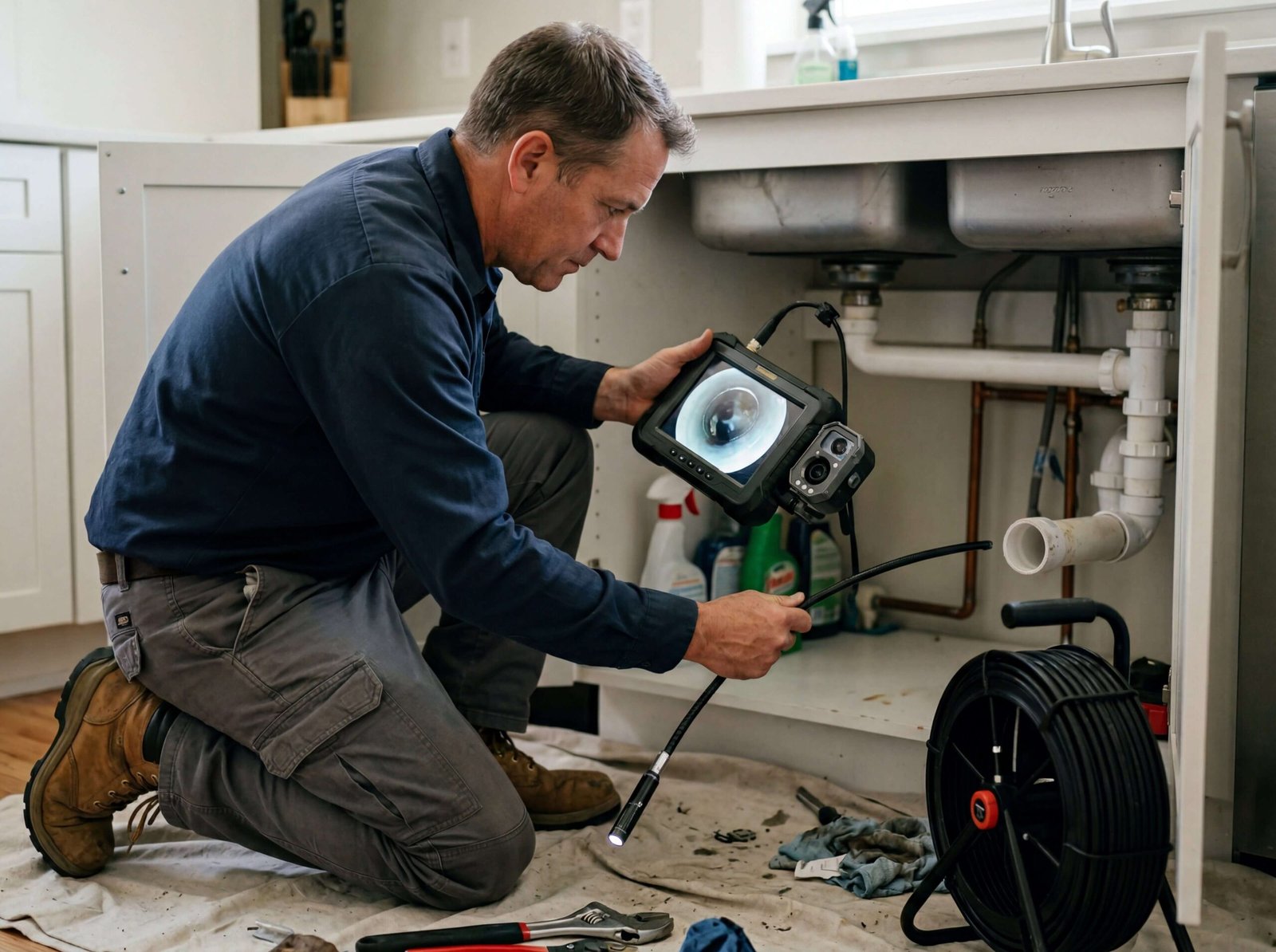
Many drain problems are not visible from the surface. What you see—slow drainage, backups, or recurring clogs—is only the symptom. The actual cause is often deeper inside the pipe, where buildup, blockages, or damage cannot be seen directly. This is where most homeowners run into frustration. Without visibility, every attempt to fix the problem becomes guesswork.
Traditionally, drain issues were handled by trying different tools until something worked. A plunger, then a snake, then maybe a stronger tool. Sometimes this approach clears the problem, but often it only provides temporary relief because the real issue was never fully identified. The clog might be deeper, the pipe might be damaged, or the buildup might be more extensive than expected.
Drain inspection cameras change that approach completely. Instead of guessing, plumbers can see exactly what is happening inside the pipe. This allows them to identify the type of clog, its location, and the overall condition of the plumbing system before choosing a solution. It removes uncertainty and replaces it with a clear understanding of the problem.
This shift from trial-and-error to accurate diagnosis is what makes camera inspection such an important part of modern drain work. It is not just about finding a clog—it is about understanding the entire situation so the right method can be used from the start.
When you can see inside the pipe, decisions become more precise. Tools are chosen based on actual conditions, not assumptions. That is what leads to more effective results and fewer repeated problems over time.
What This Page Covers
ToggleWhat a Drain Inspection Camera Actually Is
A drain inspection camera is not just a small camera attached to a wire. It is a specialized diagnostic tool designed to travel through pipes, handle harsh conditions, and provide clear visual information about what is happening inside the system. Its purpose is not just to look—it is to help identify problems accurately so the right solution can be chosen.
More Than Just a Camera
At a basic level, it may seem like a simple viewing device, but in practice, it is built specifically for plumbing environments. Pipes are dark, wet, narrow, and often filled with debris. A regular camera would not function effectively in these conditions.
A drain inspection camera is designed to move through these environments while maintaining visibility and stability. It can navigate bends, pass through water, and still provide a clear image. This makes it very different from standard cameras, which are not built for this type of use.
What sets it apart is not just the ability to capture images, but the ability to do so while traveling through an active plumbing system. It becomes an extension of the plumber’s vision, allowing them to see areas that would otherwise be completely inaccessible.
Core Purpose of a Drain Camera
The main purpose of a drain inspection camera is to remove uncertainty. Instead of assuming what might be causing the problem, it provides direct visual confirmation. This allows for more accurate decisions and reduces the chances of using the wrong method.
A drain camera is typically used to:
- Locate clogs precisely rather than searching blindly through the system
- Identify the type of blockage, whether it is grease, debris, or something more severe
- Assess pipe condition, including signs of wear, cracks, or corrosion
- Detect hidden issues such as root intrusion or misaligned sections
This level of detail changes how drain problems are handled. Instead of reacting to symptoms, the focus shifts to understanding the cause.
When you know exactly what is inside the pipe, you can choose the right tool and approach with confidence. This not only improves effectiveness but also prevents unnecessary work and reduces the risk of making the problem worse.
How Drain Inspection Cameras Are Built
A drain inspection camera is designed to function in one of the most challenging environments inside a home—narrow, wet, dark pipes filled with debris. Its effectiveness comes from how each component is built to handle these conditions while still providing clear, usable information.
Flexible Push Rod Cable
The push rod cable is what allows the camera to travel through the pipe. It needs to be flexible enough to move through bends like P-traps and elbows, but also stiff enough to be pushed forward without collapsing.
This balance is critical. If the cable is too soft, it will coil up and fail to advance. If it is too rigid, it will struggle to navigate turns. The design allows it to move steadily through the system while maintaining control, even over longer distances.
The length of the cable determines how far into the system the camera can reach. Shorter cables are used for local inspections, while longer ones are designed for deeper sewer lines.
Waterproof Camera Head
The camera head is built to operate fully submerged in water and surrounded by debris. It is sealed to prevent damage and designed to handle continuous exposure to moisture and waste.
It also uses a wide-angle lens, which allows it to capture more of the pipe interior in a single view. This helps in identifying blockages, buildup, or damage without needing perfect positioning.
The size of the camera head is carefully chosen so it can pass through standard pipe diameters without getting stuck while still providing a clear image.
LED Lighting System
Pipes are completely dark environments, so the camera relies on built-in lighting. Small LED lights are positioned around the camera head to illuminate the inside of the pipe as it moves forward.
This lighting is designed to be strong enough to reveal details without creating glare or distortion. Proper lighting is what allows plumbers to see the texture of buildup, the shape of blockages, and the condition of pipe walls.
Without this lighting system, even a high-quality camera would not provide usable information.
Monitor and Display Unit
The camera is connected to a monitor that displays the video feed in real time. This allows the plumber to see exactly what the camera sees as it moves through the pipe.
The display unit is not just for viewing—it also helps with navigation and decision-making. Many systems include the ability to record footage, which can be reviewed later or used to explain the problem clearly.
Having real-time feedback is what makes the process efficient. Instead of guessing where the camera is or what it is encountering, the plumber can adjust movement and approach based on what is visible.
Why the Build Matters
Each component of a drain inspection camera is designed to work together as a system. The cable moves the camera, the camera captures the image, the lighting makes it visible, and the monitor allows interpretation.
When all parts function properly, the result is a clear and accurate view inside the pipe. This is what turns a hidden problem into something that can be understood and solved correctly.
The strength of a drain camera is not just in seeing—it is in seeing clearly enough to make the right decision.
How Drain Inspection Cameras Work
A drain inspection camera works by providing a real-time view inside the pipe while being guided through the system. It does not fix the problem directly—it helps identify it with accuracy. This is what allows plumbers to choose the right solution instead of relying on trial-and-error methods.
Step-by-Step Process
- Inserting the camera into the drain
The camera is fed into the pipe through an accessible opening such as a drain, cleanout, or inspection point. It is introduced slowly to ensure it follows the natural path of the pipe without resistance. - Navigating through the pipe system
As the camera moves forward, it passes through bends, joints, and varying pipe sections. The flexible push rod allows controlled movement, while the operator adjusts direction and speed based on what appears on the screen. - Identifying blockages or issues
When the camera encounters resistance or a visible change in the pipe, the operator examines the area closely. This is where clogs, buildup, or structural issues become visible. The camera provides enough detail to understand what is causing the problem. - Marking the location and depth
Once the issue is identified, its position is noted. Many systems allow estimation of distance based on how much cable has been fed into the pipe. This helps locate the problem precisely without unnecessary digging or guesswork. - Recording findings for reference
The footage can be recorded and reviewed if needed. This is useful for confirming the diagnosis, planning the next step, or explaining the issue clearly.
What Plumbers Look for Inside Pipes
The camera does more than show that a clog exists—it reveals the nature of the problem. This information determines what tool or method should be used next.
- Type of clog
Whether it is grease, hair, debris, or a more solid obstruction affects how it should be cleared. - Pipe condition
The camera reveals cracks, corrosion, or wear that could affect how aggressively the pipe can be treated. - Tree root intrusion
Roots entering the pipe can be identified visually, including how dense or widespread they are. - Misalignment or damage
Sections of pipe that have shifted, collapsed, or separated can be detected, which may require repair rather than cleaning.
Why This Process Matters
Without a camera, most drain work relies on assumptions. A tool is chosen based on symptoms, not actual conditions. This often leads to partial fixes or repeated attempts.
With a camera, the process becomes precise. The problem is identified first, then the correct solution is applied. This reduces unnecessary effort and increases the chances of resolving the issue completely.
The real value of a drain inspection camera is not just seeing inside the pipe—it is understanding what you see well enough to make the right decision.
Types of Drain Inspection Cameras
Drain inspection cameras vary based on how far they can reach, the quality of the image they provide, and the type of work they are designed for. Choosing the right type is important because not every inspection requires the same level of equipment.
Basic Residential Cameras
Basic cameras are designed for short-range inspections. These are typically used for sinks, showers, and small household drains where the problem is likely close to the surface.
They are compact, easier to handle, and suitable for simple diagnostics. Their main advantage is accessibility—they can quickly confirm whether a clog is present and give a basic idea of what is causing it.
However, their limitations become clear when the issue is deeper in the system. They have shorter cables, lower image quality, and less ability to navigate long or complex pipe runs. For simple situations, they are effective, but they are not built for full system inspection.
Mid-Range Inspection Systems
Mid-range cameras provide a balance between capability and control. They are commonly used for more detailed residential inspections and can reach deeper into the plumbing system.
These systems offer better image clarity and longer cable lengths, which makes it easier to identify not just clogs, but also buildup patterns and pipe condition. They are often used when the problem is not immediately visible or when previous attempts to clear the drain have not been successful.
They also provide more reliable navigation through bends and longer sections of pipe. This makes them one of the most practical options for diagnosing recurring or unclear issues in a home.
Professional Sewer Cameras
Professional-grade cameras are designed for long-distance inspection and high-detail analysis. These systems are used for main sewer lines, deep pipe runs, and complex plumbing systems.
They offer high-resolution imaging, extended cable lengths, and greater control during navigation. This allows plumbers to inspect entire sections of a system and identify problems that would not be visible with basic equipment.
These cameras are built for accuracy and depth. They can reveal structural issues, large-scale buildup, and conditions that require more advanced solutions.
Choosing the Right Type
The type of camera used depends on the situation, not just the availability of the tool. A small camera is sufficient for local clogs, while deeper or recurring issues require more advanced systems.
Using the right camera ensures that the inspection is complete and accurate. If the camera cannot reach the problem or provide a clear image, the diagnosis remains incomplete.
When the equipment matches the situation, the inspection becomes more effective, and the next steps can be planned with confidence.
When to Use a Drain Inspection Camera
A drain inspection camera is not needed for every clog, but it becomes essential when the problem is unclear, recurring, or deeper than surface-level tools can handle. The goal is to remove guesswork and understand exactly what is happening inside the pipe before choosing a solution.
- Recurring clogs in the same drain
When a drain keeps clogging even after being cleared, it usually means the underlying issue has not been fully resolved. A camera helps identify whether the problem is leftover buildup, a deeper obstruction, or something structural. Without inspection, you may continue treating the symptom instead of the cause. - Unknown blockage location
Sometimes the clog is not near the drain opening. It may be further down the line, beyond the reach of basic tools. A camera allows you to locate the exact position of the blockage, which makes the cleaning process more targeted and efficient. - Before using stronger cleaning methods
Tools like hydro jetting or motorized augers are effective, but they require an understanding of pipe condition. A camera inspection ensures that the pipe can handle the method being used and helps determine the correct approach. - Suspected pipe damage or deeper issues
Slow drainage or backups can sometimes be caused by cracked, misaligned, or collapsed pipes rather than simple clogs. A camera can confirm whether the issue is a blockage or a structural problem that requires a different solution.
Using a drain inspection camera at the right time changes the entire process. Instead of trying multiple tools without certainty, you start with a clear diagnosis. This leads to more accurate decisions, fewer repeated attempts, and better long-term results.
When Cameras Are Most Valuable
A drain inspection camera becomes most valuable when the decision you make next matters. It is not just about seeing inside the pipe—it is about avoiding mistakes that come from acting without clarity. In certain situations, using a camera first can prevent unnecessary work, reduce risk, and lead to a more effective solution.
Before Hydro Jetting
Hydro jetting is a powerful cleaning method, but it should not be used without understanding the condition of the pipe. A camera inspection helps confirm whether the pipe can handle the pressure and what type of buildup is present.
Without inspection, there is a risk of applying too much force to a weakened or damaged pipe. The camera provides a clear view of the pipe’s condition, allowing the pressure and approach to be adjusted accordingly. It also confirms whether hydro jetting is the right method in the first place or if another approach would be more effective.
Before Major Repairs
When a drain problem appears severe, it is easy to assume that a repair or replacement is needed. However, without visual confirmation, this can lead to unnecessary work. A camera inspection helps determine whether the issue is actually structural or simply a blockage that can be cleared.
This is especially important when digging or pipe replacement is being considered. The camera allows the exact location and nature of the problem to be identified, which prevents guesswork and reduces the scope of work required.
When Accuracy Matters Most
The value of a drain camera increases as the complexity of the problem increases. In simple cases, tools alone may be enough. But when the situation involves deeper lines, recurring issues, or potential damage, accuracy becomes critical.
Using a camera at these moments ensures that:
- The correct method is chosen from the start
- The risk of unnecessary damage is reduced
- Time is not wasted on ineffective solutions
Why Timing of Inspection Is Important
The biggest mistake is using a camera too late, after multiple attempts have already been made. At that point, time and effort have already been spent without a clear understanding of the problem.
When used early, the camera changes the entire approach. It provides clarity before action, which leads to better decisions and more reliable results.
In situations where the outcome depends on choosing the right method, a drain inspection camera is not just helpful—it becomes one of the most valuable tools in the entire process.
How Cameras Prevent Wrong Solutions
One of the biggest advantages of using a drain inspection camera is that it removes guesswork. Without visibility inside the pipe, most decisions are based on symptoms rather than actual conditions. This often leads to using the wrong tool, applying the wrong method, or repeating the same ineffective approach multiple times.
Avoiding Unnecessary Digging
In more serious cases, drain problems can lead to the assumption that pipes need to be repaired or replaced. Without proper inspection, this can result in unnecessary digging or invasive work. A camera allows the exact location and nature of the issue to be confirmed before any major action is taken.
If the problem is only a blockage, it can be cleared without disturbing the system. If there is actual damage, the repair can be targeted precisely. This prevents large-scale work when it is not needed and ensures that any repair that is done is accurate.
Preventing Use of the Wrong Tool
Different drain problems require different solutions. A grease buildup, a hair clog, and a structural pipe issue all behave differently and respond to different methods. Without a clear view, it is easy to choose a tool that does not fully address the problem.
A camera inspection identifies the exact type of issue, which allows the correct tool to be selected from the start. This improves effectiveness and reduces the need for multiple attempts using different tools.
Reducing Trial-and-Error
Trial-and-error is one of the main reasons drain problems become frustrating. Trying one method after another without knowing the actual cause often leads to temporary fixes rather than complete solutions.
By using a camera first, the process becomes structured instead of reactive. The problem is identified clearly, and the solution is chosen based on that information. This reduces wasted time and effort.
Improving Efficiency and Results
When the right decision is made early, the entire process becomes more efficient. The correct tool is used, the clog is handled properly, and the chances of the issue returning are reduced.
This efficiency is not just about speed—it is about accuracy. Instead of repeating the same problem multiple times, the issue is addressed correctly in fewer steps.
Making the Process More Predictable
Without inspection, every attempt carries uncertainty. With a camera, the process becomes more predictable because the problem is visible. This allows each step to be planned with confidence.
Preventing wrong solutions is not just about avoiding mistakes—it is about improving the overall outcome. When you understand what is inside the pipe before taking action, the result is more reliable and long-lasting.
Common Problems Found with Cameras
A drain inspection camera does more than confirm that a clog exists—it reveals what kind of problem is inside the pipe and how serious it is. This is what allows plumbers to move from guessing to accurate diagnosis. Over time, certain types of issues show up repeatedly, and recognizing them helps determine the correct solution.
Grease Buildup
Grease is one of the most common problems in kitchen drains. Instead of forming a single blockage, it coats the inside of the pipe and gradually thickens. On camera, this appears as a narrowed pipe with a sticky, uneven layer along the walls.
This type of buildup is often the reason for slow drainage and recurring clogs. Mechanical tools may open a path through it, but they usually do not remove it completely. Seeing it clearly helps determine that deeper cleaning is needed rather than repeated clearing.
Hair and Debris Clogs
In bathroom drains, hair and soap combine to form dense, tangled clogs. On camera, these appear as fibrous masses that can trap additional debris over time. They are often located near bends or trap areas where material collects naturally.
These clogs can sometimes be removed directly, but if not fully cleared, they tend to return. The camera helps confirm whether the blockage is fully removed or still partially present inside the pipe.
Tree Root Intrusion
Roots entering sewer lines are a more serious issue. On camera, they appear as string-like or dense growths inside the pipe, often breaking through small openings or joints.
The camera not only confirms the presence of roots but also shows how extensive the intrusion is. This is important because light root growth can be cleared, while heavier intrusion may require more advanced solutions.
Pipe Cracks and Damage
Not all problems are clogs. Cameras often reveal cracks, corrosion, or sections where the pipe has weakened. These issues may not cause an immediate blockage but can lead to ongoing drainage problems.
Seeing this type of damage changes the approach completely. Instead of focusing on cleaning, the solution may involve repair or replacement.
Collapsed or Misaligned Sections
In more severe cases, parts of the pipe may be collapsed or shifted out of alignment. This creates a physical barrier that prevents proper flow. On camera, this appears as a sudden change in pipe shape or a section that is no longer continuous.
This type of issue cannot be solved with cleaning tools. Identifying it early prevents repeated attempts to clear a problem that requires structural correction.
Why Identifying the Exact Problem Matters
Each of these issues requires a different approach. Without a camera, they may all appear as a “clog” from the outside. With a camera, the exact cause becomes clear, which leads to the correct solution.
This is what makes drain inspection cameras so valuable. They do not just confirm that something is wrong—they show what is wrong, where it is, and how serious it is. That clarity is what leads to better decisions and more effective results.
Why Camera Inspection Is Not DIY-Friendly
A drain inspection camera may seem like a simple tool, but using it effectively requires more than just inserting it into a pipe. The challenge is not just seeing inside—it is understanding what you are seeing and controlling the equipment properly. This is why it is typically used at a professional level rather than as a DIY solution.
Equipment Cost
Drain inspection cameras are specialized tools, and their cost reflects that. Basic versions exist, but higher-quality systems that provide clear images, longer reach, and reliable performance are significantly more expensive.
For a homeowner, the investment often does not make sense. The tool is not used frequently enough to justify the cost, especially when its full capability depends on proper use and interpretation. Owning the equipment without the experience to use it effectively limits its value.
Interpretation Skills
Seeing inside a pipe is only useful if you can understand what you are looking at. Different types of buildup, damage, or obstructions can appear similar without experience. Misinterpreting what is on the screen can lead to choosing the wrong solution.
Professionals develop the ability to recognize patterns inside pipes. They can distinguish between grease buildup and structural damage, or between a simple clog and a deeper issue. Without that level of understanding, the camera may show the problem, but not clearly explain it.
Navigation Challenges
Moving the camera through a pipe requires control and awareness. Pipes are not straight—they include bends, joints, and varying diameters. The camera must be guided carefully to avoid getting stuck or losing direction.
Without proper handling, the camera may not reach the problem area or may provide incomplete information. Managing the cable, adjusting movement, and maintaining orientation all require practice.
Limitations Without Experience
Using a camera without experience often leads to partial results. You may see something, but not enough to make a confident decision. This can result in either underestimating the problem or taking unnecessary action.
The value of a drain inspection camera comes from combining visibility with correct interpretation. Without both, the process remains uncertain.
Why Professional Use Makes a Difference
Professionals use drain cameras as part of a larger system. They combine inspection with knowledge of tools, pipe behavior, and problem patterns. This allows them to move from observation to solution efficiently.
For homeowners, the practical approach is to rely on simpler tools for basic issues and use camera inspection when a clear diagnosis is needed. In those cases, having the inspection done correctly is more valuable than attempting it without the required experience.
Cost of Drain Camera Inspection (U.S.)
The cost of drain camera inspection is not just about the equipment—it reflects the value of accurate diagnosis. Instead of spending money on multiple attempts with different tools, a camera inspection helps identify the exact problem from the start. This often reduces overall cost by avoiding unnecessary work.
Equipment vs Service Cost
Professional drain inspection cameras are specialized tools designed for clarity, reach, and durability. High-quality systems can be expensive because they include advanced imaging, long cables, and reliable components that perform in difficult conditions.
For homeowners, purchasing this equipment is rarely practical. The tool is not used frequently enough, and its effectiveness depends heavily on experience. This is why camera inspection is typically offered as a service rather than something homeowners invest in directly.
The service includes not just the equipment, but also the expertise to interpret what is seen and recommend the correct next step.
Typical Inspection Pricing
The cost of a drain camera inspection can vary depending on several factors, including the complexity of the system and how accessible the pipes are. In general, typical pricing ranges from:
- Basic inspection: around $100 to $300
- More detailed or extended inspections: around $300 to $500
These costs can increase if the inspection involves longer sewer lines, difficult access points, or additional diagnostic work.
What You Are Paying For
The value of the inspection comes from clarity. Instead of guessing, you get a clear understanding of:
- The exact location of the problem
- The type of blockage or damage
- The condition of the pipe
This information helps avoid unnecessary repairs, prevents repeated attempts with the wrong tools, and allows the correct solution to be applied immediately.
Cost vs Outcome
Without inspection, multiple attempts to fix a drain issue can add up in both time and money. Each unsuccessful attempt increases frustration and may only provide temporary relief.
With a camera inspection, the process becomes more direct. The problem is identified once, and the solution is chosen based on accurate information. This often leads to better results with fewer repeated costs.
Why It Is a Practical Investment
A drain camera inspection is not something needed for every situation, but when the problem is unclear or recurring, it becomes one of the most cost-effective steps you can take.
It shifts the process from guessing to knowing. That change alone often saves more money than the cost of the inspection itself by preventing unnecessary work and ensuring the right solution is used from the beginning.
How Professionals Use Cameras Differently
The difference between a homeowner using a drain camera and a professional using the same tool is not the equipment—it is how the information is used. Professionals treat camera inspection as a diagnostic system, not just a way to look inside the pipe. They combine what they see with experience, allowing them to make accurate decisions quickly.
Reading the Pipe, Not Just Viewing It
A camera shows what is inside the pipe, but professionals go further—they interpret what it means. They understand how different materials look, how buildup forms, and how pipe damage presents itself.
For example, they can distinguish between a soft buildup that can be cleared easily and a structural issue that requires repair. They also recognize patterns, such as areas where clogs repeatedly form, which helps them identify underlying causes rather than just symptoms.
This ability to read the pipe is what turns visual information into actionable insight.
Combining Inspection with the Right Tools
Professionals do not treat camera inspection as a separate step. It is directly connected to the tools they use next. Once the problem is identified, they choose the method that matches the situation.
If the camera shows a localized clog, a mechanical tool may be used. If it shows widespread buildup, a more thorough cleaning method may be chosen. This targeted approach avoids unnecessary effort and ensures that the solution matches the problem.
The camera guides the decision, rather than the tool being chosen first.
Adjusting Strategy in Real Time
As the camera moves through the pipe, professionals adjust their approach based on what they see. If conditions change, they adapt immediately instead of continuing with a fixed plan.
This flexibility is important because drain systems are not always predictable. What starts as a simple clog may reveal deeper issues as the inspection continues. Being able to adjust in real time leads to more accurate results.
Focusing on Complete Diagnosis
Professionals do not stop at identifying the first visible issue. They continue the inspection to understand the full condition of the pipe. This includes checking for additional buildup, damage, or areas that may cause future problems.
This broader view helps prevent recurring issues. Instead of solving one problem at a time, they address the overall condition of the system.
Turning Information into Decisions
The real value of a drain camera comes from how the information is used. Professionals take what they see and turn it into a clear plan of action. This reduces uncertainty and ensures that each step is purposeful.
Without this step, the camera only provides images. With it, the inspection becomes a complete diagnostic process that leads directly to the correct solution.
What Homeowners Can Learn From This
The key takeaway is not just using the tool, but understanding its role. A drain camera is most effective when it is used to guide decisions, not just confirm that a problem exists.
When inspection leads to informed action, the entire process becomes more efficient and reliable. This is what allows professionals to solve problems more completely and avoid repeated issues over time.
Long-Term Strategy Using Camera Inspections
A drain inspection camera is not just a tool for diagnosing problems when they happen. When used strategically, it becomes part of a long-term system for maintaining your plumbing and preventing major issues before they develop. Instead of reacting to clogs, you begin to understand how your system behaves over time.
Preventive Inspection Use
Most drain problems build up gradually. Grease, debris, and wear inside the pipe do not cause immediate failure—they create conditions that eventually lead to clogs or damage. A camera inspection allows you to see these early signs before they turn into bigger problems.
Using inspection as a preventive step helps you:
- Identify buildup before it becomes a blockage
- Detect minor pipe issues early
- Plan maintenance instead of reacting to emergencies
This approach reduces unexpected problems and allows you to address issues in a controlled way.
Detecting Problems Before They Escalate
Some of the most expensive plumbing problems start small. A slight crack, a minor misalignment, or early root intrusion may not cause immediate symptoms. Over time, these issues grow and lead to more serious damage.
A camera inspection can reveal these conditions early. This allows you to take action before the situation becomes more complex or costly. Early detection is one of the biggest advantages of using inspection as part of a long-term strategy.
Reducing Repeated Drain Issues
Recurring clogs are often a sign that the root cause has not been fully addressed. Without inspection, each occurrence is treated as a separate problem. With inspection, patterns become visible.
You can identify:
- Areas where buildup consistently forms
- Sections of pipe that restrict flow
- Conditions that contribute to repeated clogs
Understanding these patterns allows you to apply more effective solutions and reduce how often the problem returns.
Supporting Smarter Maintenance Decisions
A camera inspection provides clear information that helps you decide what level of maintenance is needed. Instead of using tools blindly, you can choose the right method based on actual conditions.
This leads to:
- More targeted cleaning
- Better use of tools
- Fewer unnecessary interventions
Maintenance becomes more efficient because it is based on knowledge rather than assumptions.
Building a Predictable System
When camera inspections are used as part of a system, drain maintenance becomes more predictable. You are no longer waiting for problems to appear—you are monitoring and managing the condition of your pipes over time.
This creates a more stable plumbing system where:
- Issues are identified early
- Maintenance is planned, not reactive
- Major disruptions are less likely
Thinking Beyond Immediate Fixes
The biggest shift is moving from fixing problems to understanding the system. A drain camera allows you to see what is happening inside your pipes, which changes how you approach maintenance entirely.
When you use that visibility to guide decisions, you move from uncertainty to control. That is what makes camera inspections valuable not just as a diagnostic tool, but as part of a long-term strategy for keeping your plumbing system reliable.
Final Thoughts
Drain inspection cameras have changed how drain problems are solved. Instead of relying on guesswork, they allow you to see exactly what is happening inside the pipe before taking action. This shift from assumption to visibility is what makes modern drain work more accurate and effective.
What makes these cameras valuable is not just the ability to find clogs, but the ability to understand the condition of the entire system. A slow drain might be caused by buildup, a deeper obstruction, or even structural damage. Without inspection, all of these can look the same from the outside. With a camera, the difference becomes clear.
This clarity leads to better decisions. The right tool is chosen from the start, unnecessary work is avoided, and the chances of recurring problems are reduced. Instead of trying multiple solutions, the process becomes focused and predictable.
At the same time, it is important to recognize that a camera is a diagnostic tool, not a solution by itself. Its value comes from how the information is used. When combined with the right approach and tools, it allows problems to be handled more completely and efficiently.
The most practical takeaway is simple: seeing the problem before fixing it leads to better results. When you understand what is inside the pipe, you move from reacting to issues to solving them with clarity and confidence. That is what makes drain inspection cameras such an important part of maintaining a reliable plumbing system.