
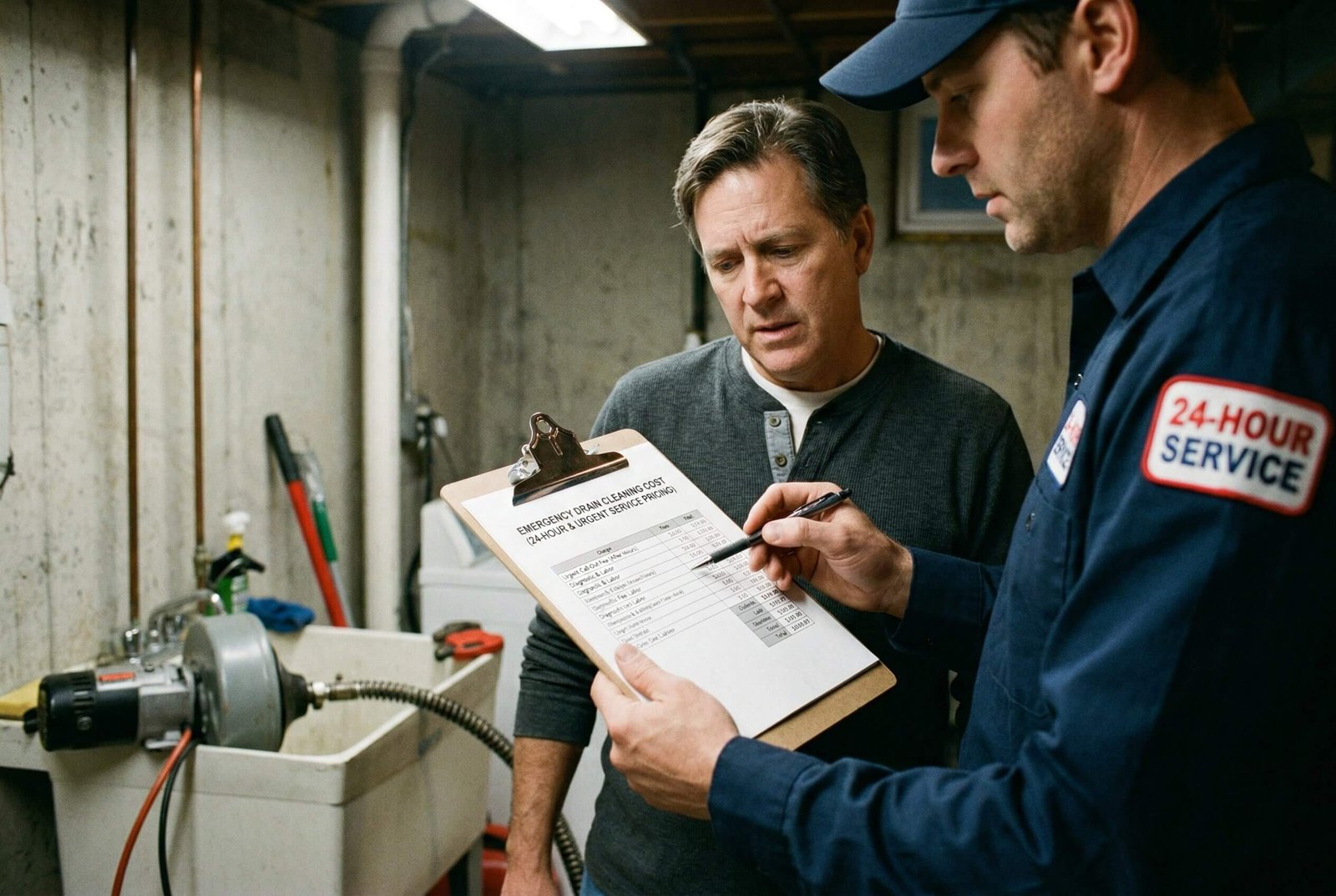
Emergency drain problems are not just inconvenient—they change how plumbing service is priced.
A slow drain or minor clog can usually wait for a scheduled appointment. But when water starts backing up, toilets overflow, or multiple drains stop working at once, the situation becomes urgent. At that point, the goal is no longer just cleaning a drain. It is restoring function quickly and preventing damage inside the home.
This shift from a routine issue to an urgent one is what increases the cost.
From a plumber’s perspective, emergency service is different from standard work. It requires immediate response, often outside normal working hours, and under conditions where the problem may already be causing disruption or damage. The plumber may need to rearrange existing jobs, extend working hours, or respond during nights, weekends, or holidays.
Another important factor is the condition of the drain at the time of the call. Emergency situations are usually more severe. By the time a homeowner calls urgently, the blockage is often fully developed or affecting multiple fixtures. This means more time, stronger equipment, and faster decision-making are required.
That is why emergency drain cleaning costs are higher than standard service. You are not just paying for the work itself—you are paying for speed, availability, and the ability to handle a problem under pressure.
Understanding this difference is important because not every drain issue needs emergency service. Knowing when a problem is truly urgent—and when it can wait—can make a significant difference in how much you pay.
What This Page Covers
ToggleAverage Emergency Drain Cleaning Cost in the U.S.
Emergency drain cleaning costs are higher than standard service because you are paying for both the work and the urgency. The same clog that might cost a moderate amount during regular hours can become significantly more expensive when handled immediately, especially outside normal working times.
Most emergency drain cleaning jobs fall into a wider and higher price range depending on how severe the situation is at the time of the call.
Typical Cost Range (Explained Properly)
- Minor emergency clog: $150 – $300
- Moderate urgent blockage: $300 – $600
- Severe emergency (main line or backup): $600 – $1,200+
These ranges reflect not just the difficulty of clearing the clog, but the urgency of the response.
A minor emergency usually involves a single fixture that is completely blocked and needs immediate use, such as a kitchen sink or toilet. The work itself may still be simple, but the timing increases the cost.
Moderate emergency situations involve deeper or more compacted clogs that require more time and effort. These often include blockages that are starting to affect multiple fixtures or causing partial backups.
Severe emergencies are typically system-level issues, such as a main drain blockage or sewage backup inside the home. These require more advanced equipment, more time, and immediate attention, which pushes costs into the higher range.
What “Emergency Cost” Actually Includes
Emergency pricing is not just a higher number—it reflects additional factors that are not part of standard service.
A typical emergency drain cleaning cost may include:
- Immediate call-out or dispatch fee
- Labor during off-hours (night, weekend, or holiday)
- Faster response time and priority scheduling
- Additional effort due to urgency and working conditions
This is why the cost increases even if the actual cleaning method is similar to a standard job.
Why Emergency Pricing Feels Higher
For many homeowners, emergency pricing feels unexpectedly high because it combines multiple cost elements at once.
First, there is the time factor. Work done outside regular hours carries higher labor rates.
Second, there is availability. The plumber must be ready to respond quickly, often adjusting their schedule or interrupting other work.
Third, there is the condition of the problem. Emergency calls usually involve more severe blockages that take longer to resolve.
All of these factors come together, which is why emergency service costs more than a scheduled visit.
Real-World Baseline Expectation
A practical way to estimate emergency cost is to consider both the severity of the clog and the timing of the service.
- A simple but urgent clog during off-hours will cost more than the same job during the day
- A deeper or system-wide blockage will increase cost regardless of timing
- A severe backup requiring immediate attention will fall into the highest range due to both complexity and urgency
Instead of focusing on a single number, it is more useful to understand how urgency and severity combine to determine pricing. That gives you a clearer expectation before calling for emergency service.
Cost by Type of Emergency Drain Problem
Not all emergency drain problems are the same, and the type of issue has a direct impact on cost. A plumber evaluates what is happening in real time—how many fixtures are affected, whether water is backing up, and how severe the blockage is.
This is why emergency pricing varies even within urgent situations. The more widespread and disruptive the problem, the higher the cost tends to be.
Single Drain Fully Blocked (Sink or Shower)
- Typical cost: $150 – $350
This is one of the most common emergency calls. It usually involves a sink or shower that has become completely unusable.
In many cases, the blockage is still localized and can be cleared with standard tools. The cost remains on the lower end when:
- The clog is near the drain opening
- Only one fixture is affected
- There is no backup elsewhere in the home
Even though the work itself may be straightforward, the emergency nature of the call increases the price compared to a scheduled visit.
Toilet Overflow or Immediate Blockage
- Typical cost: $200 – $400
Toilet emergencies are treated with higher urgency because they can quickly create unsanitary conditions.
If the blockage is caused by normal waste and paper and is not too deep, the cost remains moderate. However, costs increase when:
- Non-flushable items are involved
- The blockage extends beyond the toilet into the drain line
- There is active overflow that requires immediate control
The added urgency and potential for damage contribute to higher pricing compared to non-emergency situations.
Multiple Drains Backing Up
- Typical cost: $400 – $900
When more than one fixture is affected at the same time, it usually indicates a deeper problem in the main drainage system.
These jobs are more complex because the blockage is not isolated. The plumber must clear the line in a way that restores flow to the entire system.
Costs increase because:
- The blockage is deeper and more severe
- More time is required to fully clear the line
- Stronger equipment may be needed
This type of emergency often signals a main line issue rather than a simple clog.
Sewage Backup Inside the Home
- Typical cost: $600 – $1,200+
This is one of the most serious emergency situations. When sewage backs up into the home, the problem must be addressed immediately to prevent damage and contamination.
These jobs require:
- Immediate response
- Careful handling of the blockage
- More thorough cleaning of the line
Costs are higher because the situation is both urgent and complex. The plumber must restore flow quickly while minimizing further impact.
Scenario-Based Cost Breakdown
- Urgent single fixture blockage: Usually stays in the $150 – $300 range
- Toilet overflow or deeper fixture issue: Moves toward $200 – $400
- Multiple drains affected: Typically starts around $400 and increases with severity
- Full system backup or sewage issue: Falls into the highest range due to urgency and complexity
The key pattern is that emergency drain costs increase as the problem spreads across the system. A single blocked drain is easier to handle, even in urgent conditions. But once multiple fixtures or the main line are involved, the job becomes more demanding and requires more time, equipment, and care.
Understanding the type of emergency helps you better estimate the cost and evaluate whether a quote matches the severity of the situation.
Cost by Cleaning Method (Emergency Context)
In emergency situations, the cleaning method plays an even bigger role in cost because the goal is speed and reliability. A plumber is not just choosing the most cost-effective option—they are choosing the method that will restore flow quickly and safely under pressure.
This often means using stronger or faster methods than would be used in a scheduled visit, which directly increases the cost.
Emergency Snaking (Quick Flow Restoration)
- Typical cost: $150 – $400
Snaking is usually the first method used in emergency calls because it is fast and effective for many blockages. A cable is inserted into the drain to break through the clog and restore water flow.
In emergency situations, this method is preferred when:
- The blockage is localized to one fixture
- The clog is not extremely compacted
- Immediate usability needs to be restored quickly
Costs stay on the lower end when the clog clears in a single pass and no additional work is needed. However, if the blockage is deeper or more stubborn, the plumber may need to spend more time working through it, which increases the cost.
Snaking is often a quick solution, but it may not fully clean the pipe, especially if buildup is heavy.
Emergency Hydro Jetting
- Typical cost: $400 – $1,000+
Hydro jetting is used in emergencies when the blockage is severe, widespread, or cannot be cleared effectively with snaking alone.
In urgent situations, this method is chosen when:
- The pipe is heavily clogged with grease or sludge
- The blockage keeps reforming after initial attempts
- The problem affects multiple fixtures or the main line
Hydro jetting increases cost because it requires more setup, more time, and careful operation. In an emergency, it may be used to ensure the line is thoroughly cleared so the problem does not return immediately.
While expensive, it is often the more reliable option in severe cases where a quick but incomplete fix would not be enough.
Camera Inspection During Emergency
- Typical cost: $150 – $400
Camera inspection is sometimes used during emergency calls when the cause of the blockage is unclear or when initial attempts do not fully resolve the issue.
In urgent situations, inspection helps:
- Identify the exact location of the blockage
- Determine whether the issue is deeper in the system
- Confirm if there is damage or a recurring problem
This adds cost, but it can prevent repeated attempts and unnecessary work. Instead of guessing, the plumber can take a targeted approach, which is especially valuable when time is critical.
Method vs Cost Comparison
- Emergency snaking: Lower cost, fastest way to restore basic flow
- Emergency hydro jetting: Higher cost, more thorough and reliable for severe blockages
- Camera inspection: Additional cost, improves accuracy and avoids repeated work
Why Method Affects Cost More in Emergencies
In emergency situations, the priority shifts from cost efficiency to immediate resolution.
A plumber may choose a more aggressive or advanced method sooner than they would in a standard visit because there is no time to delay or experiment. The focus is on solving the problem quickly and preventing further disruption or damage.
This is why costs can increase even for similar blockages. The urgency changes how the job is approached, and that directly affects pricing.
Understanding this helps you evaluate recommendations more clearly. In emergencies, a higher-cost method is often chosen not because it is unnecessary, but because it is the most reliable way to resolve the issue quickly.
What Affects Emergency Drain Cleaning Cost
Emergency drain cleaning is not priced the same way as standard service because the situation itself changes how the job is handled. A plumber is not just dealing with the blockage—they are dealing with time pressure, urgency, and often a more severe condition of the drain.
This combination of factors is what causes emergency pricing to vary significantly from one situation to another.
Time of Service (Night, Weekend, Holiday)
One of the biggest cost drivers is when the service takes place.
Emergency calls during evenings, nights, weekends, or holidays are priced higher because they fall outside normal working hours. The plumber must adjust their schedule, remain available on call, or respond immediately when others would typically not be working.
Even if the actual clog is simple, the timing alone can increase the cost. This is why the same job can cost noticeably more at night compared to a scheduled daytime visit.
Severity of the Blockage
Emergency situations are often more severe than routine service calls. By the time a homeowner calls urgently, the blockage is usually fully developed or causing visible problems.
A partial clog that allows slow drainage is easier to handle. A complete blockage, especially one causing backups or overflow, requires more time and effort to resolve.
More severe blockages often need stronger tools, multiple passes, or additional methods, all of which increase the cost.
Location of the Clog
Where the blockage is located plays a major role in pricing.
A clog in a single fixture, such as a sink or shower, is usually easier to access and clear. These jobs tend to stay on the lower end of the emergency pricing range.
If the clog is deeper in the system—such as in the main drain line—it becomes more complex. The plumber must work through longer pipe sections and may need heavier equipment, which increases both time and cost.
Main line emergencies are typically the most expensive because they affect the entire plumbing system.
Accessibility Under Urgent Conditions
Accessibility becomes even more important during emergency calls.
If the plumber can quickly access the drain through a standard opening or cleanout, the job moves faster and stays more controlled.
If access is limited or difficult—such as pipes behind walls, under floors, or without a proper cleanout—the job takes longer. In emergency situations, this added complexity increases the cost because time is critical.
Time Pressure and Labor Intensity
Emergency work is often more demanding than scheduled service.
The plumber must work quickly to restore functionality, often under less-than-ideal conditions. There is less time for gradual troubleshooting, and more focus on immediate results.
This increases labor intensity. Even if the tools used are the same, the pace and pressure of the work contribute to higher pricing.
Equipment Required
The type of equipment needed also affects emergency cost.
Basic tools like standard snakes keep the job on the lower end. However, if the blockage requires motorized augers, hydro jetting, or inspection equipment, the cost increases.
In emergencies, plumbers may choose stronger or faster methods earlier in the process to ensure the issue is resolved quickly. This can raise the overall price compared to a more gradual approach during a scheduled visit.
Key Cost Drivers (Quick View)
- After-hours service increases labor cost
- Severe blockages require more time and effort
- Main line issues are more expensive than fixture clogs
- Limited access adds complexity and time
- Urgency increases labor intensity
- Advanced equipment raises overall pricing
When you understand these factors, emergency pricing becomes easier to evaluate. Instead of focusing only on the total cost, you can see what is driving it.
That understanding helps you make better decisions—both in urgent situations and in preventing them before they happen.
24-Hour vs Standard Drain Cleaning Pricing
One of the biggest differences in drain cleaning cost comes down to timing. A standard service call and a 24-hour emergency call may involve similar work, but the pricing can be significantly different because of how the service is delivered.
Understanding how 24-hour pricing works helps you decide when immediate service is necessary—and when it can be avoided.
How 24-Hour Service Pricing Works
24-hour drain cleaning services are designed to respond at any time, including nights, weekends, and holidays. This level of availability comes with higher operational costs, which are reflected in the price.
Emergency pricing typically includes:
- A higher call-out or dispatch fee
- Increased labor rates for after-hours work
- Priority scheduling over non-urgent jobs
Even if the actual cleaning process is straightforward, these additional factors increase the overall cost compared to a scheduled visit.
Typical Price Differences
- Standard scheduled drain cleaning: $100 – $400
- 24-hour emergency drain cleaning: $200 – $800+
The difference is not just about the difficulty of the job—it is about when and how quickly the service is provided.
A simple clog handled during regular hours stays within a controlled price range. The same clog handled late at night or on a weekend can cost significantly more due to availability and urgency.
Why 24-Hour Service Costs More
There are several practical reasons behind higher 24-hour pricing.
First, there is the cost of availability. Plumbers must be prepared to respond outside normal hours, which requires additional staffing or extended work schedules.
Second, there is disruption. Emergency calls often require rearranging or delaying other jobs, which affects overall workflow.
Third, there is urgency. The expectation in a 24-hour service is immediate response, which means less flexibility in planning and more pressure to resolve the issue quickly.
These factors combine to increase the cost beyond what is typical for standard service.
When 24-Hour Service Is Necessary
There are situations where waiting is not a safe or practical option.
24-hour service is justified when:
- Water or sewage is backing up into the home
- Multiple drains are completely unusable
- There is a risk of property damage
- The plumbing system cannot be used at all
In these cases, the higher cost of emergency service is often less than the cost of potential damage or disruption caused by waiting.
When You Can Avoid 24-Hour Pricing
Not every drain issue requires immediate attention.
If the problem is limited to a slow drain or a single fixture that is still partially functional, it can usually wait for a scheduled appointment during regular hours. This can significantly reduce the cost.
Early-stage issues are especially important. Addressing them before they escalate into full blockages helps avoid the need for emergency service altogether.
Typical Differences in Real Situations
- A slow sink scheduled for next-day service stays in the lower range
- The same sink fully blocked late at night may cost much more due to emergency response
- Planned maintenance allows for controlled pricing and method selection
- Urgent calls focus on immediate resolution, often at higher cost
Understanding the difference between 24-hour and standard pricing gives you control over when and how you spend money on drain cleaning. Acting early and scheduling service when possible can keep costs lower, while emergency service remains a necessary option when the situation cannot wait.
How to Avoid Overpaying for Emergency Drain Cleaning
Emergency drain situations often put homeowners under pressure, and that pressure is exactly where overpaying can happen. When water is backing up or a toilet is overflowing, the focus naturally shifts to fixing the problem as quickly as possible. However, even in urgent situations, understanding what you are paying for—and why—can make a significant difference in the final cost.
One of the most important things to recognize is that not every urgent-feeling problem is a true emergency. A completely blocked sink at night may feel urgent, but if it is isolated and not causing damage, it can often wait until regular service hours. On the other hand, a sewage backup affecting multiple fixtures is a real emergency where immediate action is justified. Knowing the difference allows you to decide whether the higher cost of emergency service is necessary or avoidable.
Another key factor is how the plumber approaches the job. A professional should still take a moment to understand the problem, even in urgent conditions. If a high-cost method is recommended immediately without any explanation or attempt at a simpler solution, it is reasonable to ask questions. Emergency situations do not eliminate the need for proper diagnosis—they simply reduce the time available. Clear reasoning behind the method and cost is still an important sign of fair pricing.
It is also important to understand that higher emergency costs are not always excessive. In many cases, they reflect real factors such as after-hours labor, immediate availability, and the need to resolve the issue quickly under pressure. The key is whether those factors match your situation. If the problem truly requires immediate attention to prevent damage or restore basic functionality, then the higher cost is often justified.
The biggest way to avoid overpaying, however, is to act before a situation becomes an emergency. Most drain problems give early warning signs—slow drainage, occasional backups, or unusual sounds. Addressing these issues during normal service hours keeps the job simpler and the cost lower. Waiting until the problem escalates removes that flexibility and forces a more expensive response.
In practical terms, making better decisions comes down to staying aware of the condition of your drains, asking clear questions when a quote is given, and understanding the difference between urgency and severity. When you combine those factors, you are much less likely to overpay, even in situations where quick action is required.
Final Thoughts
Emergency drain cleaning is one of those services where cost is driven as much by timing as by the problem itself. The same blockage can be relatively affordable during regular hours but significantly more expensive when handled urgently. That difference is not just about pricing—it reflects how the job is approached, how quickly it must be resolved, and the conditions under which the plumber is working.
The most important thing to understand is that emergency pricing is not random. It follows a clear pattern. When urgency increases, flexibility decreases. The plumber has to respond immediately, often outside normal hours, and deal with a situation that is usually more severe than a routine service call. That combination of urgency and complexity is what raises the cost.
At the same time, not every drain issue needs to become an emergency. Many problems develop gradually and give early warning signs. Acting during that early stage gives you more control over both the method used and the price you pay. Once the situation escalates into a full blockage or backup, your options become limited, and emergency service often becomes unavoidable.
There are a few practical takeaways that apply in almost every situation:
- Urgent problems cost more because they require immediate response
- Severe blockages increase cost regardless of timing
- Early action gives you the most control over pricing
When you understand these patterns, emergency drain cleaning becomes much easier to evaluate. Instead of reacting only to the situation, you can assess whether the cost matches the urgency and complexity of the problem.
That clarity is what helps you avoid unnecessary expense while still making the right decision when immediate action is truly needed.