
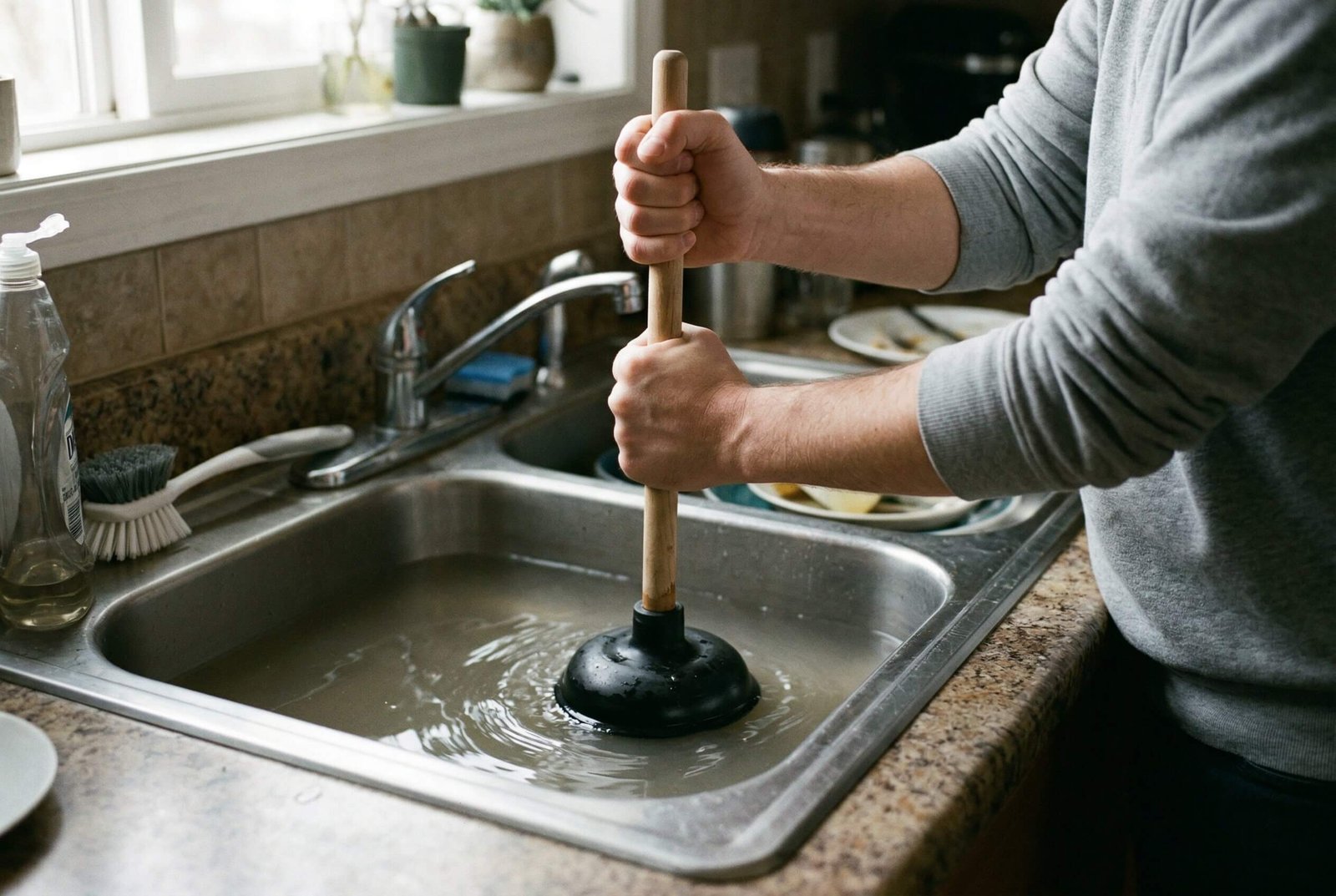
A clogged drain is one of the most common plumbing problems in U.S. homes, whether it’s a bathroom sink filled with hair buildup, a kitchen sink struggling with grease, or a shower drain slowing down from soap residue. In many of these situations, the simplest and most effective first tool is a plunger.
A plunger works by creating pressure and suction inside the pipe, which helps loosen and dislodge the clog. Unlike chemical cleaners, it doesn’t rely on dissolving the blockage—it physically moves it. That’s why professional plumbers often start with plunging before using more advanced tools.
However, many homeowners use a plunger incorrectly. Poor sealing, wrong technique, or using the wrong type of plunger can make it seem like it doesn’t work at all. When used properly, a plunger can clear a large percentage of common household clogs quickly and safely.
In this guide, you’ll learn exactly how to fix a drain clog with a plunger, including the correct technique, when it works best, when it won’t help, and how to combine it with other methods for better results.
What This Page Covers
ToggleIdentify the Type of Clog Before Using a Plunger
Before you start plunging, it’s important to understand what kind of clog you’re dealing with. A plunger is a powerful tool, but it doesn’t work on every type of blockage. Using it in the wrong situation can waste time or even push the clog deeper into the pipe.
A quick diagnosis helps you use the plunger correctly and know what to expect.
Surface vs Deep Clogs
Plungers work best on clogs that are close enough for pressure to affect them.
- Surface or near-surface clog signs:
- Slow draining water
- Partial blockage
- Water level changes slightly when plunging
- Deep clog signs:
- Water doesn’t move at all
- No response when plunging
- Gurgling sounds from deeper in the system
A plunger can sometimes help with deeper clogs, but results are less reliable.
Fixture-Specific Clogs
Different fixtures behave differently when clogged, and plunging technique varies slightly.
- Sink drains:
Often clogged with grease, soap, or food debris - Shower and tub drains:
Usually blocked by hair and soap buildup - Toilets:
Require a flange plunger and respond well to pressure
Understanding the fixture helps you apply the correct approach.
Organic vs Solid Blockages
A plunger is designed to move soft or semi-solid material.
- Works well for:
- Hair clogs
- Soap scum buildup
- Food residue
- Light grease
- Does NOT work well for:
- Solid objects (toys, plastic, jewelry)
- Hard obstructions
- Compacted debris deep in the pipe
If the clog is solid, plunging may not remove it.
Warning Signs of Serious Issues
Some situations indicate a larger plumbing problem where plunging won’t help.
- Multiple drains backing up at once
- Water coming up in another fixture
- Strong sewer odors
- Bubbling or gurgling sounds
These signs usually point to a main sewer line issue, not a simple clog.
Identifying the clog type ensures you’re using the plunger in the right situation. If your clog matches a soft, near-surface blockage, plunging can be extremely effective when done correctly.
Quick Preparation Before Using a Plunger
Before you start plunging, proper setup is critical. In real plumbing situations, most plunging failures happen because of poor preparation—not because the plunger doesn’t work. A proper seal, correct water level, and the right tool can make the difference between clearing the clog in minutes or getting no results at all.
Taking a few minutes to prepare ensures maximum pressure and suction inside the pipe.
Ensure Proper Water Level
A plunger works by moving water, not air. Without enough water, it won’t create effective pressure.
- Make sure the drain is covered with water
- Add water if the sink or tub is too empty
- For sinks, fill until the plunger cup is fully submerged
This helps:
- Create strong suction
- Transfer pressure directly into the pipe
- Improve effectiveness with each plunge
Block Overflow Openings
Most sinks and some tubs have an overflow hole that allows air to escape. If this isn’t sealed, the plunger won’t build proper pressure.
- Locate the overflow opening (usually near the top of the sink)
- Cover it with a wet cloth or tape
- Ensure it’s tightly sealed during plunging
This step is often overlooked but is essential for success.
Choose the Right Plunger Type
Using the wrong plunger reduces effectiveness significantly.
- Cup plunger (flat bottom):
Best for sinks, tubs, and shower drains - Flange plunger (with extended rubber flap):
Designed for toilets but can be used in deeper drains
Choose based on the fixture:
- Sink/shower → cup plunger
- Toilet → flange plunger
Positioning and Seal Check
Before plunging, make sure everything is aligned correctly.
- Place the plunger directly over the drain opening
- Press gently to remove trapped air
- Ensure the rubber forms a tight seal
A good seal is what allows pressure to build inside the pipe.
Proper preparation ensures that every plunge is effective. Without it, even strong plunging won’t move the clog.
How to Use a Plunger Correctly (Core Section)
Using a plunger properly is what determines whether you clear the clog in seconds or struggle with no results. In real plumbing work, technique matters far more than force. The goal is to create controlled pressure and suction inside the pipe to loosen and move the blockage—not to push as hard as possible.
When done correctly, plunging can clear most common drain clogs quickly and safely.
Step-by-Step Plunging Method
Follow this exact sequence for best results:
- Position the plunger over the drain
Center it directly over the opening so the rubber cup fully covers the drain. - Create a tight seal
Press down gently to remove air from inside the cup. You want water inside the plunger, not air. - Push down slowly first
Start with a controlled downward push to build pressure inside the pipe. - Pull up sharply
This is the most important step. The upward pull creates suction that helps dislodge the clog. - Repeat steady plunging cycles
Perform 10–15 consistent plunges without breaking the seal. - Check drainage
Lift the plunger and see if water begins to drain. If not, repeat the cycle.
Proper Technique Tips
Small adjustments in technique can dramatically improve results:
- Maintain a tight seal at all times
- Focus on steady rhythm, not force
- Keep the plunger submerged to avoid air
- Avoid aggressive splashing motions
- Reposition if the seal breaks
Controlled movement is far more effective than random or forceful plunging.
How Many Plunges Are Needed
There’s no fixed number, but most clogs respond within a few cycles.
- Typical attempt: 10–15 plunges per cycle
- Repeat 2–3 cycles if needed
- Improvement signs:
- Water level drops
- Gurgling sound changes
- Drain begins to flow
If there’s no change after several cycles, the clog may be too deep or too solid for plunging alone.
When used correctly, a plunger is one of the fastest and most effective tools to fix a clogged drain. The key is maintaining pressure, using proper technique, and knowing when to move to the next method.
Intermediate Fix Methods (If Plunging Partially Works)
If plunging improves the drain but doesn’t fully clear it, that’s actually a good sign. It means the clog has loosened but hasn’t been completely removed. In real plumbing situations, this is where combining methods becomes highly effective.
At this stage, the goal is to take advantage of the loosened blockage and fully clear it using supporting techniques.
Combine With Hot Water Flush
After plunging, flushing with hot water helps move loosened debris further down the pipe.
- Boil a pot of water
- Slowly pour it into the drain
- Allow it to flow through in stages
This helps:
- Wash away broken-up material
- Clear remaining buildup
- Improve overall flow
It’s especially effective for grease and soap residue.
Use Baking Soda and Vinegar Before Plunging Again
If the clog is organic, adding a natural reaction before plunging again can increase effectiveness.
- Pour baking soda into the drain
- Add vinegar and let it fizz for 15–20 minutes
- Flush lightly with hot water
- Plunge again immediately after
This combination:
- Loosens stubborn buildup
- Makes plunging more effective
- Breaks down organic material
Follow With a Drain Snake
Once the clog is loosened, a drain snake can remove what remains.
- Insert the snake into the drain
- Rotate and push slowly
- Pull out debris carefully
Best for:
- Hair clogs
- Soap buildup
- Partially broken debris
This step physically removes the clog instead of just moving it.
These intermediate methods are often the point where a partially cleared drain becomes fully functional again. Combining techniques is how professionals ensure the clog is completely removed, not just temporarily shifted.
Advanced Fix Methods (If Plunger Fails)
If plunging and intermediate methods don’t fully clear the drain, the clog is likely deeper, denser, or more compacted inside the pipe. At this stage, stronger mechanical approaches are needed to reach and break apart the blockage.
These methods go beyond basic DIY but are still non-chemical and commonly used in real plumbing situations.
Deep Drain Snaking
A deeper or longer auger allows you to reach clogs that are beyond the range of a standard hand snake.
- Feed the auger further into the pipe
- Rotate continuously to cut through debris
- Pull back material in sections
- Repeat until flow improves
This method is effective for:
- Dense hair buildup
- Compacted debris
- Clogs located several feet into the drain line
It’s one of the most reliable ways to clear stubborn blockages.
Wet/Dry Vacuum Method
Instead of pushing the clog deeper, a wet/dry vacuum can pull it out.
- Set the vacuum to liquid mode
- Seal the hose tightly over the drain
- Turn on suction to extract debris
This helps:
- Remove loosened material
- Avoid pushing blockages further into the pipe
- Clear partial obstructions
It works best when the clog has already been loosened by plunging or other methods.
High-Pressure Water Flushing
Using strong water pressure can help push through and clean out debris.
- Use a hose or pressure attachment
- Direct water flow into the drain
- Maintain steady pressure
This method is useful when:
- The clog is partially broken up
- Water can still pass through slowly
- Pipes are in good condition
Avoid excessive pressure in older plumbing systems to prevent damage.
If these methods still don’t resolve the issue, it’s a strong indication that the clog is part of a larger problem that requires professional equipment or inspection.
Professional Drain Fix Methods
If a plunger and advanced DIY methods fail to clear the clog, the issue is likely deeper in the drain system or more severe than a typical household blockage. In real U.S. plumbing scenarios, professionals use specialized tools to fully remove clogs and restore proper flow without damaging the pipes.
These methods are designed to solve the root problem rather than provide temporary relief.
Motorized Augers
Motorized augers (power snakes) are a more powerful version of manual drain snakes. They use a rotating cable driven by a motor to break through tough clogs.
- Cuts through dense debris
- Reaches deep into the drain system
- More effective on compacted blockages
Commonly used for:
- Stubborn sink and shower clogs
- Deep drain blockages
- Situations where manual snaking fails
Hydro Jetting
Hydro jetting uses high-pressure water to clean the inside of pipes completely.
- Removes grease, sludge, and buildup
- Clears long sections of pipe
- Restores pipe walls to near-original condition
Best for:
- Recurring clogs
- Kitchen drain grease buildup
- Main sewer line cleaning
This method doesn’t just remove the clog—it cleans the entire pipe.
Camera Inspection
To accurately locate and diagnose the issue, plumbers use inspection cameras.
- Identifies exact clog location
- Detects cracks, root intrusion, or misalignment
- Prevents unnecessary trial-and-error
This is especially useful when:
- Clogs keep returning
- Multiple drains are affected
- The cause is unclear
Pipe Repair or Replacement
Sometimes the clog is caused by a structural issue rather than simple buildup.
- Collapsed or damaged pipes
- Tree root intrusion
- Pipe misalignment
In these cases, clearing the clog alone won’t fix the problem. The damaged section must be repaired or replaced to prevent future issues.
Professional methods ensure the clog is fully resolved and help prevent repeat problems. If your drain hasn’t improved after multiple attempts, calling a plumber at this stage is the most effective and safest solution.
Tools Used Alongside a Plunger
Using a plunger alone can clear many clogs, but in real plumbing situations, combining it with the right supporting tools often leads to a complete and long-lasting fix. These tools help remove debris that plunging loosens or reach areas where a plunger cannot.
Understanding these tools also helps you decide how far you can go with DIY before needing professional help.
Basic Tools
These are commonly used by homeowners and work well with plunging for most everyday clogs.
- Cup Plunger
Flat-bottom design, ideal for sinks, tubs, and shower drains. Creates a seal over flat surfaces. - Flange Plunger
Includes an extended rubber flap, mainly designed for toilets but can be used in deeper drain openings. - Drain Snake (Hand Auger)
Flexible cable used to pull out or break apart debris. Highly effective after plunging loosens the clog.
These tools are best for:
- Bathroom sink and shower clogs
- Hair and soap buildup
- Light to moderate blockages
Advanced Tools
These tools are used when the clog is deeper or more severe.
- Power Auger (Motorized Snake)
Stronger and deeper-reaching than a hand snake. Cuts through dense clogs. - Hydro Jet Equipment
Uses high-pressure water to fully clean pipe interiors and remove buildup. - Inspection Camera
Helps identify clog location and detect hidden pipe issues.
These tools are typically used for:
- Deep or recurring clogs
- Main drain or sewer line problems
- Situations where the clog source is unknown
Combining a plunger with the right tools significantly increases your chances of fully clearing the drain. In most cases, a plunger followed by a hand auger is enough to solve common household clogs effectively.
Cost to Fix a Drain Using a Plunger (U.S.)
Using a plunger is one of the most cost-effective ways to fix a clogged drain. In many cases, it can solve the problem without any additional expense beyond the tool itself. However, if the clog is more severe or requires additional tools or professional help, costs can increase depending on the situation.
Understanding these cost ranges helps you decide when to continue DIY and when it’s more practical to call a plumber.
DIY Cost
Plunging is typically a one-time investment with minimal ongoing cost.
- Cup plunger: $10–$20
- Flange plunger: $15–$30
- Optional tools (drain snake): $15–$40
Typical DIY total:
- $10–$50 depending on tools
Once purchased, these tools can be reused for years, making them highly cost-effective.
Plumber Cost Range
If plunging doesn’t resolve the clog, a professional may be required.
- Minor clog (simple clearing): $100–$250
- Moderate clog (deeper blockage): $250–$500
- Severe clog (main line issue): $500–$1,000+
Additional services:
- Hydro jetting: $300–$800
- Camera inspection: $150–$400
Factors Affecting Cost
Several real-world factors influence the total cost:
- Clog location: Sink, tub, or main sewer line
- Severity: Partial vs complete blockage
- Accessibility: Easy access vs hidden pipes
- Equipment required: Basic vs advanced tools
- Time required: Quick fix vs extended labor
Emergency Pricing
Urgent plumbing calls increase the overall cost.
- Emergency surcharge: +$100–$300 or more
- Applies to nights, weekends, and holidays
Using a plunger is almost always the cheapest first step to fix a clogged drain. Even if it doesn’t completely solve the issue, it can reduce the severity and potentially lower the cost of professional repair.
When NOT to Use a Plunger
A plunger is one of the most effective first tools for clearing a clogged drain, but it’s not always the right solution. In certain situations, using a plunger can be ineffective or even make the problem worse by pushing the blockage deeper into the plumbing system.
Knowing when not to use a plunger helps prevent damage and saves time.
Completely Blocked Pipes
If the drain is fully blocked and water is not moving at all, a plunger may not create enough pressure to reach the clog.
- Water remains completely stagnant
- No change after multiple plunging attempts
- No movement or sound in the pipe
In these cases, the clog is often too dense or too deep for plunging alone.
Multiple Fixture Backups
If more than one drain in your home is backing up at the same time, the issue is not isolated.
- Water backing up in tubs when using sinks
- Toilet affecting other drains
- Several fixtures clogged simultaneously
This usually indicates a main sewer line blockage, which cannot be fixed with a plunger.
Fragile or Old Pipes
Older plumbing systems can be sensitive to pressure.
- Excessive plunging force can loosen joints
- Weak pipes may crack under repeated pressure
- Older metal pipes may already be corroded
If you’re unsure about your plumbing condition, it’s best to avoid aggressive plunging.
Solid Object Blockages
If a solid object is stuck in the pipe, a plunger won’t remove it.
- Jewelry, plastic, or foreign items
- Objects dropped into the drain
- Hard obstructions
Plunging may push the object further down, making it harder to retrieve.
Using a plunger in the wrong situation can delay proper repair and worsen the clog. If you notice these conditions, it’s better to switch to other methods or call a professional.
How to Prevent Future Drain Clogs
Using a plunger can quickly fix a clogged drain, but preventing clogs in the first place is what saves you time, effort, and repeated issues. In real U.S. homes, most drain problems are caused by daily habits rather than one-time events. Small changes in how you use your drains can significantly reduce the chances of needing to plunge again.
Prevention is about consistency, not complexity.
Proper Drain Usage
What goes down your drain directly determines how often it clogs.
- Avoid pouring grease, oil, or fat into kitchen sinks
- Do not rinse food scraps unless using a garbage disposal properly
- Keep coffee grounds and fibrous food waste out of drains
- Limit heavy soap and product buildup in bathroom drains
Even small amounts of grease or debris can stick to pipe walls and build up over time.
Routine Maintenance
Regular maintenance keeps pipes clean and reduces buildup.
- Flush drains with hot water once a week
- Occasionally use safe cleaning methods like baking soda and hot water
- Watch for early signs of slow drainage
Addressing small issues early prevents major clogs later.
Use the Right Tools Early
Using a plunger at the first sign of slow drainage can stop a clog from forming completely.
- Don’t wait until the drain is fully blocked
- A few plunges early can restore normal flow
- Prevents buildup from becoming compacted
Early action is one of the most effective prevention strategies.
Bathroom Drain Care
Bathroom drains are especially prone to clogs from hair and soap residue.
- Remove visible hair regularly
- Use drain strainers to catch debris
- Clean drain covers frequently
Simple habits can prevent most bathroom clogs.
Kitchen Drain Care
Kitchen drains deal with grease and food waste, making them more vulnerable.
- Wipe greasy cookware before washing
- Run cold water when using garbage disposal
- Avoid dumping starchy or sticky foods down the drain
Consistent kitchen habits greatly reduce the risk of buildup.
Preventing clogs reduces the need for plunging and keeps your plumbing system working efficiently. With proper usage and simple maintenance, most drains can stay clear without frequent issues.
Final Thoughts
A plunger is one of the simplest yet most powerful tools you can use to fix a clogged drain. When used correctly, it can clear a wide range of common household blockages quickly, safely, and without the need for chemicals or expensive equipment. The key is not force—but technique, preparation, and understanding the type of clog you’re dealing with.
Most successful drain fixes follow a clear progression. Start by identifying the clog, prepare the drain properly, and use correct plunging technique. If the clog loosens but doesn’t fully clear, combining plunging with hot water flushing or a drain snake often completes the job. This step-by-step approach is exactly how professionals handle many routine clogs.
At the same time, it’s important to recognize when a plunger is no longer enough. Deep blockages, recurring clogs, or system-wide issues require stronger tools or professional intervention. Continuing to plunge in those cases won’t solve the problem and may delay proper repair.
By using the right method at the right time—and maintaining good drain habits—you can handle most clogs efficiently without unnecessary cost or damage. A plunger isn’t just a quick fix tool; it’s a reliable first step in a smart drain maintenance strategy.