
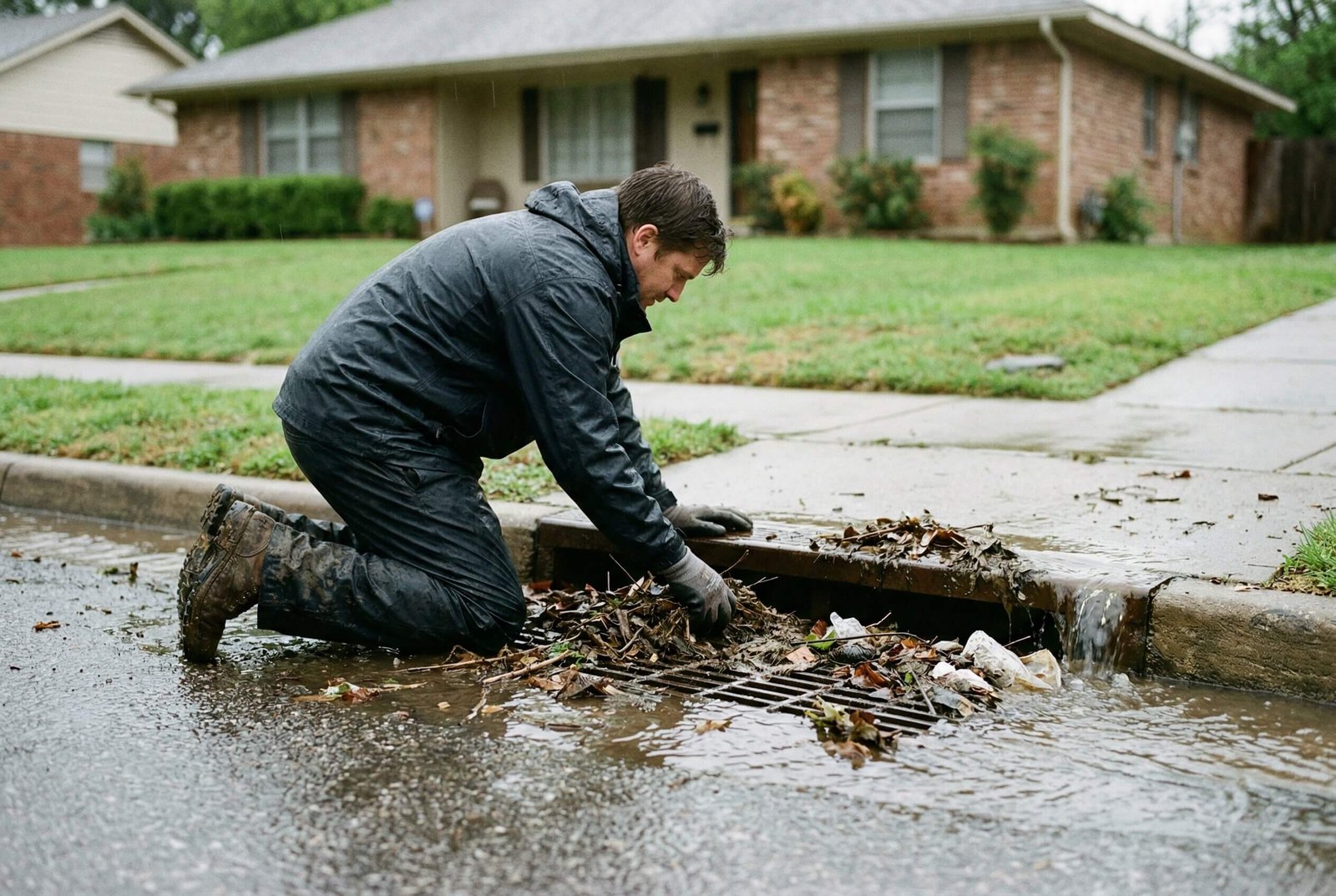
A storm drain blocked near your house may seem like a street problem—but in real situations, it can quickly turn into a drain emergency that affects your property directly. These drains are designed to carry large volumes of rainwater away from roads, driveways, and surrounding areas. When they stop working, that water doesn’t disappear—it redirects. And often, the nearest low point is your home.
The danger comes from how quickly water builds up. During heavy rain, a blocked storm drain doesn’t just slow drainage—it creates pressure across the entire surface around it. Water begins spreading outward, covering roads, sidewalks, and driveways. If your property sits even slightly lower than the street, that water will naturally move toward it. What starts as a clogged street drain can become water reaching your garage, pooling near your foundation, or even entering your home.
One of the biggest risks in this situation is misjudging responsibility. Many homeowners assume that because the drain is outside, it’s not their concern. But in reality, the impact is immediate and local. By the time municipal services respond, the damage may already be done. That’s why understanding how to respond in the moment—before help arrives—is critical.
Another challenge is that not all storm drain problems are the same. Some are simple surface blockages caused by leaves or debris. Others are signs of a larger system overload, where the city drainage network is under pressure and pushing water back up. Knowing the difference helps you decide what actions are safe and effective—and when to step back.
The most important thing to remember is this: a blocked storm drain is a water direction problem, not just a clog problem. Your role is not to fix the entire system. Your role is to control where the water goes, protect your property, and recognize when the situation requires escalation.
If you act early and correctly, you can keep a street-level issue from turning into a costly emergency inside your home.
What This Page Covers
ToggleWhat Counts as a Drain Emergency with a Blocked Storm Drain
When a storm drain is blocked near your house, not every situation is immediately a drain emergency. Some are temporary slowdowns during heavy rain, while others signal a failure in the drainage system that can lead to flooding. The key is understanding when the situation crosses that line—because once it does, your response needs to change quickly.
When a blocked storm drain is just temporary vs a real emergency
During intense rainfall, it’s normal for water to collect briefly around storm drains. If the system is still functioning, you’ll see water gradually entering the drain, even if it takes time. This is a capacity issue—the drain is working, just slower than the incoming flow.
A real problem begins when water stops entering the drain altogether. If the level continues to rise instead of falling, the system is no longer managing flow. This usually means the drain is blocked at the surface or deeper in the line. At that point, you’re no longer dealing with slow drainage—you’re dealing with a failure to drain.
When a storm drain blockage becomes dangerous
The situation becomes a true drain emergency when water starts moving in the wrong direction or reaching areas it shouldn’t.
You should treat it as an emergency when:
- Water is flowing toward your driveway, garage, or home instead of staying in the street
- Water begins pooling near your foundation or entry points
- The overflow spreads beyond the immediate drain area and continues expanding
- Water appears to be backing up rather than simply failing to drain
These signs indicate that the system is under pressure and unable to handle the load. Waiting for the rain to stop will not solve the problem if the blockage remains.
Why storm drain problems escalate quickly
Storm drains are designed to handle large volumes of water, but they rely on continuous flow. When that flow is interrupted, even partially, the system can become overwhelmed very quickly.
Rainwater doesn’t come from just your property—it flows from roads, nearby surfaces, and surrounding areas. This means a blocked drain is dealing with water from multiple directions at once. At the same time, debris like leaves, mud, and trash gets pushed into the drain under pressure, making the blockage tighter and more compact.
In some cases, the issue isn’t just local. The municipal drainage system itself may be overloaded, especially during heavy storms. When that happens, water can push back up through the drain, creating the appearance of a blockage even if the surface is clear.
Recognizing when a blocked storm drain becomes a true drain emergency allows you to shift from observing to acting. The sooner you make that distinction, the more effectively you can protect your property from water damage.
Most Common Storm Drain Blockage Situations Near Homes
When a storm drain is blocked near your house, the cause is usually not random. It follows predictable patterns based on weather, surroundings, and how water flows through your area. Understanding these common situations helps you quickly recognize what you’re dealing with—and whether it’s something you can influence or something beyond your control.
Leaves and debris clogging street drain grates
This is the most frequent cause of storm drain blockage, especially during heavy rain combined with seasonal debris like leaves and twigs. As water flows across roads and sidewalks, it carries everything with it and deposits it directly onto the drain grate.
At first, the blockage may be partial, allowing some water to pass. But as pressure builds, debris compacts and forms a tight layer over the grate, preventing water from entering at all. This creates rapid pooling around the drain, and within minutes, water can begin spreading across the street and toward nearby properties.
Mud, sand, and construction runoff blocking drainage
In areas with ongoing construction or loose soil, rainwater often carries fine sediment into the drainage system. Unlike leaves, this material doesn’t just sit on the surface—it settles inside the pipe.
Over time, this buildup reduces the capacity of the drain. During heavy rain, the reduced flow becomes noticeable as water struggles to enter the system. Eventually, what looks like a sudden overflow is actually the result of gradual restriction that has been building over multiple rain events.
Trash or foreign objects blocking storm drains
Plastic bags, packaging, and other lightweight trash can easily get trapped against drain grates. Once caught, they act like a barrier, blocking water flow almost completely.
This type of blockage is especially problematic because it can happen quickly, even if the drain was clear moments before. As more debris collects around the trapped object, the blockage becomes more severe, leading to rapid water accumulation.
Storm drain backing up from city system overload
Not all blockages are visible. In some cases, the drain itself is clear, but the system downstream is overwhelmed. During intense storms, municipal drainage systems can reach capacity, causing water to push back up through storm drains.
This situation often looks different from a surface clog. Instead of water simply not draining, you may see water rising from the drain or surging upward. Clearing the surface in this case will not solve the problem because the restriction is further down the system.
Water pooling in the street and moving toward your property
Sometimes the issue is not just the drain—it’s how water is moving across the area. If the road or surrounding surfaces slope toward your property, a blocked storm drain can cause water to collect and flow directly toward your home.
This is where the situation becomes more urgent. The drain is no longer just a point of overflow—it becomes the source of a broader flooding pattern that affects everything downhill from it.
Each of these situations behaves differently, but they all lead to the same outcome: the system stops controlling water effectively. Recognizing which scenario you’re facing helps you decide whether clearing the surface will help—or whether you’re dealing with a larger issue that requires containment and escalation.
Warning Signs That a Blocked Storm Drain Is Becoming an Emergency
Storm drain problems rarely become emergencies without warning. In most cases, the system shows clear signs that it’s struggling before flooding actually reaches your property. The challenge is that these signs often appear subtle at first—and by the time they’re obvious, the situation is already escalating.
Recognizing these stages early allows you to act before water starts moving toward your home.
Early warning signals
The first signs usually appear during light or moderate rain, before any serious overflow begins. You may notice that water starts collecting around the storm drain instead of flowing directly into it. The drain is still working, but not efficiently.
Another common sign is slower-than-usual drainage from the street. Water may linger longer than expected or take time to recede after rainfall slows. At this stage, the issue is often partial blockage or reduced system capacity. It’s a warning—not yet an emergency—but it indicates that the system is under stress.
Escalating signs
As the situation worsens, the behavior of the water changes. Instead of staying localized near the drain, it begins spreading outward across the street, sidewalk, or nearby surfaces. This indicates that the drain is no longer handling incoming water effectively.
You may also see visible debris collecting on or around the drain grate. Leaves, trash, or mud can form a barrier that blocks water entry. In some cases, water may appear to “hover” at the drain opening without entering, which is a clear sign that flow is restricted.
At this stage, the system is close to failure. Without intervention or relief, it will likely escalate into a full drain emergency.
Critical emergency indicators
Once certain conditions appear, the situation should be treated as urgent. These are the moments where water can begin affecting your property directly.
You are now dealing with a drain emergency if:
- Water starts flowing toward your driveway, garage, or home
- Water reaches property boundaries or entry points
- Overflow continues even after rainfall begins to decrease
- Water appears to be pushing upward from the drain instead of draining downward
These indicators mean the system is no longer just struggling—it has lost control of water flow.
Understanding these warning signs helps you shift from passive observation to active response at the right time. The earlier you recognize the transition, the more effectively you can prevent water from reaching your home and causing damage.
How to Assess Severity: Local Blockage or System-Wide Issue
When a storm drain is blocked near your house, the most important question is not just “is it clogged?”—it’s “where is the problem actually happening?” The answer determines whether your actions will help or have little effect.
Some situations are caused by debris right at the drain opening. Others come from deeper within the municipal system, where water is backing up under pressure. Knowing the difference helps you respond correctly and avoid wasting time on actions that won’t work.
Signs of a local surface blockage
A local blockage is usually caused by debris sitting on or just inside the drain opening. This is the most manageable type of situation and often happens suddenly during heavy rain.
You are likely dealing with a surface-level issue if:
- You can clearly see leaves, trash, or debris covering the drain grate
- Water begins to move once you remove that debris
- The overflow is limited to a single drain location
- The problem appeared quickly during rainfall and improves when cleared
In these cases, the drainage system itself is still functional. The restriction is local, and once it’s removed, water flow typically returns, even if gradually.
Signs of a system-wide or municipal issue
System-wide issues behave very differently. The drain may look clear, but water still does not go down—or worse, it pushes upward. This means the problem is not at the surface but somewhere deeper in the drainage network.
You are likely dealing with a broader system issue if:
- Multiple nearby storm drains are overflowing at the same time
- Water appears to be rising from the drain rather than draining into it
- Clearing visible debris does not improve the situation
- Water continues to spread even after rainfall slows
In these scenarios, the drainage system is overwhelmed or blocked further downstream. This is common during intense storms when municipal systems reach capacity.
Real-world decision checkpoints
Instead of guessing, use these simple checks to quickly assess the situation:
- Is water draining at all?
Even slow drainage suggests partial function. No drainage suggests blockage or system overload. - Is the overflow isolated or widespread?
A single affected drain points to a local issue. Multiple affected areas suggest a system-wide problem. - Is pressure coming from above or below?
Water sitting on top indicates blocked entry. Water pushing upward indicates deeper system pressure.
Making this distinction early helps you stay focused. If it’s a local blockage, your efforts can improve the situation. If it’s a system-wide issue, your priority shifts to protecting your property and preparing for escalation.
That clarity is what prevents wasted effort and reduces the risk of the situation getting out of control.
What to Do Immediately When a Storm Drain Is Blocked
When a storm drain is blocked near your house, the situation can escalate quickly because you’re dealing with moving surface water, not just a slow drain. The priority is not to fix the drain completely—it’s to control water direction and prevent it from reaching your property.
The first few minutes matter the most. Acting early can keep water on the street instead of inside your home.
Step-by-step emergency response
Follow this sequence calmly and in order. Each step is designed to reduce risk and stabilize the situation.
- Observe water direction and risk to your property
Before taking action, take a moment to understand how water is flowing. Look at the slope of the road, sidewalk, and your driveway. If water is already moving toward your home, your focus should immediately shift to redirection and protection—not just clearing the drain. - Clear visible debris from the drain grate safely
If you can clearly see leaves, trash, or mud blocking the grate, remove it from the surface. This is often the fastest way to restore some flow. Do not force debris into the drain or reach deep inside—just clear what is loose and visible. - Create temporary flow paths away from your property
If water is spreading, guide it away. Use simple methods like creating a shallow path along the edge of the road or repositioning objects to redirect flow. Even a small change in direction can prevent water from reaching your driveway or foundation. - Protect entry points around your home
Focus on vulnerable areas like garage doors, basement-level entrances, and low thresholds. Use towels, barriers, or any available material to slow down water. At this stage, even partial protection can make a big difference. - Monitor water movement continuously
After taking action, watch how the situation changes over the next few minutes. If water begins to drain or slow down, your intervention is helping. If it continues to rise or spread, the problem is likely deeper or system-wide.
If water is approaching your property
Once water gets close to your home, your priorities change. You are no longer trying to improve the drain—you are trying to protect the structure.
Focus fully on redirecting water and blocking entry points. Move anything valuable away from risk areas and reinforce barriers where water is most likely to enter. Even slowing down water can prevent it from crossing into your home.
If the drain remains blocked after clearing
If removing visible debris does not improve the situation, the issue is likely not at the surface. The blockage may be deeper in the system, or the municipal drainage network may be overloaded.
At this point, stop trying to force a solution. Continue managing water flow and protecting your property, but recognize that further improvement will require external help or system recovery.
Handling this stage correctly is what keeps a blocked storm drain from turning into property flooding. You’re not fixing everything—you’re controlling the situation and buying time.
Safe Emergency Actions Homeowners Can Take
After you’ve taken the first steps to stabilize the situation, the next phase is about controlled, low-risk actions that actually help without making the problem worse. With a blocked storm drain, you are dealing with moving water on public surfaces, which means your role is limited—but still important.
The goal here is simple: guide water safely and reduce pressure near your property without interfering with the drainage system in a risky way.
Surface clearing of storm drain grates
If the blockage is visible and within reach, removing debris from the surface of the grate is one of the most effective actions you can take. Leaves, plastic, and loose debris often form a barrier that stops water from entering the drain.
Clear only what is easy to access. Use your hands (with gloves) or a simple tool to remove debris sitting on top of the grate. In many cases, even partial clearing allows water to start flowing again and reduces immediate pressure.
What matters is restraint. Do not try to push debris into the drain or dig inside the opening. This can compact the blockage further or create a deeper obstruction that is harder to resolve later.
Redirecting water flow
If clearing the drain doesn’t fully solve the problem, your focus should shift to controlling where the water goes. Water will always follow the easiest path, so small adjustments can make a meaningful difference.
You can create temporary channels along the edge of the road or driveway to guide water away from your property. If available, use objects or barriers to influence flow direction. The aim is not to stop the water, but to prevent it from reaching areas where it can cause damage.
Even minor redirection can reduce the volume of water collecting near your home.
Personal safety during response
Stormwater in streets is not clean. It often carries dirt, oil residue, bacteria, and debris. Treat it as potentially contaminated.
Wear gloves and avoid direct contact with the water whenever possible. Be cautious when walking through wet areas, as surfaces can become slippery and unstable. Avoid stepping into deeper water where visibility is poor, as you may not see hazards beneath the surface.
Your safety should always come before attempting to manage the situation.
Monitoring and adjusting your response
Storm drain emergencies are dynamic. Conditions change as rainfall intensity shifts and debris moves. What works initially may need adjustment a few minutes later.
Keep observing the flow of water. If your actions improve drainage or reduce spread, continue reinforcing those measures. If water continues to rise or change direction, adapt quickly—redirect flow again or strengthen protection around vulnerable areas.
Safe actions during a storm drain blockage are about staying effective without overreaching. You’re not trying to solve the entire drainage issue—you’re managing risk, protecting your property, and keeping the situation under control until normal flow is restored or help arrives.
Actions to Avoid During a Storm Drain Emergency
When a storm drain is blocked near your house, it’s easy to act on instinct—especially when you see water rising. But certain actions can actually make the situation worse, either by increasing pressure in the system or putting you at risk. Knowing what to avoid helps you stay in control and prevents a manageable situation from escalating.
Mistakes that worsen flooding
One of the most common mistakes is trying to force water into the drain instead of allowing it to flow naturally. This usually happens when homeowners push debris into the grate or try to “clear” the drain by compressing the blockage.
Avoid actions like:
- Pushing leaves, mud, or trash deeper into the drain
- Pouring additional water toward the drain to “help it flow”
- Ignoring the situation assuming it will resolve once rain stops
These actions either tighten the blockage or increase the volume of water the system is already struggling to handle. In real cases, this often leads to faster overflow and wider spread.
Unsafe actions during flooding
Stormwater conditions can be unpredictable, especially when water is moving across streets and sidewalks. Avoid stepping into deep or fast-moving water where you cannot clearly see the surface underneath.
Also, do not attempt to remove heavy drain covers or access deeper parts of the drainage system. Storm drains can hold pressurized water during heavy rain, and removing covers can lead to sudden surges or unstable footing.
Even if the situation feels urgent, your safety should not be compromised for the sake of clearing the drain.
Misjudging the situation
Another major mistake is assuming every blocked storm drain is a simple surface issue. If the drain appears clear but water is still not going down—or worse, pushing upward—the problem is likely deeper in the municipal system.
In these cases, continuing to focus on the drain itself will not help. It may also delay more important actions like redirecting water away from your property.
It’s also important not to rely on the blocked drain as your only solution. If water is already moving toward your home, waiting for the drain to recover is risky. You should shift your focus to controlling water direction and protecting entry points.
Avoiding these actions helps you stay effective during a storm drain emergency. It keeps the system from being stressed further and ensures that your efforts are focused where they actually make a difference.
How to Tell If the Problem Is Your Property or City System
When a storm drain is blocked near your house, one of the most important things to understand is who—or what—is actually causing the problem. Some situations are localized and influenced by debris near your property. Others are part of a larger municipal system issue that you cannot fix yourself.
Making this distinction early helps you decide whether your actions will help—or whether your focus should shift entirely to protecting your home.
Indicators the issue is near your property
If the blockage is local, it usually involves debris or buildup at a specific drain point close to your house. These situations often respond, at least partially, to surface-level clearing.
You are likely dealing with a local issue if:
- Only one storm drain near your property is affected
- You can see visible debris blocking the grate
- Water begins to drain once that debris is removed
- Overflow is limited and does not spread across a wide area
In these cases, the drainage system itself is functioning, but the entry point is restricted. Clearing the surface and managing flow can make a noticeable difference.
Indicators the issue is municipal or system-wide
Municipal drainage problems behave very differently. The system is overwhelmed or blocked further downstream, and the drain near your home is simply reflecting that pressure.
You are likely dealing with a city-level issue if:
- Multiple nearby storm drains are overflowing at the same time
- Water appears to be rising from the drain instead of entering it
- Clearing the surface does not improve drainage
- Water continues to spread even after rainfall begins to decrease
This type of situation is beyond homeowner control. The restriction exists somewhere deeper in the network, and only municipal services can resolve it.
Why this distinction matters
If the issue is local, your actions—like clearing debris or redirecting water—can directly improve the situation. But if it’s municipal, those same actions will have limited impact.
In system-wide scenarios, the priority shifts completely. Instead of trying to fix the drain, you focus on protecting your property, controlling water direction, and preparing for continued overflow until the system stabilizes.
Understanding whether the problem is local or part of the city system keeps you from wasting time and energy in the wrong place. It allows you to respond more effectively and focus on what actually reduces risk during a storm drain emergency.
When DIY Is No Longer Safe or Effective
There’s a clear point in a storm drain situation where homeowner actions stop making a meaningful difference. Recognizing that point early is what prevents frustration, wasted effort, and—more importantly—property damage. With storm drains, the limit is reached faster than most people expect because much of the system is outside your control.
Situations requiring escalation
You should stop relying on DIY efforts and shift your focus when the situation shows signs that it’s no longer a simple surface issue.
Step back and escalate if:
- Water is reaching or entering your garage, driveway, or home
- Clearing visible debris has no effect on water flow
- Overflow continues even after rainfall begins to slow
- Multiple drains in your area are behaving the same way
These are strong indicators that the blockage is not limited to the drain opening. The issue is either deeper in the line or part of a larger system overload.
Why homeowner action has limits
Storm drains are part of a broader infrastructure system designed to handle water from entire streets or neighborhoods. When that system is overwhelmed or blocked downstream, there is nothing you can do at the surface to restore full flow.
Even if you clear the grate completely, water may still not drain because the restriction exists further along the line. In these cases, continuing to focus on the drain itself leads to diminishing returns.
This is why professional or municipal intervention becomes necessary. The tools, access points, and system knowledge required to resolve deeper issues are not available at the homeowner level.
When to contact help
If the situation continues to worsen or shows no improvement, it’s time to involve the appropriate authority. For storm drains, this is typically your local municipal drainage or public works department.
If water is actively threatening your home, don’t wait for conditions to improve on their own. Reporting the issue early increases the chance of a faster response and helps prevent further damage—not just for your property, but for others in the area as well.
Knowing when to stop is part of handling the situation correctly. At this stage, your role is no longer to fix the problem—it’s to protect your property and ensure the issue is addressed by the right people.
What Happens When You Call for Help
When a storm drain is blocked near your house and the situation goes beyond what you can manage, calling for help becomes the right move. Unlike private plumbing issues, storm drains are often part of the municipal system, so the response process is different from calling a typical plumber.
Understanding what happens next helps you stay prepared and realistic about timing and outcomes.
Who to contact for storm drain issues
In most cases, storm drains located on streets, sidewalks, or public areas are maintained by your local municipal or public works department. They are responsible for clearing blockages, maintaining flow, and managing stormwater systems.
If the situation is urgent—such as active flooding moving toward homes—you should report it as soon as possible. In some areas, emergency services may also coordinate with municipal teams during severe weather conditions.
The key is not to delay. Even if response time varies, early reporting increases the chances of intervention before the situation worsens.
What professionals typically do
Once a crew arrives, their first step is to assess the situation and determine where the blockage exists. They may start by inspecting the visible drain opening and surrounding area to check for surface debris or obvious obstructions.
If the issue is at the surface, they will clear the grate and remove debris, restoring immediate flow. If the blockage is deeper, they may use specialized equipment to access and clear the line. This can include high-pressure water systems or mechanical tools designed for stormwater infrastructure.
In cases where the system is overloaded rather than blocked, their role may be more about managing flow and monitoring conditions until the system stabilizes.
Restoring and verifying drainage flow
After clearing the blockage, professionals typically ensure that water is moving correctly through the system. This may involve observing how quickly water drains or checking additional access points nearby.
They may also identify contributing factors—such as recurring debris buildup, sediment accumulation, or structural limitations in the system. If the issue is likely to repeat, further maintenance or follow-up work may be recommended.
Calling for help doesn’t mean giving up control—it means shifting responsibility to the right level. While you focus on protecting your property, professionals handle the system itself. That combination is what resolves the situation safely and effectively.
Emergency Health and Safety Risks
When a storm drain is blocked near your house, the focus is usually on water buildup and flooding—but the safety risks go beyond just property damage. The water involved in these situations is often contaminated, unpredictable, and capable of creating hazards that aren’t immediately visible.
Understanding these risks helps you respond more carefully and avoid turning a stressful situation into a dangerous one.
Contamination risks from street water
Stormwater flowing through streets is rarely clean. As it moves across surfaces, it collects oil, dirt, chemicals, and bacteria. When a storm drain is blocked, that contaminated water has nowhere to go and begins pooling or spreading.
If the system is under pressure or partially backed up, the water may also carry material from inside the drainage network. This can include organic waste and debris that has built up over time.
Direct contact with this water should be avoided whenever possible. Even brief exposure can carry health risks, especially if you have cuts or are handling debris with bare hands. Treat all standing street water during a blockage as potentially unsafe.
Physical hazards
Flooded streets and sidewalks create unstable conditions. Surfaces that are normally safe become slippery, uneven, and difficult to navigate.
There may also be hidden hazards beneath the water—such as debris, potholes, or displaced drain covers. Stepping into water without visibility increases the risk of injury. In some cases, fast-moving water along slopes or driveways can also affect your balance.
Moving carefully and avoiding unnecessary exposure is essential, even if the situation feels urgent.
Property and structural risks
When water begins to move toward your home, the risk shifts from inconvenience to potential damage. Even a small amount of water entering a garage or lower-level area can lead to long-term problems.
Water that pools near the foundation can seep into structural areas over time, weakening materials and creating conditions for mold growth. These issues often develop gradually and may not be visible immediately, which is why they are often underestimated.
There is also a potential electrical risk if water reaches areas with wiring, outlets, or utility equipment. In these situations, keeping distance and avoiding contact becomes more important than trying to manage the water directly.
Storm drain emergencies are not just about clearing water—they involve real safety considerations. By understanding these risks, you can make smarter decisions, protect yourself, and focus on actions that reduce harm instead of increasing it.
Tools and Supplies to Prepare for Storm Drain Issues
When a storm drain blocks near your house, you don’t get time to prepare—the situation is already happening. That’s why having a small set of basic tools ready beforehand makes a real difference. The goal isn’t to fix the drainage system yourself, but to respond quickly, stay safe, and control water movement before it reaches your home.
Basic response tools
You don’t need specialized equipment. Simple, practical items are enough to handle most emergency situations effectively.
A pair of sturdy gloves helps you safely remove debris from drain grates without direct contact. Waterproof boots or footwear allow you to move through wet areas without slipping or exposing your skin to contaminated water. A flashlight is useful during storms, especially in low visibility or evening conditions when it’s harder to assess water movement.
Buckets and old towels can help with minor containment near entry points like garage doors or thresholds. While they won’t stop large volumes of water, they can slow it down enough to give you time to react.
Flow control items
Managing water direction is often more important than clearing the drain itself. A few simple items can help you guide water away from your property.
Sandbags are one of the most effective tools for this. Even a small number can redirect water away from doors, driveways, or low-lying areas. If sandbags aren’t available, you can use similar barriers—anything that helps alter the path of flowing water.
In some cases, basic tools like a stick or hand tool can help you remove debris from the surface of a storm drain safely, without needing to reach into it.
Why preparation matters
In real situations, speed is everything. When water starts rising, every minute counts. If you already know where your tools are and can access them immediately, you can start controlling the situation before it escalates.
Preparation also reduces hesitation. Instead of figuring out what to do, you act. That quick response is often what prevents water from reaching your home in the first place.
These tools are not about solving the entire problem—they’re about buying time and reducing impact. In a storm drain emergency, that time is what keeps a manageable situation from turning into a costly one.
Cost and Responsibility Considerations
When a storm drain is blocked near your house, one of the biggest points of confusion is who is responsible and whether you’ll have to pay for anything. Unlike indoor plumbing issues, storm drains often fall under public infrastructure—but there are situations where responsibility can overlap.
Understanding this clearly helps you avoid delays and make the right decisions during a drain emergency.
When the city is responsible
In most cases, storm drains located on streets, sidewalks, and public areas are maintained by your local municipality. This includes the drain grate, underground stormwater pipes, and the broader drainage network.
If the blockage is within this public system—whether it’s debris buildup, sediment, or system overload—it is typically the city’s responsibility to resolve it. Homeowners are not expected to perform repairs or bear the cost for clearing these drains.
However, response times can vary depending on weather conditions and demand. During heavy storms, municipal crews may be handling multiple incidents at once, which is why early reporting is important.
When homeowner responsibility applies
There are situations where drainage issues near your property may involve private responsibility. This usually applies if your property has a private drain connection that feeds into the public system.
For example, if a blockage exists in a pipe that originates on your property before connecting to the municipal drain, that portion may fall under homeowner responsibility. Similarly, poor drainage design on your property—such as improper grading or runoff direction—can contribute to recurring problems even if the street drain is functioning.
In these cases, a professional inspection may be needed to determine where the responsibility lies.
Cost implications
If the issue is within the public storm drain system, you typically won’t pay for the service itself. But if the problem affects your property—such as water damage, cleanup, or preventative improvements—those costs fall on you.
If a private drainage line is involved, costs can vary depending on the severity of the issue. Minor clearing is relatively inexpensive, but deeper problems like pipe repair or redesign of drainage flow can increase costs.
Why early action still matters
Even when the city is responsible, waiting can be costly for you. Water damage to your home, driveway, or foundation is not covered by the municipal response—it’s your property at risk.
That’s why taking early action to redirect water and protect entry points is critical. You’re not replacing the city’s role—you’re preventing damage while waiting for the system to be restored.
Understanding responsibility helps you act with clarity. You know when to intervene, when to report, and what to expect—without wasting time or taking on unnecessary risk.
What to Do After the Situation Is Controlled
Once the storm drain clears or water levels begin to drop, it’s easy to assume the problem is over. In reality, this is the stage where you prevent the next drain emergency from happening. What you do after the situation stabilizes determines whether this was a one-time issue—or the start of a recurring problem.
Cleanup and inspection
Start by clearing any remaining debris from around the storm drain and nearby areas. Leaves, trash, and mud often remain even after water drains away, and if left there, they become the starting point for the next blockage.
Take a closer look at the drain grate and surrounding area. Check if debris is building up in a pattern or if certain materials are consistently collecting in the same spot. This helps you understand whether the issue was random or likely to repeat.
Also observe how water drains under normal conditions. If you pour a small amount of water or wait for light rain, it should enter the drain smoothly. If it still seems slow or inconsistent, there may be a partial blockage deeper in the system.
Monitoring drainage performance
Over the next few days or during the next rainfall, pay attention to how the drain behaves. This is where patterns become clear.
If water begins to collect again quickly—even during moderate rain—it suggests the issue was not fully resolved. Similarly, if nearby areas start pooling before reaching the drain, it may indicate a flow or slope issue rather than just a blockage.
Monitoring doesn’t require constant attention—just awareness. These small observations help you catch problems early before they escalate.
Reporting recurring problems
If you notice that the same storm drain repeatedly blocks or overflows, it’s important to report it to your local municipal authority. Recurring issues often indicate deeper problems in the drainage system, such as sediment buildup or limited capacity.
Providing clear information—like when the issue occurs and how it behaves—can help authorities respond more effectively. Many recurring drainage problems are only addressed after multiple reports, so your input plays a role in long-term resolution.
Handling the aftermath correctly turns a reactive situation into a preventive one. You’re not just cleaning up—you’re learning how your drainage system behaves and reducing the chances of facing the same emergency again.
How to Reduce Future Storm Drain Blockage Risks
Storm drain problems near your house are rarely one-time events. If it happened once, there’s a reason—and unless that reason is addressed, it will likely happen again during the next heavy rain. Prevention is not about controlling the entire system, but about reducing the chances of blockage where you can make a difference.
Regular monitoring of nearby drains
One of the simplest and most effective habits is checking nearby storm drains before and after rainfall. You don’t need to inspect them daily—just a quick look during changing weather conditions is enough.
Before a storm, check if debris is already building up on or around the drain. After a storm, look for leftover materials that didn’t wash away. Removing debris early prevents it from compacting into a blockage during the next rainfall.
Over time, you’ll start noticing patterns—specific drains that collect more debris or areas where water tends to slow down first. These patterns are valuable and help you act earlier next time.
Keeping the area around drains clear
Storm drains don’t get blocked on their own—something blocks them. Most of that material comes from the immediate surroundings.
Keep nearby areas clean, especially during seasons when leaves, dust, or trash are more likely to accumulate. Even small amounts of debris can build up under pressure when rainwater pushes everything toward the drain at once.
This doesn’t require constant effort—just occasional attention. Clearing the area regularly reduces the chance of sudden blockage during heavy rain.
Understanding local drainage patterns
Every street and property has its own drainage behavior. Water follows natural slopes, and once you understand those paths, you can anticipate where problems will occur.
Watch how water flows during rain. Does it move directly toward the drain, or does it collect first and then shift direction? Does it pass near your driveway or foundation before reaching the drain?
Knowing these patterns allows you to act early—either by clearing debris or preparing to redirect water before it reaches critical areas.
Reducing future storm drain blockages is about awareness and timing. You’re not controlling the entire drainage system—you’re managing the conditions that lead to blockage near your home.
Long-Term Prevention Strategy
Preventing storm drain emergencies near your house is not about reacting faster each time—it’s about reducing how often the situation happens at all. The most effective approach is building a simple, repeatable system based on how water behaves around your property and street.
Awareness of high-risk conditions
Storm drain issues don’t happen randomly. They are usually triggered by predictable conditions—heavy rainfall, seasonal debris like leaves, nearby construction, or poor drainage flow patterns.
Pay attention to when problems occur. Is it during the first heavy rain after dry weather? During monsoon periods? When debris buildup is high? These patterns help you anticipate risk before it becomes visible.
Once you recognize these triggers, you can prepare in advance instead of reacting late.
Early action before storms
One of the most effective prevention strategies is acting before the rain begins. Checking nearby storm drains and clearing visible debris ahead of a storm significantly reduces the chance of blockage under pressure.
This doesn’t take much time, but it makes a major difference. When water starts flowing, it carries everything with it. If the drain is already partially blocked, that debris gets compacted quickly and turns into a full obstruction.
A few minutes of early clearing can prevent hours of dealing with overflow later.
Coordinating with local authorities
If you notice recurring issues with the same storm drain, it’s important to report it—even if the problem resolves temporarily. Repeated blockages often indicate deeper issues like sediment buildup, pipe damage, or limited system capacity.
Municipal systems are maintained based on observed need. If a drain is reported multiple times, it is more likely to be inspected and properly serviced. Your input helps move the issue from temporary fixes to long-term resolution.
Building a simple response habit
Over time, you should develop a clear mental routine:
- Check drains before heavy rain
- Watch water flow early during storms
- Act quickly if buildup starts
- Shift to protection if water moves toward your home
This habit removes hesitation and makes your response automatic. You’re no longer figuring things out in the moment—you’re following a system.
A strong prevention strategy is not complex—it’s consistent. When you understand your environment, act early, and respond with clarity, storm drain issues become manageable instead of unpredictable emergencies.
Final Thoughts
A storm drain blocked near your house may seem like a public issue, but its impact is immediate and personal. The difference between minor inconvenience and serious damage comes down to how early you recognize the signs and how effectively you respond.
The most important shift is understanding that this is not just a clog—it’s a water flow problem under pressure. When you focus on controlling direction, protecting your property, and avoiding unnecessary risks, you stay in control of the situation.
At the same time, knowing your limits is critical. Some problems are local and manageable. Others are part of a larger system that requires municipal intervention. Recognizing that difference prevents wasted effort and helps you act where it matters most.
Over time, experience becomes your biggest advantage. Once you’ve seen how water behaves around your home during heavy rain, you can anticipate problems before they happen and reduce their impact significantly.
Storm drain emergencies cannot always be avoided—but they can be controlled, contained, and handled with confidence when you approach them the right way.